

The marketing game for crypto casinos is changing in front of me, and most operators have not connected the dots yet.
Telegram has been getting harder to operate on for over a year. Platform terms tightened, entire countries started openly considering bans over the gambling hosted there, and a wave of crypto casino operators quietly walked away from the platform. Whale.io was one of the more public exits.
Now, in the last few weeks, X has been quietly rebuilt into a payments and crypto super app. The same compliance gravity that has been squeezing Telegram is now landing on X too.
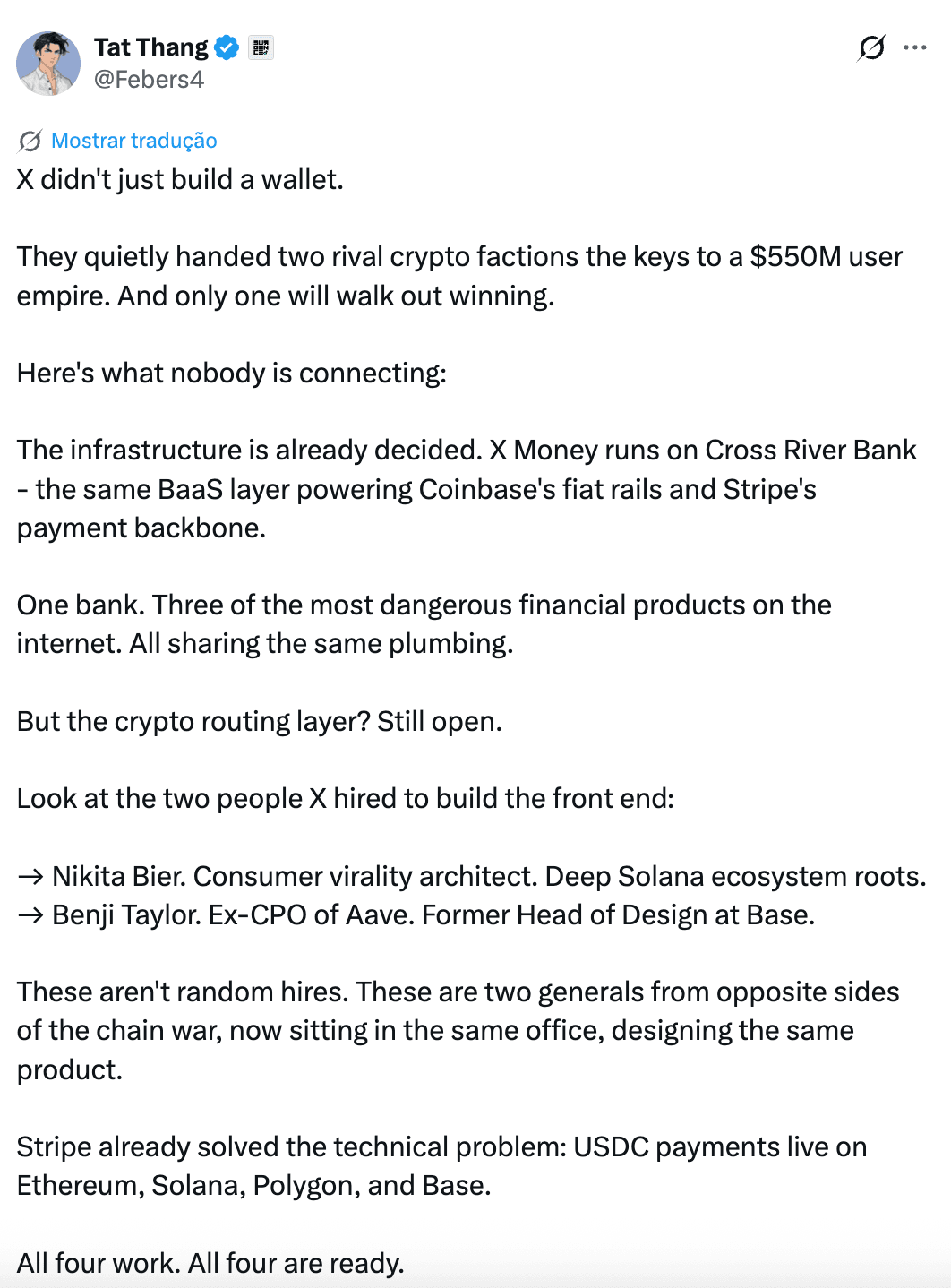
One thread in particular helped me see the X piece clearly. On April 14, Tat Thang (@Febers4) laid out the X super-app sequence cleanly: the bot purge, the new hires, the X Money rollout, the XChat launch. In his read, none of it is random. X is becoming WeChat Pay for Web3.
I agree with that read on the platform side, and Tat Thang deserves credit for naming the sequence. The part I want to talk about is downstream.
I am a crypto casino media outlet, so this piece is about what this whole pattern means for how crypto casinos market. Telegram first, X next. The same playbook that broke on Telegram is the playbook the entire industry has been running on X.
The short version: the marketing game crypto casinos have been playing on every social platform is being rewritten, and X is the next platform to rewrite the rules.
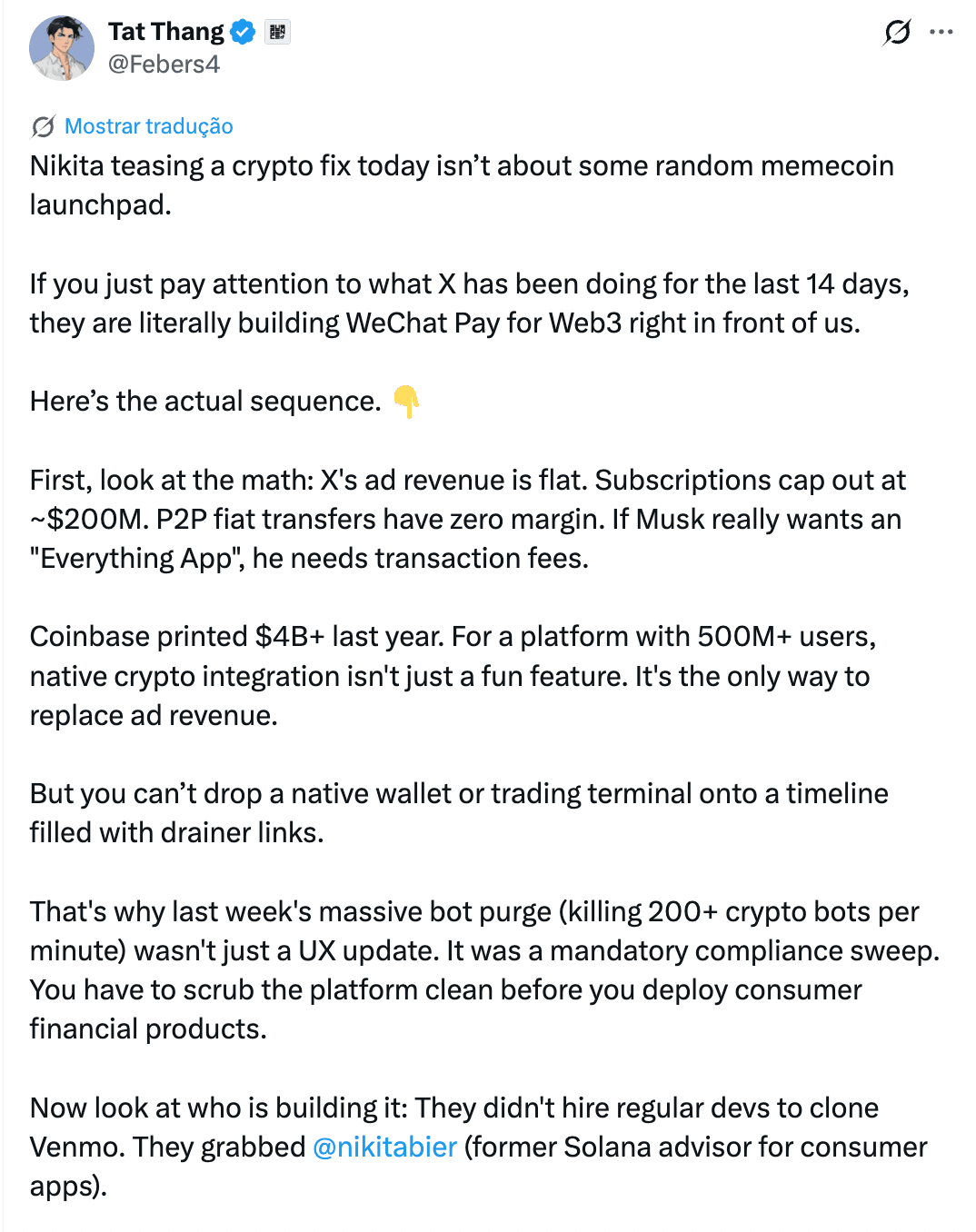
Post by @Febers4 on X, April 14, 2026.
The Sequence Febers Spotted
The argument is structural, not vibes-based. According to the thread, X has stacked four moves in a row that only make sense if you read them as one product launch:
- Early April: X Money rolling out fiat rails in 40 plus US states
- April 9: a mass crypto bot purge, allegedly killing more than 200 bots per minute
- Around April 12: XChat shipping as a standalone app
- April 14: Nikita Bier teasing a "crypto fix" launch
- April 17: the native crypto piece going live inside X, the "crypto fix" Bier teased turning into a shipping feature
The hires reportedly back the read. Nikita Bier was a Solana advisor. Benji Taylor, the other senior product hire mentioned, allegedly comes from Base and Aave. These are not generic fintech operators. These are people you bring in when you are about to ship a consumer crypto product to hundreds of millions of users.
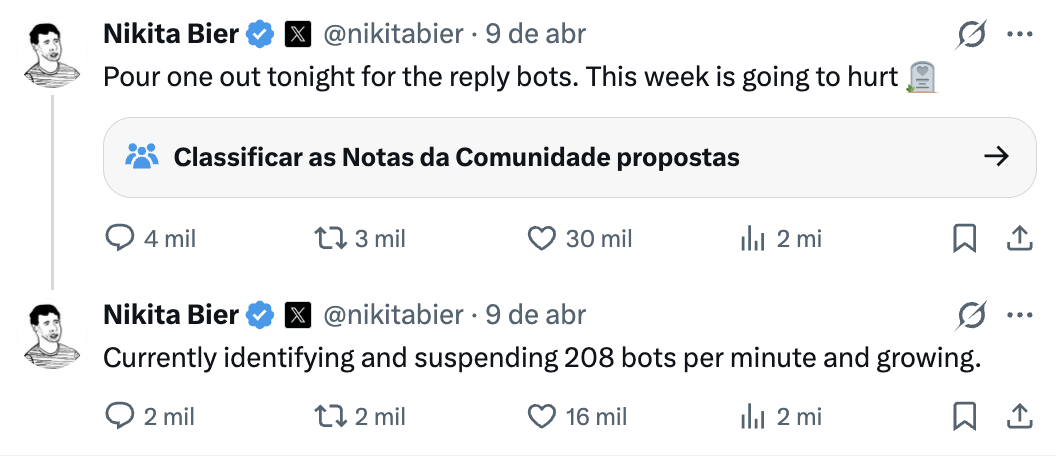
Nikita Bier, April 9: "Currently identifying and suspending 208 bots per minute and growing."
The bot purge is the part most people skim past, so it is worth slowing down on it. X's timeline has been full of crypto scam bots for years: fake giveaway accounts, drainer links disguised as airdrops, copycat profiles impersonating real projects, reply farms pumping rug tokens. That was tolerable when X was just a social app. The second X starts shipping a wallet, sending real money, and routing through a US bank, that same noise becomes a legal problem.
The math is simple. If a user clicks a drainer link sitting next to the X Money button and loses their funds, the complaint does not stop at X. It travels up to Cross River Bank, the US bank reportedly powering X Money, and to the regulators behind it. Banks lose charters over patterns like that. So before any consumer financial product can safely go live, the surrounding environment has to be scrubbed.
That is what the 200-bots-per-minute purge looks like in practice: a mandatory cleanup sweep, not a moderation mood swing. Whether or not that is the official internal reason at X, the effect is the same: the platform is being scrubbed, and anything that even visually resembles spammy crypto promotion is collateral.
The April Sequence
The April sequence as Febers laid it out. Five moves, one launch.
Why This Matters for Crypto Casinos
For the last few years, X was the easiest distribution channel a crypto casino could plug into. The growth stack was simple and well known to anyone in the space:
- Giveaway loops with high-engagement accounts and retweet farms
- Affiliate creators dropping signup links in replies, often without disclosure
- "Expose" and beef threads engineered to push referral codes in the noise
- Reply bot networks amplifying anything paid
- Cashtag and pump-style hooks pulling gamblers into casino funnels
None of that is illegal in most jurisdictions, but most of it depends on a permissive platform. A platform that does not enforce disclosure rules. A platform that tolerates bot amplification. A platform that does not care which licensed jurisdiction the operator is in. That is the X I have been operating on.
That platform is changing. If you are launching a regulated payments and crypto product to a US user base, you cannot tolerate the same level of grey-zone affiliate spam in your timeline. Banks do not let you sit next to drainers. The same logic applies to anything that looks too close to unlicensed gambling promotion.
Related: I Felt This Already
My X account got suspended after I published a casino expose. It came back, but the message was clear. The platform is already less tolerant than it was a year ago, even before the wallet ships.
The Compliance Squeeze: What Actually Changes
This is where most takes on the X super app stop. Everyone says "regulation is coming." Almost no one walks through what that actually means for a crypto casino with an X presence. Let me do that.
Once X ships payments and crypto products through Cross River Bank, the platform inherits a regulatory perimeter that did not exist before. X is no longer just a social network with light moderation. It is now a distribution channel with a US bank attached. Five separate policy stacks start to apply at the same time.
Post by @Febers4 on X, April 16, 2026.
1. The bank stack: BSA, AML and the FDIC chain
Cross River Bank is FDIC-insured, chartered in New Jersey, and supervised by the New Jersey Department of Banking and Insurance plus the FDIC. That means everything routed through X Money inherits Bank Secrecy Act and Anti-Money-Laundering obligations: KYC on senders and receivers, transaction monitoring, suspicious activity reports, sanctions screening.
For a regulated bank, "promoting unlicensed gambling to US residents" is one of the cleanest red flags a compliance team can find. Cross River has already been hit with enforcement actions before, including a 2023 FDIC consent order over fair-lending issues with fintech partners. They are not going to take that risk twice. If X surfaces a casino brand next to its wallet, that brand gets reviewed at the bank layer, not just the platform layer.
2. UK financial promotions: gambling and crypto both gated
In October 2023, the UK Financial Conduct Authority extended its financial promotions regime to cover crypto assets. Promoting a crypto product to UK consumers without FCA authorization, or one of four narrow exemptions, is now a criminal offense punishable by up to two years in prison. This rule does not care if you are a casino, an exchange or an influencer. If you talk about a token, a yield product or a crypto deposit option to UK users, you are inside the regime.
On the gambling side, the UK Gambling Commission already required UKGC licensing for any operator marketing to UK consumers, even passively. Stake.com lost its UK license over advertising and white-label issues. The FCA crypto rules and the UKGC gambling rules now overlap perfectly on every crypto casino marketing post that lands in a UK timeline.
3. EU MiCA and the new marketing rules for CASPs
The EU's Markets in Crypto-Assets regulation became fully applicable in December 2024. Any "Crypto Asset Service Provider" marketing into the EU has to be authorized in a member state. MiCA Title III specifically covers marketing communications: they must be fair, clear, not misleading, and identifiable as marketing. Member states have already started enforcement against unauthorized CASPs running paid social.
For a crypto casino running affiliate threads on X to a European audience, this is the legal regime that catches them first. The platform does not have to ban anyone. National regulators just send takedown notices, and the platform complies.
4. US state gambling licensing: only seven states matter
Inside the US, online casino gaming is currently legal in only a handful of states (New Jersey, Pennsylvania, Michigan, West Virginia, Connecticut, Delaware, Rhode Island). Promoting an unlicensed online casino to a resident of any other state can violate state gambling laws, and several state attorneys general have started treating affiliate marketers as participants, not just observers.
Once X Money is live in 40 plus US states, the platform's geo-data on its users gets cleaner. That makes targeted enforcement easier, not harder. A casino link served to a Texas resident on a US-bank-connected platform is a much riskier object than the same link served on a stateless social app.
5. Disclosure: FTC, CMA, ASA, and X's own paid-partnership rules
The disclosure stack is the one most affiliate creators ignore. The US FTC requires clear and conspicuous disclosure of material connections. The UK CMA and ASA enforce the same on a tighter standard. X already has a "paid partnership" feature and a policy requiring it to be used; enforcement has been soft, but the policy exists. The moment X starts policing financial-services-adjacent content for the wallet, paid-partnership tagging stops being optional theater.
And there is the platform's own gambling policy. X's existing gambling content rules already require pre-authorization, country-by-country jurisdiction approval, and proof of operator licensing before paid gambling content runs. Until now this only applied to ads. The pattern, on every major platform, is for organic policy to slowly catch up to ads policy once the platform takes on financial liability. Meta did it. TikTok did it. X is the next domino.
Stack those five regimes together and the picture gets very specific. Crypto casino marketing on X has to clear a US banking risk filter, a UK criminal-promotion test, an EU CASP-authorization test, fifty separate US state gambling laws, and the platform's own restricted-content policy, all at once. The old "post a thread, drop a referral link" workflow was built for a platform that did not have to satisfy any of those.
Cashtags becoming a real product, as Nikita Bier announced in mid April, only sharpens this. When the platform itself surfaces financial information natively, it has every reason to scrub the noise around it. Casino spam in cashtag replies is exactly the noise that gets scrubbed first.
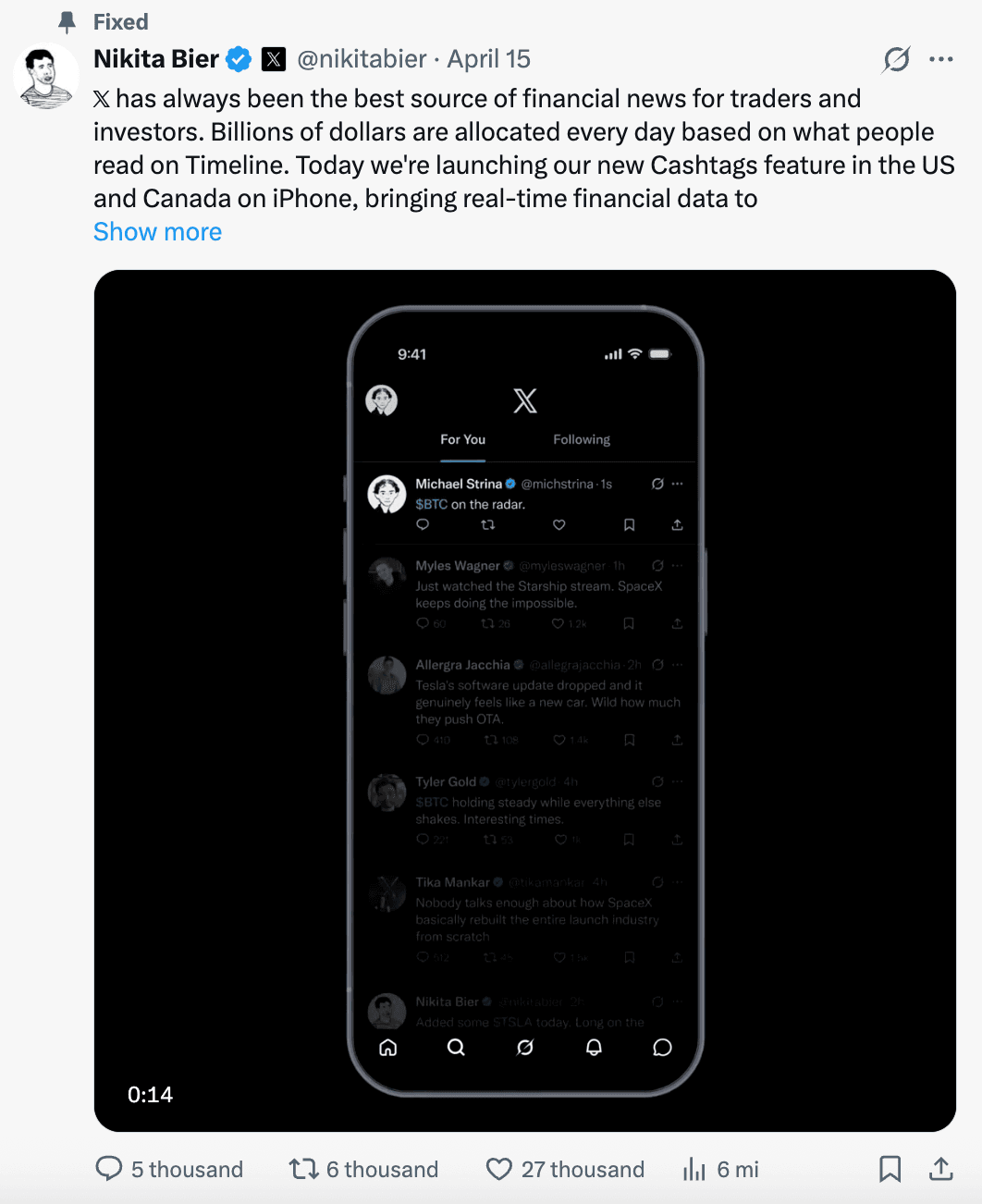
Cashtags shipping in the US and Canada. The platform is now in the financial-data business.
The Telegram Precedent Already Played Out
The Telegram comparison is not theoretical. I watched it happen in real time, and one of the major casino operators on Telegram made the call early.
On February 14, 2025, Whale.io announced it was shutting down its Telegram bot and moving its entire operation to the web. At the time, Whale was reportedly one of the largest crypto casino operations running inside Telegram, with more than 15 million users. The official message named the reason directly: "recent actions in the ecosystem" and "recent changes to platform Terms," combined with the need for "compliance with emerging regulatory frameworks."
That is operator language for "the platform got too risky to keep running my product on." Today, Whale drives a meaningful chunk of its traffic from Telegram to X instead. The platform shift was permanent, not a pause.
The Philippines almost pulled the plug on Telegram
The Philippines case is worth slowing down on, because it is the cleanest example of a government using a platform-wide ban as leverage against gambling activity, and most operators outside Southeast Asia missed it.
The backdrop matters. In late 2024, President Marcos signed an executive order shutting down all Philippine Offshore Gaming Operators (POGOs), the licensed-but-controversial offshore casino industry that had been operating from inside the country for years. POGOs were tied to scams, human trafficking and money laundering cases, and the ban removed an entire legal category overnight. That activity did not disappear. It migrated to less regulated rails. A meaningful chunk of it landed on Telegram, where channels and bots started running the same offshore casino and scam-adjacent operations the POGO ban had just removed from the formal sector.
By early 2026, Philippine regulators had had enough. On February 3, the government openly considered a nationwide Telegram ban over what officials described as illegal gambling, online scam operations and cybercrime hosted on the platform. This was not a regulator wagging a finger. The Department of Information and Communications Technology (DICT), the National Telecommunications Commission (NTC), and law enforcement openly discussed cutting Telegram off from the entire country, the way India and Brazil have done with apps in the past.
For roughly four weeks, every crypto casino bot, affiliate channel and gambling group operating on Telegram in the Philippines was looking at the possibility of losing access to one of the largest user bases in Southeast Asia. For the operators that had built TG-native casino products, that was an existential moment.
The resolution came on February 27, 2026, when the Philippine government and Telegram jointly announced a deal to avoid the ban. Telegram committed to concrete cooperation measures: faster takedown of channels flagged for illegal activity, a direct law-enforcement liaison, and stronger enforcement against the kind of gambling and scam content that had triggered the threat in the first place. The follow-up reporting from GizGuide framed it the same way: ban averted in exchange for compliance.
The numbers behind that decision are worth sitting with. The Philippines has roughly 90 million internet users. Telegram losing that market overnight would have been one of the largest single-country exits in messaging history. Telegram chose compliance over freedom-of-speech posture, and that choice tells you which way the platform is bending.
Two things came out of that month that crypto casinos should not ignore.
First, the precedent for governments using ban-threats as leverage on messaging apps over gambling content is now established in Southeast Asia. The Philippines is not an outlier market. Indonesia, Vietnam and Thailand all have active enforcement programs against online gambling, and all three watch Philippine policy closely. The next regulator that wants the same outcome has a working playbook.
Second, and more important, Telegram has now formally agreed to cooperate with at least one government on takedowns of gambling-adjacent channels. That cooperation does not stay in one country. Compliance teams build reusable processes. The same channel-takedown pipeline Telegram built for the Philippines is the pipeline that will get reused the next time another country, or another regulator, makes the same demand. The platform's posture has structurally shifted from "I host everything" to "I cooperate when pressed."
For crypto casinos, that is the part that lasts. The headline was "no ban." The actual change is that Telegram is now a platform that takes channels down for governments, and the gambling category is the one that triggered the precedent.
The pattern is clean. Telegram did not get shut down. It just stopped being a stable distribution channel for grey-zone gambling. A major operator left voluntarily. A national government almost banned the entire app. What used to be a default acquisition surface for crypto casinos quietly turned into a place serious operators decided to leave.
If the platform thesis is right about X, the same play runs again on a different platform. Telegram cleaned up under criminal and regulatory pressure. X is cleaning up because it wants to be a bank. Different mechanics, same direction. The marketing surface that crypto casinos have been renting is being rewritten on top of them.
Winners and Losers in the New Game
Crypto casino marketing on X
Old playbook vs new playbook.
Losing reach
- Affiliate-only growth stacks
- Giveaway and retweet loops
- Reply bot amplification
- Offshore-only license + US traffic
- Undisclosed paid promotions
Holding reach
- Real licenses in real markets
- Owned content and audit work
- Brand voice that travels off X
- Compliant disclosure on every post
- Trust-led funnels, not link spam
It is worth being specific about who is exposed and who is not.
The exposed: Affiliate-driven casino brands whose entire growth engine is paid creator threads, giveaway loops and reply networks. Operators with only an offshore license and US-resident promotional traffic. Anyone using bot amplification on X today as a real input to acquisition. These are the businesses where margin lives in the grey area, and the grey area is shrinking.
The protected: Operators that already hold licenses in regulated markets, even if those markets are not the US. Brands with a real content layer that does not depend on platform tricks. Streamers and media outlets whose audience already knows their voice and follows them across platforms. Anyone who has been quietly building a brand instead of renting reach.
The New Marketing Game
If the old game was "buy the most reach for the least money," the new game looks very different. Three things start to matter more, in my reading:
- Compliance as a product moat. Holding actual licenses in real markets becomes a marketing asset, not just an operations cost. The brands that can publicly point to a regulator are the ones platforms will eventually whitelist
- Content over performance. Indirect funnels start to win. Build trust through reviews, audits and honest reporting. Then convert through that trust, not through a giveaway thread. This is the part of the game I have been playing since day one, so I am biased here
- Brand as the asset. The followers, the voice, the recognized name. Those things travel across platforms. A paid affiliate stack does not. When a single platform can change the rules in a quarter, only the brand survives the rule change
Related: Distribution Was Already Fragile
I just covered how Kick is reportedly running on heavy bot amplification. Crypto casinos lean on that ecosystem too. If both Kick traffic and X bot networks tighten in the same year, the playbook crypto casinos have run on social media stops working at the same time.
Read: Kick Claims 100 Million Users. Up to 68.7% Could Be Bots. →
So What Now
This is not a prediction. It is already happening. The bot purge is the visible part, but the quieter part is the wave of new crypto casino brands that have been getting their accounts destroyed, suspended or shadow-throttled in the last few weeks. Operators that look clean enough to sit next to a wallet will keep their reach. The rest are already losing distribution, one rule update at a time.
The deeper shift is the one worth sitting with. Telegram already did this. X is doing it now. The marketing game crypto casinos have been running for years was built on platforms that did not yet care what you put in front of users. Those platforms are starting to care.
So the question every operator and every investor in this space has to answer in the next twelve months is the same question, and I am not going to answer it for you.
If the platforms that built crypto casino acquisition are no longer the platforms that will tolerate it, what is the new marketing game?