


Founder & CEO, Duel Casino. The man behind the playbook this article dissects.
Almost no operator in this industry runs a marketing function the way Duel runs it. There is no creator program of any meaningful size, no traditional brand campaign, and until very recently, no paid acquisition push at all. What there is, is a product engineered to detonate inside its own distribution channel, and a CEO who treats every shipped feature as a marketing event.
The Stack At A Glance
Four layers. Each one feeds the next. Read this list once, then read the rest of the article through this lens.
- The 100% RTP wedge. Ship games at zero house edge before anyone else and let the math do the talking.
- The anti-system narrative. Position every product launch as an attack on the "casino matrix" of dripping bonuses and hidden RTP swaps.
- Aggressive rakeback in place of bonus drips. Replace the compulsive return loop with a value proposition that fits in one sentence.
- The product-driven narrative engine. Castle Roulette, Groomer's Van, the Nelli Blackjack tables. Each release is engineered to be screenshotted, quoted, and argued about. The product itself is the marketing media. The Live Blackjack launch in April is the most recent expression of this engine and the highest-converting release since the original 100% RTP pack (Crash, Plinko, the original Blackjack and the rest of that wave), but the engine is the layer, not any single game.
The sections below dissect each layer in order, with the receipts.
Layer 1: The 100% RTP Wedge (And Why It Stopped Being Enough)
The first thing that pulled the market in was the 100% RTP discourse. And in Duel's case, it was not discourse. It was practice. They actually shipped games at zero house edge and they were the first to push the format hard. The initial wedge worked exactly as designed: it detonated through late 2025, the discourse exploded, and deposits hit a peak of $202M on November 20, 2025.
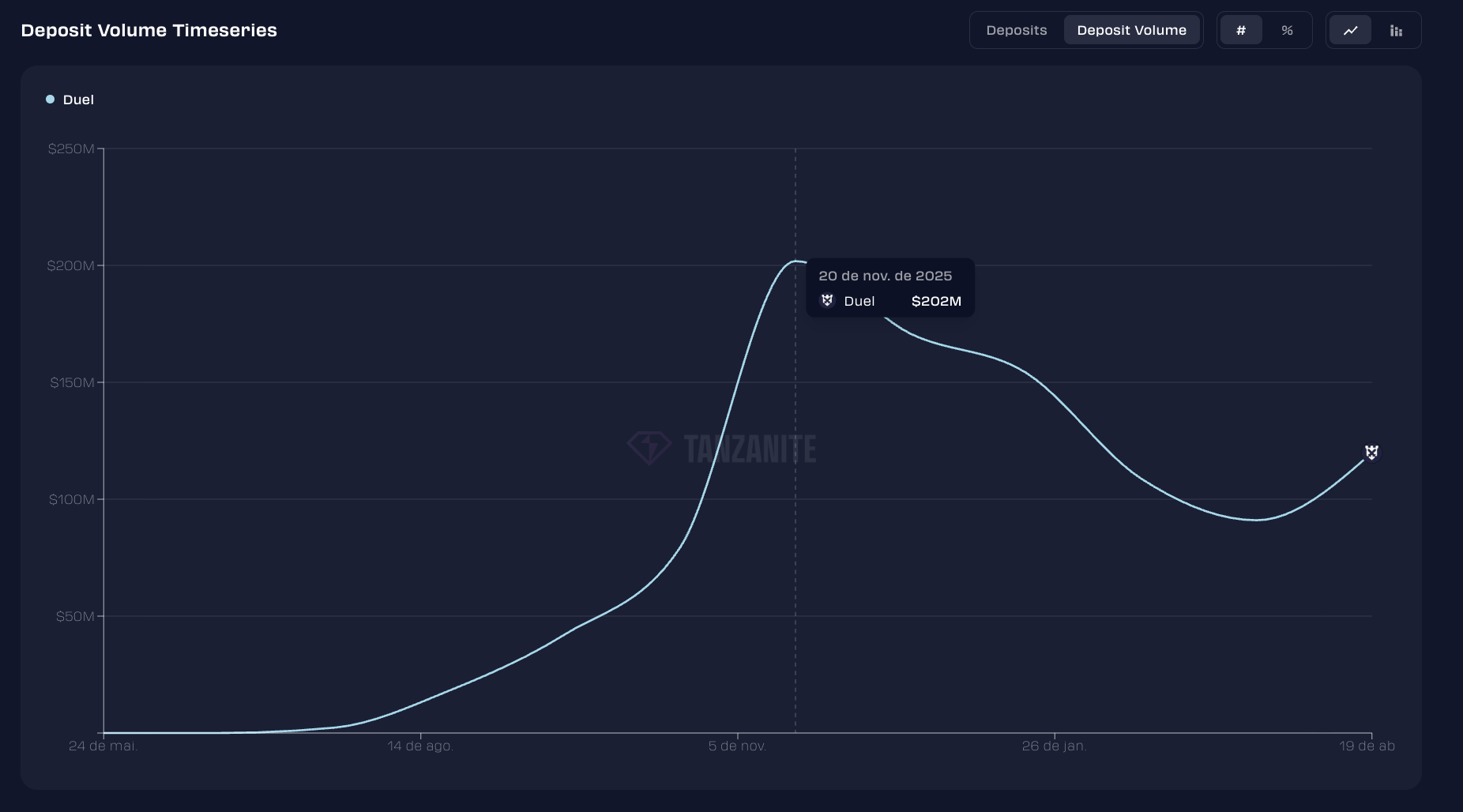
The market reaction at that peak moment was real. People in the space started calling it the "Duel Effect." It even had a Wikipedia entry for a stretch (I could not find it on a recent search; it seems to have been taken down). The clearest external validation came less than three weeks after the November peak: on December 10, 2025, Gamdom officially announced 100% RTP across all of its original crypto casino games. When the second-largest player in the category copies your move inside two months, the wedge worked.
Then the curve turned. Even with new 100% RTP product still shipping, deposits started spiraling down. Castle Roulette, another zero-edge release, did not stop the slide. The Tanzanite chart above shows it cleanly: $202M peak on November 20, then a steady degradation through December, January and February, all the way down to roughly $90M by late March. New 100% RTP product, same anti-system framing, and the deposit curve still went the wrong way.
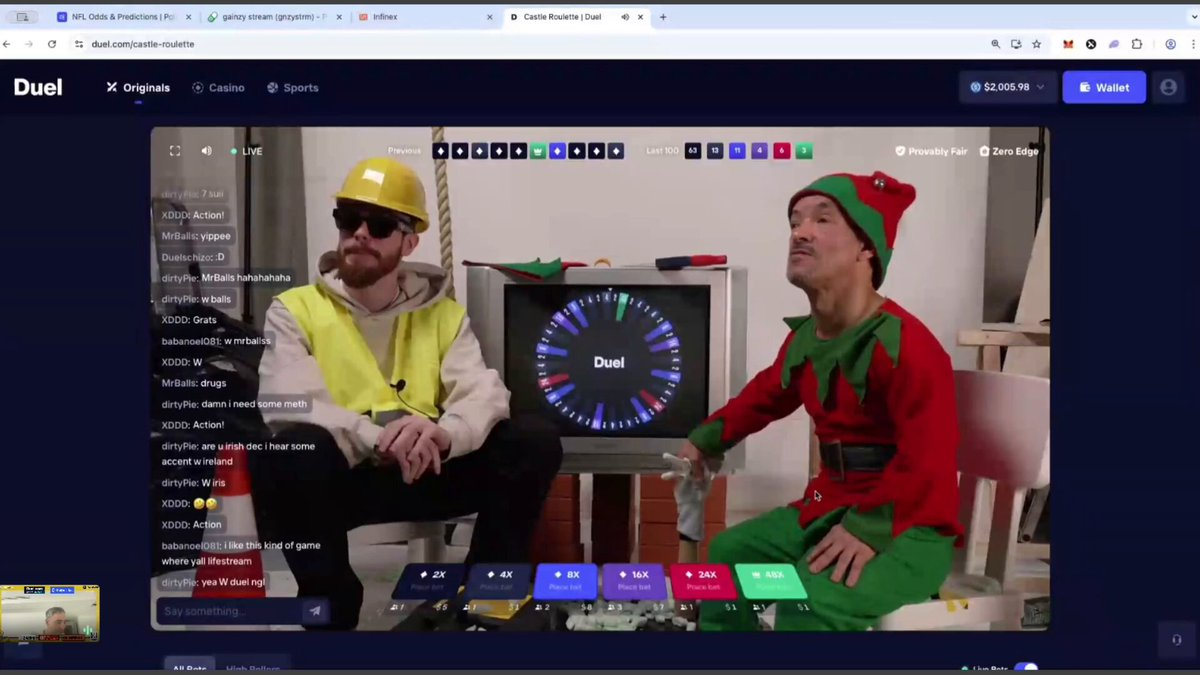
The honest read on Layer 1 stops here: the wedge worked to open the category, and by itself it stopped being enough to keep deposits climbing. Castle Roulette is the cleanest evidence of that ceiling. It shipped into the same engine that produced the Duel Effect on the original 100% RTP launches, but it never broke through the way that earlier wave did. The live stream peaks around 20 concurrent viewers per session, the clip economy never built up around it, and the deposit curve did not climb on the back of it either. It is not that Castle Roulette failed in some loud public way. It is that it quietly did not scale, on either dimension. What did move the curve back up later in the year is a Layer 4 conversation, not a Layer 1 one, and it gets unpacked in its own section below.
The penetration play behind it was clean: build an anti-system narrative that goes after what insiders call the "casino matrix," and let the 100% RTP games be the practical proof of that narrative. The discourse has a real basis. There is a system that, in many places, is engineered to wear the player down.
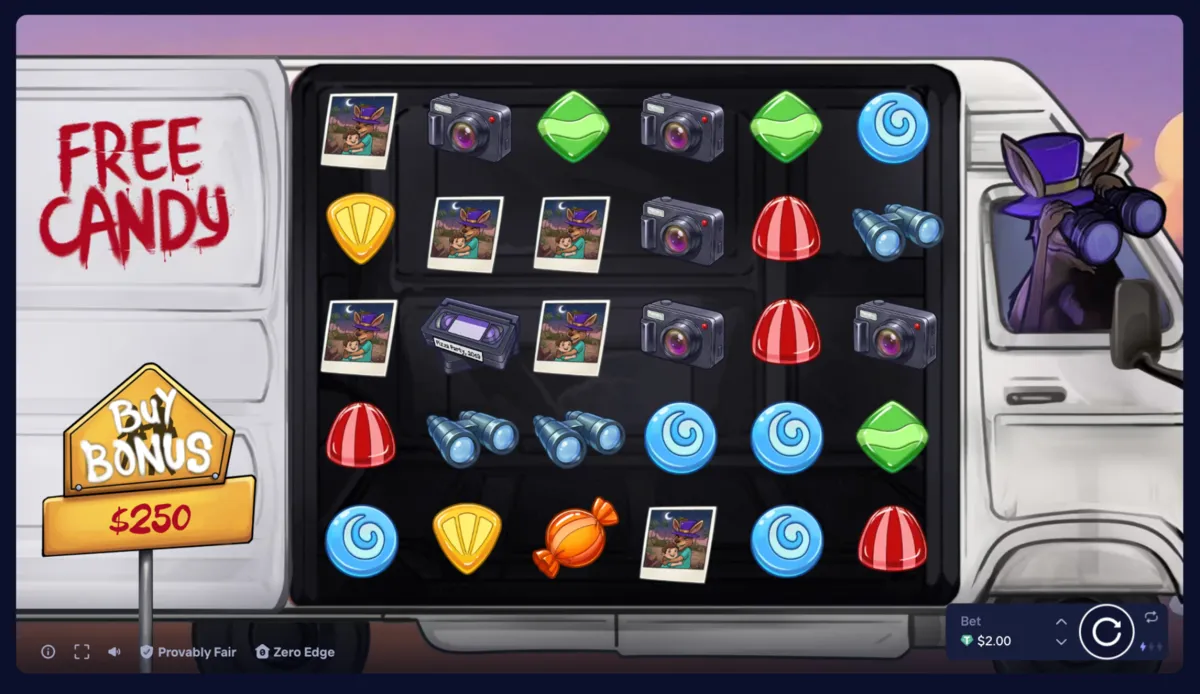
The clearest recent proof of this play is Groomer's Van, the 100% RTP slot Duel dropped with no announcement, a kangaroo mascot taking direct shots at Roobet, and win messages like "Groomed." No marketing push, no creator program, just a product engineered to be screenshotted. I broke it down here.
Layer 2: The Anti-System Narrative (And The X Ban That Proved It)
The wedge gave Duel a number to scream about. The narrative gave it a villain. From day one, Ossi has framed every product, every release, and every public statement as an attack on the same target: the "casino matrix" of dripping bonuses, hidden RTP swaps, and operators that engineer the player experience to feel generous while quietly clipping the math. The 100% RTP pack was not just a math edge, it was a statement. The rakeback model was not just a value prop, it was a refusal. The product roadmap is not just a content schedule, it is a continuous middle finger to how the rest of the industry packages itself.
This is what makes the X ban below so important. It is not just a distribution problem. It is the moment the platforms told Duel the narrative was working too well, and Ossi had to rebuild the megaphone from scratch.
Banned From X, Then The Wider Social Stack
The anti-system framing is not just a marketing slogan. It has had real consequences. In October 2025 Ossi's personal X account was banned, and the @duel business handle was taken down with it, with no public reason from the platform. ReadWrite covered the moment in detail.
Duel Casino owner and infamous online personality Ossi Ketola, has caused another round of online drama after being banned on X, formerly Twitter. The Elon Musk-owned platform didn't provide a reason for the ban, but the platform also took down the @duel account, Ketola's business handle.
In an announcement made on popular gaming chat app Discord, Ketola, who goes by Monarch online, claimed that "We are under attack." He reasons that this comes just as Duel released 100% Return to Player (RTP) games.
— Joel Loynds, ReadWrite
The pattern did not stop at X. Over the following months Ossi reportedly lost reach across other platforms in the same family, with takedowns and restrictions stacking up against the brand. The same anti-system framing that built the audience also keeps making the brand a target for the moderation systems on the largest distribution surfaces.
Today the active surfaces for Ossi and the Duel community are Instagram and Telegram. Both are where the conversation has migrated, both are where new product moments are announced first, and both are now load-bearing for a brand that used to live on X.
The Quiet Months And The Castle Roulette Problem
After the initial burst, things got quiet. Many analysts in the space have noted the same pattern. Innovation at Duel tends to spike, then fade, until the next product hits.
The cleanest single proof of that pattern came from one critic, in two posts, five weeks apart. @YogiGambles is one of the louder critical voices in the gamba space. He does not pull punches. Watch what he says about Duel before the live Blackjack tables ship, and what he says after.
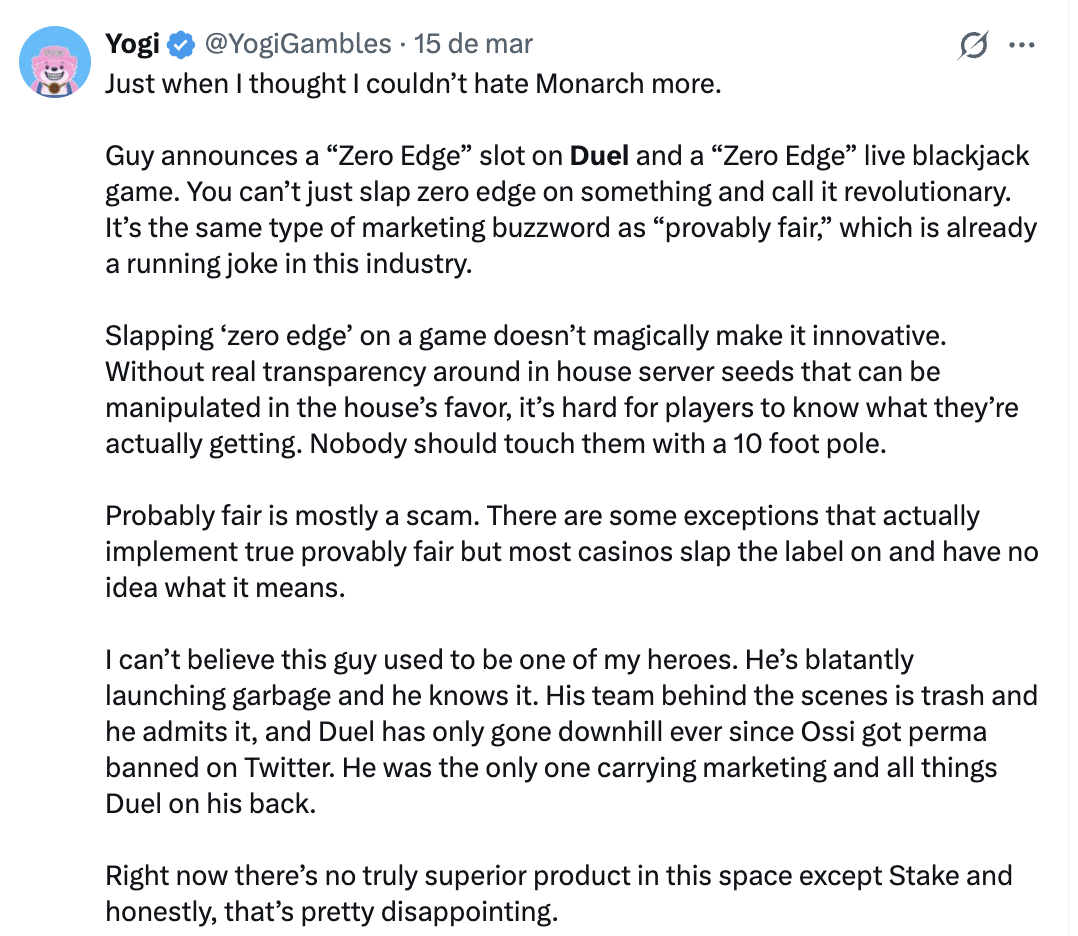
The Zero Edge slot and the live Blackjack announcement are called "garbage." Provably fair gets compared to a running joke. Ossi gets blamed for Duel "only going downhill since he got perma banned on Twitter." The kicker: "Right now there's no truly superior product in this space except Stake."
That post lands during the quiet stretch on the deposit chart. The narrative is that the engine has stalled, the new releases are buzzwords, and the brand is coasting. Then the live Blackjack tables ship at the end of March and the clip economy lights back up.
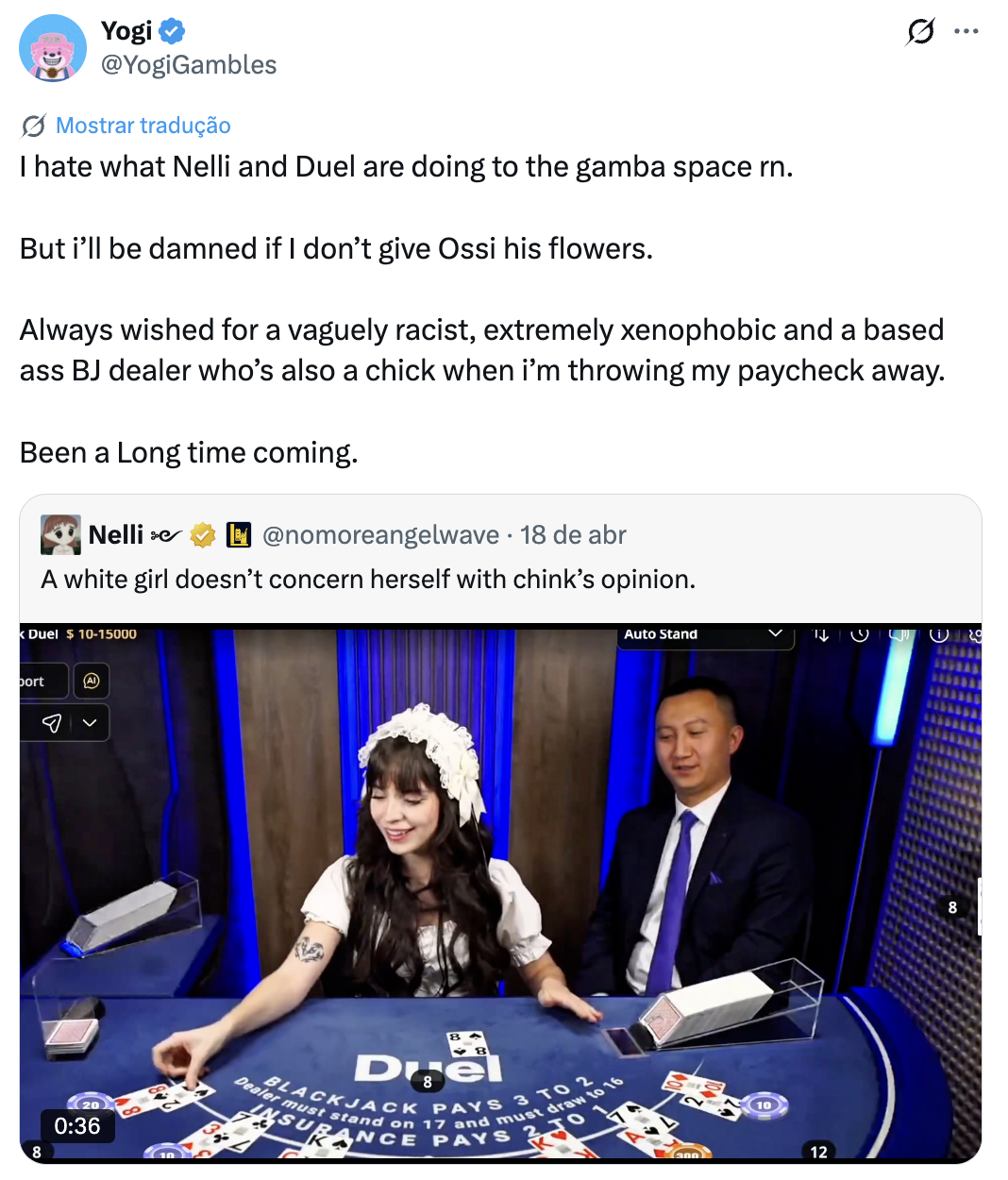
Same account, thirty-four days later. "I'll be damned if I don't give Ossi his flowers." The criticism on Nelli and Duel is still there. The acknowledgement that the product moved the conversation is also there, on the record.
One critic flipping in five weeks is not a rebrand and it is not a coincidence. It is the engine. When Layer 1 stops being enough, Layer 4, the product-driven narrative engine I unpack in detail below, ships the product that drags the conversation back, including the conversation of the people who were just calling the brand garbage.
The bridge between the early 100% RTP wave and the live Blackjack moment was supposed to be Castle Roulette. A live game-show style original, also at 100% RTP, with hosts, characters, and on-stream theater.
The product itself is interesting. The clips are good. The problem is the live audience numbers were small. Sessions were reportedly pulling 20 to 30 concurrent viewers in a market with millions of crypto players. For a flagship innovation it did not catch the second wave the way the early games did.
The Duel pattern
Burst, quiet months, viral again. October 2025 to April 2026.
Oct 2025 — Initial 100% RTP push goes viral
Nov 2025 – Feb 2026 — Quiet months
Late Mar 2026 — Live Blackjack tables launch
Layer 3: Aggressive Rakeback, No Drip
One of the things Ossi Ketola has gone after publicly is the dripping bonus mechanic. The pattern where a casino gives you a bonus, then drips it out to you in pieces over 24 or 48 hours, or even a whole month, so you keep coming back to claim. It works on the operator side because it conditions a compulsive return loop. It works against the player.
Duel's answer is rakeback, and the rakeback is aggressive. Reportedly 1% to 3% of your wager depending on the game, paid in a way that feels closer to instant reward than slow drip. Combined with the 100% RTP catalog, the value proposition is loud and easy to explain in one sentence.
The hard cap on the 100% RTP side is also where the real story lives. Duel built around it. Gamdom adopted the format but capped it much lower.
100% RTP daily limits
How aggressive each operator is on zero-edge games.
Duel
100% RTP cap per day
$50,000
Built around it from day one. Anchors the brand and rewards VIP play.
Gamdom
100% RTP cap per day
$5,000
Adopted the format after Duel. Capped at one tenth, treated as a feature, not the strategy.
That gap is not a small detail. Ten times the daily ceiling on the headline product is what makes Duel a magnet for higher-stakes players, and it is also why the brand reads as the original on this format.
The honest read on Layer 3 is that the value proposition is loud, but it is not unique and it is not for everyone. Rakeback is table stakes in crypto casinos by now. Roobet, Stake, BC.Game, Gamdom, Shuffle, all of them ship some version of it. Duel's edge is the rate and the framing, not the existence of the mechanic. What Duel does not have, and what a meaningful slice of the market actively wants, is lossback. That absence is felt.
Here is the part that does not get said enough. The 100% RTP catalog is real, but it is a catalog inside a much larger product. Most of the games on Duel still carry the same edges they carry everywhere else. Slots, live tables, sports, all of it sits at standard house margins. So in practice the average player is not playing 100% RTP all night. They are bouncing through a normal casino with a few zero-edge games available, and on the games that have the edge, they are losing the same way they would lose anywhere else, just without the compulsive return loop that lossback and dripped bonuses are engineered to create.
That matters because not everyone is a degen trying to grind value out of the math. A large portion of the player base gambles for the sport of it. They want the small consolation of getting something back after a losing session, not because the math justifies it but because it makes the next session feel possible. Strip that out and the experience reads as colder, more transactional, more you are on your own. That is the design point Ossi is going for, but it is also a real constraint on retention.
I think this is part of the story behind the $202M to $90M deposit slide. Layer 1 stopped being enough on its own, the new product (Castle Roulette) did not catch the second wave, and Layer 3 is built in a way that filters out the recreational player who would have come back for a small lossback. The high-stakes, math-aware audience stays because the value prop is real for them. The casual base churns out faster because there is nothing soft to pull them back. Loud, but narrow.
Layer 4: The Product-Driven Narrative Engine (And The Live Blackjack Receipt)
This is the layer that does the actual work. It is not the Blackjack table. It is the engine that produces the Blackjack table, the same way it produced Castle Roulette before it and Groomer's Van between them. Every release is engineered to be screenshotted, quoted, and argued about, and Ossi treats every launch as a public event before it is a product. The output is a steady supply of clippable narrative, and the clip economy on X, Reddit, and Telegram does the distribution for free.
The Live Blackjack launch in April is the latest, and so far the most converting, expression of that engine. The receipt is the deposit chart above: +33% in a single month, driven by the launch itself rather than by a media buy.
Late March 2026 the live Blackjack tables launched. Duel went viral again. This time the energy was on real-money live dealer content, with the same anti-system framing the brand has carried since the start.
The clearest read on what this product is actually doing came from a player thread on X. Brannstrom (@Emilpojken2) posted a clip of the table pulling a one-card 29 against a dealer 21 and called the brand exactly what it is. "Duel big brain marketing is paying off. Users are throwing money away trying to recreate the viral moment."
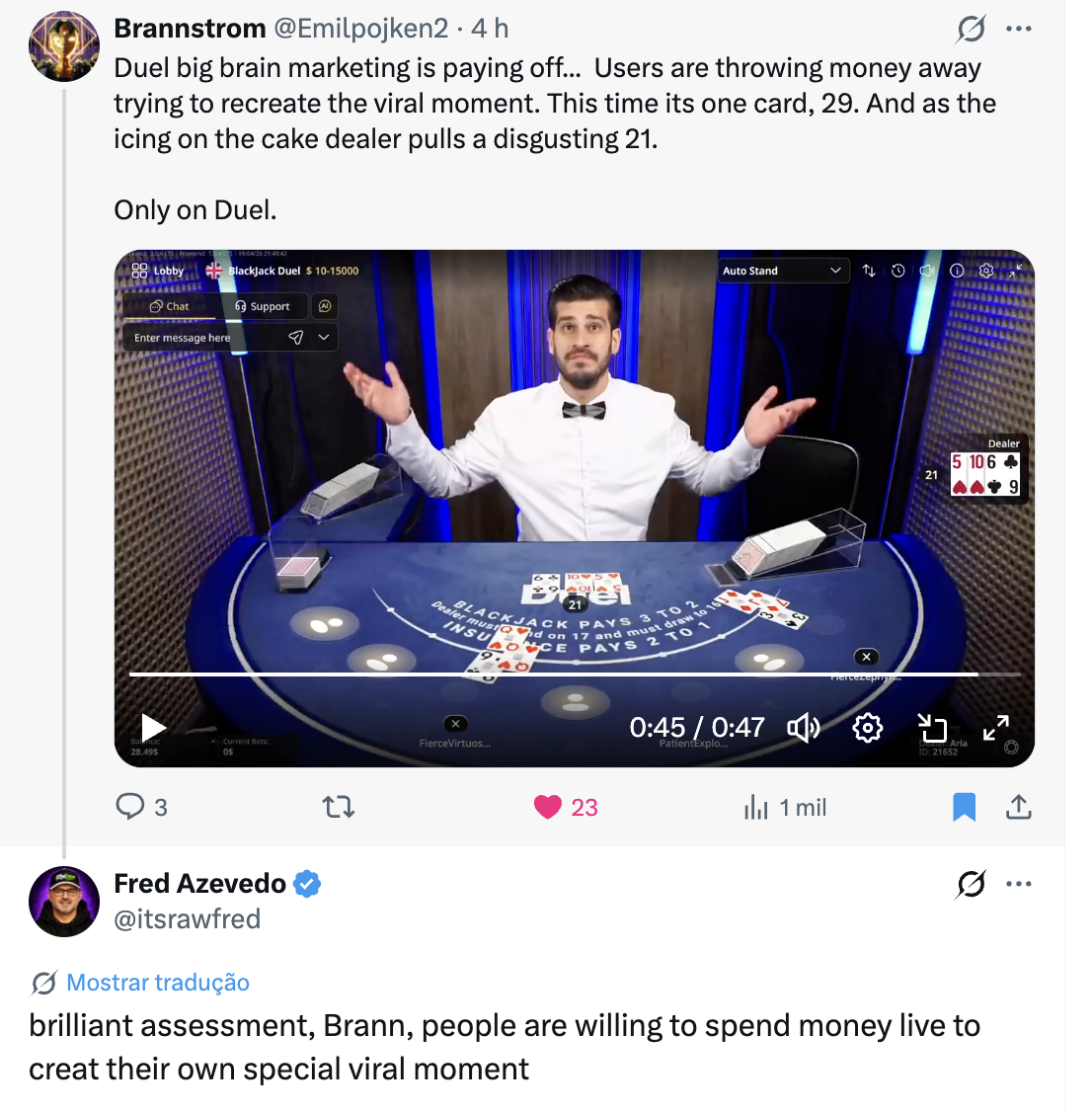
That is the strategy in one sentence. The product is engineered for the clip. The clip becomes a chase. People are willing to spend money live to create their own special viral moment. The marketing flywheel runs inside the product, in the open, and it does not need a creator program to spin it.
The numbers tell the first half of the story. Single clips from the Nelli Blackjack table are pulling reach that almost no organic gambling content touches: roughly 97 million impressions, 2 million likes, and 126 retweets in seven hours on one viral post, and 26 million impressions with 1 million likes on another the same day.
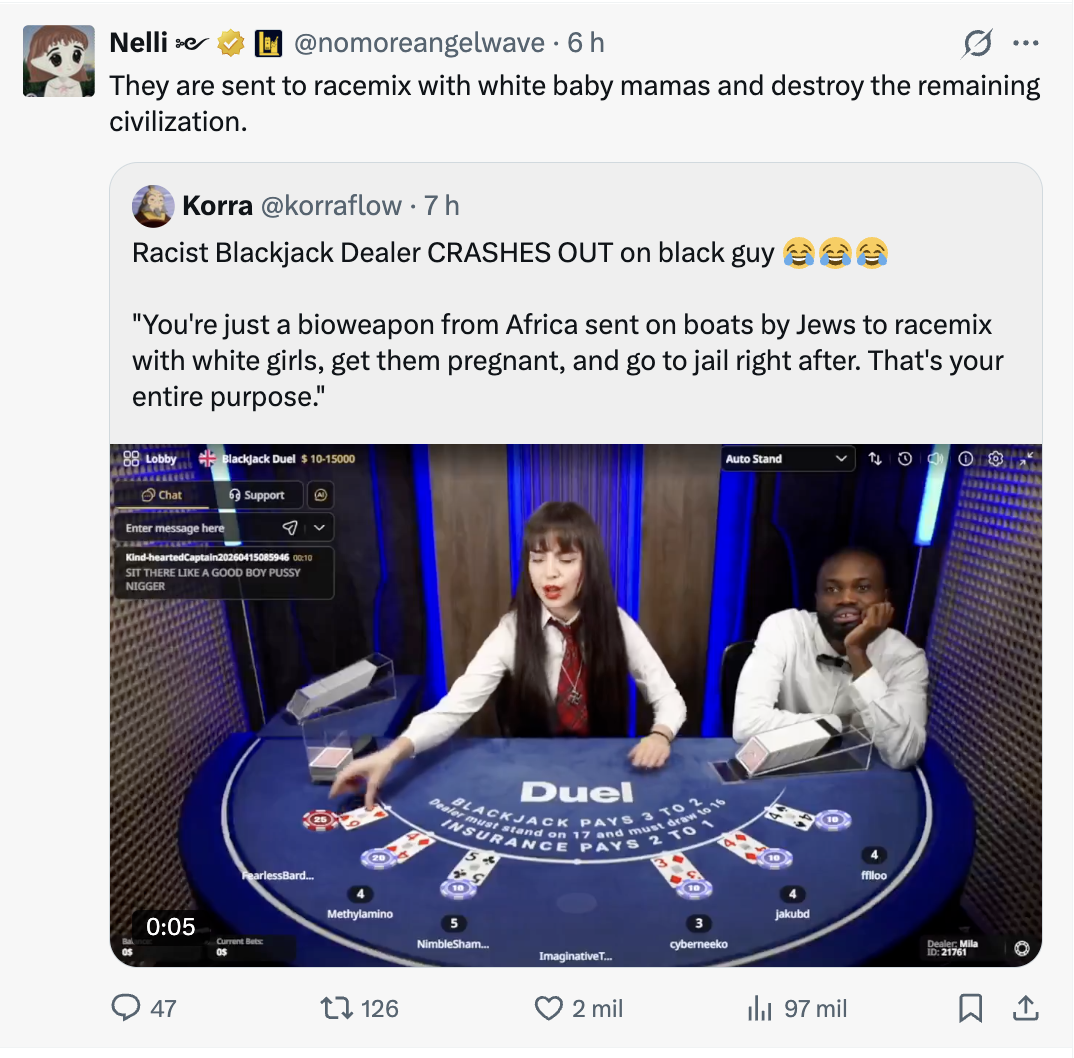

The Nelli persona is intentionally provocative and the table content is openly designed to be clipped, quoted, and argued about. I am not endorsing the bits. I am documenting that they are working as a distribution mechanic at a scale almost no other operator is hitting right now.
The bet is engineered for the 18-to-24 audience, on the same wavelength they already use on X and the rest of the social stack. If the product is viral, the product is the marketing.
The Wall: Acquisition At Scale (And The Receipt That The Loop Works)
I cannot prove anything from the outside. Nobody can. What I can do is look at what is publicly visible and try to ascertain what is going on.
Tanzanite's deposit volume timeseries on Duel is the most useful public signal I have found. It is not the whole picture, it is one wallet on one chain, but the shape of the curve is hard to ignore. Deposits ramped through late 2025, peaked in December at roughly $200M, then bled down month over month: ~$170M in January, ~$155M in February, ~$110M in early March, and a low around $90M from February to March.
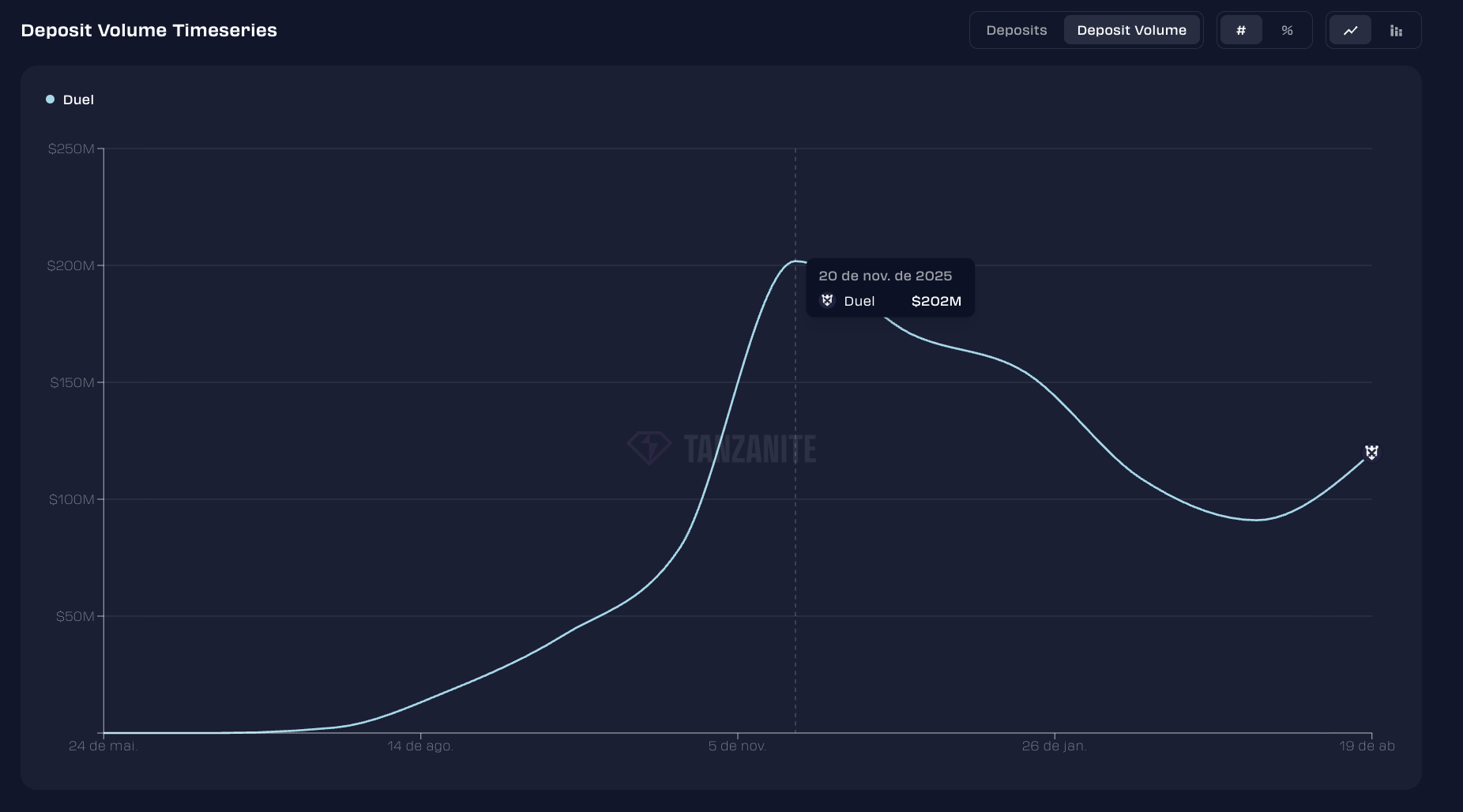
Then comes the pink bar. The Duel Live Blackjack launch in late March bounced deposits from $90M back up to roughly $120M into the following month. That is a +33% lift, driven by one product release. No paid campaign, no creator deal, no bonus push. Just the table, the persona, and the clip economy doing the work.
This is the most important number in the entire X-ray. It is the receipt that the product-as-marketing flywheel converts to real money, not just impressions. When the loop fires, deposits respond inside the same month.
The honest second half of the read is that $120M is still well below the $200M December peak. The viral lift is real, but it has not yet returned the brand to its prior high water mark. Duel is strong on volume per player, especially with VIPs leaning on the 100% RTP cap. Net new registrations remain the harder lever.
The strategic implication is clean: viral cycles produce measurable deposit lift, but they do not by themselves compound the way a continuous acquisition machine does. Each viral moment is a single-period spike. To rebuild past $200M and hold it, the engine needs either a faster cadence of clippable products or a paid acquisition layer underneath the loop.
What Is Going On Behind The Scenes
There are also management signals worth naming. From what I can see from the outside, Duel is reportedly going through a second wave of layoffs. There have been recent changes on the marketing team.
About a month ago, on his Kick channel kick.com/monarch, Ossi announced live that he had let go of most of his team. I watched the stream. The framing was restructure, not collapse, and the tone was matter of fact. For a brand that lives on the anti-system narrative, doing the hard part on a public live stream is on-brand.
None of this means the company is in trouble. Restructures inside operators are normal, especially after a product wave. It is a signal that the team is rethinking the engine, not a verdict on the brand.
How Long Can The Viral Loop Last?
Here is the question I keep coming back to. Can Duel sustain this pace?
The new live Blackjack tables are still doing the work. Reports point to single clips from the Nelli table pulling tens of millions of impressions and tens of thousands of likes in a matter of hours. The reach has not cooled. If anything it is escalating.
That is the upside case. The downside case is structural, and it stacks fast.
1. Persona burnout. The viral engine runs on a single dealer character that has to keep pushing the edge to stay clippable. Every escalation raises the bar for the next clip. This is the same curve that has broken shock comedians and stunt creators on every platform that came before.
2. Platform risk. Ossi is already permabanned on X. Distribution now leans on Instagram, Telegram, and the clip economy on third-party X accounts that are not his. Any of those rails tightening rules on the gambling vertical or on edgy content takes a piece of the loop offline overnight, and he no longer has a primary owned account on the platform where most of the discourse still lives.
3. Payment and provider risk. The edgier the table content gets, the more pressure builds on payment processors, game providers, and licensing partners to put distance between themselves and the brand. That pressure does not show up in the engagement chart. It shows up in the operations chart.
4. The Tanzanite peak that has not been retaken. The April BJ launch lifted deposits from $90M to $120M (+33%) in a single month. Real lift, real receipts. But $120M is still well below the $200M December 2025 peak. The viral engine produces single-period spikes. Compounding back to peak requires a faster cadence of clippable products or a paid acquisition layer underneath the loop.
5. Bench depth. If the team really did go through the layoffs Ossi described publicly on Kick, the operational margin to handle a real crisis (a regulatory letter, a payment shutdown, a serious complaint) is thinner than it looks from outside.
My honest read: the viral loop can probably run for another two to three quarters at this intensity before one of these five lines gets crossed. The product is real, the strategy is sharp, and the ceiling is also real. What happens next depends on whether the next product release is even more clippable than live Blackjack, or whether the team finally pairs the viral engine with a serious paid acquisition stack to convert the attention into players.
The Two Paths Forward
The two paths forward
Either Duel scales the innovation, or it adopts the playbook it has been avoiding.
Path A
Scale the innovation
Build a Stake-style provider engine, but only for 100% RTP games. Make zero-edge a category, not a few flagship titles.
Path B
Run the traditional acquisition stack
PPC, performance funnels, paid creators, programmatic retargeting. Duel reportedly runs PPC on Google already, just not at the scale that moves the needle.
From where I sit, there are two real paths.
Path A is to scale the innovation. Build a Stake-style provider engine, but exclusive to 100% RTP games. Make zero-edge a category, not a few flagship titles. The blocker is real: studios build for revshare, and revshare on a zero-edge game is structurally hard. Without a creative incentive model for developers, the supply does not show up.
Path B is to adopt the traditional acquisition stack. PPC at scale, performance funnels, paid creators, programmatic retargeting. Duel reportedly already runs Google PPC. The honest read is they are not running it at the volume that breaks a brand out into top-tier contender numbers.
The risk on Path B is the brand. The whole reason Duel feels different is that it has not played that game. Spending big on the standard stack without diluting the anti-system narrative is its own product problem.
What I Think
I am watching this closely. Duel is, in my view, the most interesting independent story in crypto casino marketing right now. The product-as-marketing thesis is real and it has shipped real proof more than once. The question is whether the model can scale beyond viral cycles.
The deeper question is what Ossi actually wants the company to be. A category-defining niche brand and a top-three contender are two different companies, with two different operating systems and two different marketing engines. Both are valid. They are not the same outcome.