

This is the full breakdown of how US sweepstakes casinos actually work in 2026, end to end. The legal carve-out. The dual-currency model. The bonus math, the rollover, the KYC walls, and the real cash-out path. The demographics, the distribution stack, the legal pressure, and the market structure underneath the whole category. I picked Sweet Sweeps as the live field test for the platform-level deep dive in Chapter 2, because I wanted real money on the line, not secondhand reporting. Chapter 1 is the category context. Chapter 3 is the strategic read on the market, the operator channel audit, and where this category is actually going next. If you want to understand US sweepstakes casinos without filtered marketing copy, this is the piece.

Everything You Need to Know About US Sweepstakes Casinos, With Sweet Sweeps as the Live Field Test
A real-money, end-to-end breakdown of how American sweepstakes casinos actually work, with Sweet Sweeps as the live test bench, plus a strategic read on the market, the operator channel audit, and where the category is going next.
The piece runs in three chapters, end to end on the category, with Sweet Sweeps as the live field test that grounds the whole thing in real-money evidence.
How the Category Actually Works (Research Context)
Where sweepstakes casinos came from, how they differ from social casinos, what Gold Coins and Sweepstakes Coins really are inside the model, and what the U.S. market looks like today. The setup the rest of the research stands on.
The Sweet Sweeps Field Test, From the Welcome Bonus to the Terms of Service
A section-by-section walk-through of Sweet Sweeps on a funded test account, plus a careful read of the Terms of Service: the bonus math, the AMOE no-purchase path, the KYC wall, the rollover, the crypto cash-out, the JAMS arbitration. Closes with what the field test surfaced before we zoom out to the bigger question.
The Research Conclusion, and the Strategic Question About Building an Instagram Channel
The central thesis: a multi-billion-dollar industry with no creator class. The three theories I tested to explain why. The synthesis. And the strategic answer to whether this market is actually worth building an Instagram channel around.
Sweet Sweeps is a Basher Agency client of mine; that disclosure also lives in the body of the piece. Use the index below to jump anywhere you want.
Quick Reference, the Two Things to Read First
Chapter 1: How the Category Actually Works
- 1.1 Before Sweepstakes Casinos, America Already Had Sweepstakes Culture
- 1.2 The Reader's Digest Model, and Why It Matters Today
- 1.3 The Internet, Social Gaming, and the Birth of Sweepstakes Casinos
- 1.4 Social Casinos vs Sweepstakes Casinos, and Why the Difference Matters
- 1.5 First Things First, What Is a Gold Coin, What Is a Sweepstakes Coin, and How Do They Actually Relate
- 1.6 How Big Is the Sweepstakes Casino Market?
- 1.7 Who Is Actually Playing Sweepstakes Casinos?
- 1.8 But for How Long Can Sweepstakes Casinos Keep Growing?
Chapter 2: The Sweet Sweeps Field Test, From the Welcome Bonus to the Terms of Service
- 2.1 Reading the Official Rules of Sweet Sweeps, and Where the Platform Starts Feeling Much More Serious
- 2.2 The 200% Welcome Bonus, How the Numbers Work
- 2.3 The First Thing That Stands Out: This Is Clearly Built as a U.S. Product
- 2.4 Apparently I Am Also Not Supposed to Win Big Today
- 2.5 Sweepstakes Coins (SC), Where the Entire Model Changes
- 2.6 The "Free Entry" System Exists, but Let's Be Honest About How Practical It Is
- 2.7 The Most Important Rule in the Entire System
- 2.8 KYC Is Mandatory, and Anonymous-Casino Users May Hate That
- 2.9 The 30-Day Redemption Window, and Why It Exists
- 2.10 The $5,000 Redemption Cap, and the Business Logic Behind It
- 2.11 Despite Being Based in Gibraltar, Sweet Sweeps Anchors Its Rules in American Law
- 2.12 Time to Actually Test the Platform
- 2.13 Hitting the First KYC Wall, Right Before I Could Spend a Cent
- 2.14 The UI, And Why It Actually Took the Edge Off Real Stakes
- 2.15 The Game Info Card Tells You Everything Except the Most Important Number
- 2.16 The Quests System, And What It Says About How Sweet Sweeps Keeps You Coming Back
- 2.17 The Bonus Area, and Why It Already Feels Different from a Traditional Casino
- 2.18 Buying Sweet Spins, the UX Issue I Hit, and the Quiet Surprise About Gold Coins
- 2.19 Saying Goodbye, KYC With Veriff, and a Quick Tour Through Sweet Sweeps Support
- 2.20 The Rollover Surprise, and Why I Think Sweet Sweeps Should Be Marketing This Number on the Front Page
- 2.21 The Redemption Flow, Limits, Crypto Cash-out, and Why I Withdrew the Minimum
- 2.22 The VIP Tier Ladder, What Swirl, Double Dip, and Trio Treat Actually Give You
- 2.23 Now Let's Read the Terms of Service, Because This Is Where Real Player Protection Lives
- 2.24 Step 1, the Notice of Dispute, the Part Most Players Will Skip
- 2.25 Step 2, Binding Arbitration via JAMS, Translated for Humans
- 2.26 What You Give Up, the Class Action Waiver
- 2.27 Where the Whole Thing Lives Legally, Delaware and the Federal Arbitration Act
- 2.28 The Bottom Line on the Terms of Service
- 2.29 The Field Test Bottom Line, Before I Zoom Out to the Research Question
Chapter 3: The Research Conclusion, and the Strategic Question About Building an Instagram Channel
- 3.1 The Central Contradiction at the Heart of This Market
- 3.2 The Two Questions This Market Forces You to Ask
- 3.3 Theory 1, the Sweepstakes Audience Is Not Content-Native
- 3.4 Theory 2, This Market Scaled on Performance Marketing, Not Culture
- 3.5 Theory 3, Legal Instability Has Been Suppressing Long-Term Media Investment
- 3.6 The Synthesis, Massive Engagement Without Gambling Identity
- 3.7 The Strategic Read, What This Market Structure Means for Anyone Building Content Here
- 3.8 The Operator Channel Audit, How Sweet Sweeps and SpinQuest Actually Use Instagram
FAQ, Quick Answers on US Sweepstakes Casinos
Five questions I get the most about this category. Real answers, no marketing copy. The full reasoning lives further down the piece.
The five questions worth answering up front
If you want the short answer, this is it. The full breakdown of each lives further down in the piece.
Are sweepstakes casinos legal in the US?
Yes in most states, with a handful of exceptions where they have been pulled out by the operator or banned outright. The legal model is the "no purchase necessary" sweepstakes carve-out from US promotional law, the same framework Reader's Digest and McDonald's Monopoly have used for decades. The current pressure in 2025 to 2026 is at the state-AG level, not federal. Section 3.5 walks through the legal trajectory in detail.
What is the difference between Gold Coins and Sweepstakes Coins?
Gold Coins are play-money, no real-world value, no redemption. Sweepstakes Coins are the redeemable currency you can cash out for real money, gift cards, or crypto once you clear the rollover. You buy Gold Coins; you receive Sweepstakes Coins as a free bonus on top, which is what keeps the model legal under US promotional law. Section 1.5 breaks the dual-currency model down end to end.
Can you actually cash out real money?
Yes, if you clear the rollover and pass KYC. Each operator has its own minimum redemption threshold and its own payout rails (gift cards, bank transfer, crypto, paper check). The cash-out path is real, but it is also where most of the player friction lives, KYC is strict and rollover requirements are non-trivial. Chapter 2 is the live field test of the cash-out path on Sweet Sweeps with real money on the line.
Are sweepstakes casinos rigged?
The licensed slot games come from the same major studios that supply real-money casinos, so the certified RTPs are public. The provably-fair originals from operators like Stake.us are independently verifiable. Honest read: the games themselves are not where we lose, the bonus math, the rollover, the KYC walls, and the predatory bonus design are. Chapter 2 walks through how the math actually plays at the bankroll level.
Which states ban sweepstakes casinos?
Washington State and Idaho have effectively closed the category for years. Michigan has issued cease-and-desist letters. Several other state AGs in New York, New Jersey, and elsewhere are turning up the pressure in 2025 to 2026. The full state-by-state picture is moving fast, so the safest play is to check the operator's own list of accepted states at signup time. Section 3.5 covers the legal trajectory.
1.1 Before Sweepstakes Casinos, America Already Had Sweepstakes Culture
1.1.1The Pre-Internet Prize Culture
Long before mobile gaming apps, crypto casinos or online gambling platforms, sweepstakes were already deeply embedded into American culture. For generations, Americans grew up surrounded by prize-based promotional campaigns. Inside magazines. On television. In fast-food restaurants. On soda bottles. Inside cereal boxes.
The language became iconic:
No purchase necessary
Enter to win
Official sweepstakes rules
Mail-in entry
1.1.2The Reader's Digest Template
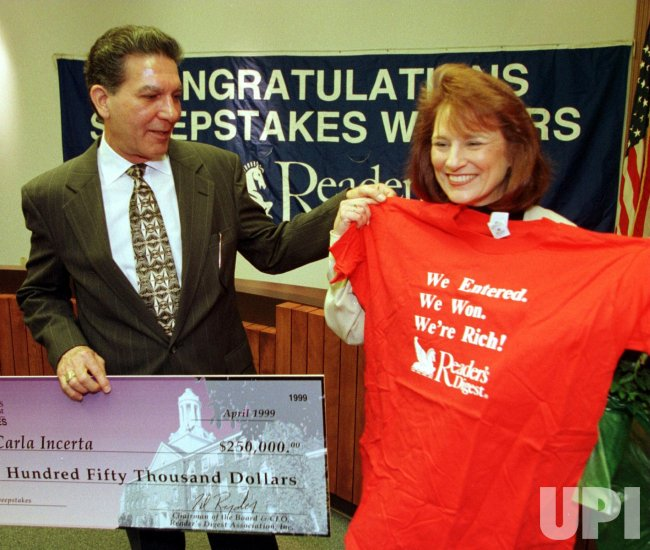
One of the companies most associated with this culture was Reader's Digest. Throughout the 20th century, Reader's Digest became famous for massive direct-mail sweepstakes campaigns that reached millions of American households, helping turn sweepstakes promotions into a mainstream part of American consumer culture, according to reporting from The New York Times and historical reviews of direct-mail marketing campaigns.
The formula was powerful. Large envelopes would arrive promising:
- luxury vacations
- cash prizes
- dream homes
- new cars
- life-changing jackpots
1.1.3The No-Purchase Distinction That Shaped the Law
Importantly, participation generally did not require a purchase. That distinction helped shape how sweepstakes promotions evolved legally in the United States. Over time, the concept expanded far beyond magazines. Brands across the country adopted similar promotional systems:
- retailers
- food chains
- television networks
- beverage companies
- eventually online businesses
1.1.4McDonald's Monopoly, the Mass-Market Moment
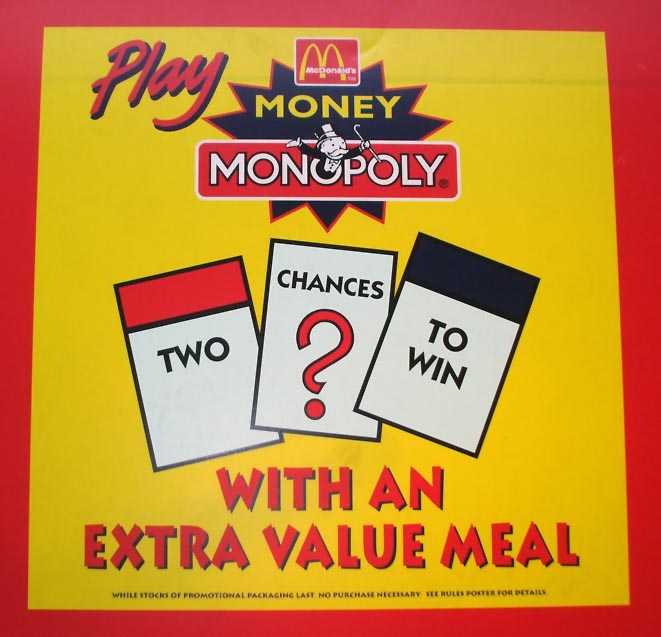
Perhaps the most famous example was the McDonald's Monopoly campaign, which became one of the largest promotional sweepstakes campaigns in American history. For decades, Americans became accustomed to the idea that promotional prize systems could exist separately from traditional gambling. And eventually, the internet transformed that concept into something much larger.
1.2 The Reader's Digest Model, and Why It Matters Today
1.2.1The Attention Problem It Solved
One of the reasons sweepstakes became so powerful historically is because they solved an extremely important business problem: How do you keep millions of users continuously engaged with your product? At first glance, the Reader's Digest model almost looked irrational. The company mailed millions of promotional envelopes promising huge prizes.
1.2.2Why the Math Worked for the House
Naturally, many people asked: how could this possibly be profitable? Because the sweepstakes itself was never really the product. Attention was the product. Retention was the product. Recurring engagement was the product. According to historical analyses of direct-mail marketing, sweepstakes campaigns dramatically increased:
- subscriptions
- recurring interactions
- mailing-list growth
- long-term customer retention
1.2.3The Psychology That Kept People Coming Back
Even users who never won anything continued participating because the possibility of winning created emotional engagement. And psychologically, that mechanism still matters enormously today. Because modern sweepstakes casinos operate on surprisingly similar engagement principles, only digitized, gamified and optimized for mobile platforms.
1.3 The Internet, Social Gaming, and the Birth of Sweepstakes Casinos
Three eras of American prize-based engagement
From mailbox to phone to dual-currency casino, the same playbook keeps evolving.
1.3.1Two Trends Colliding in the 2000s
During the 2000s and 2010s, two massive trends collided in the United States. The first was online gambling expansion. The second was the explosion of social gaming and mobile gaming economies. The American gambling market developed unevenly. Some states legalized online casinos. Most did not. At the same time, millions of users became deeply familiar with:
- virtual currencies
- in-app purchases
- daily rewards
- progression systems
- free-to-play monetization
1.3.2The Social Gaming Boom That Trained the Audience
Games like Slotomania, Zynga Poker, Candy Crush Saga, and FarmVille helped normalize digital reward ecosystems for mainstream audiences. According to market research from Mordor Intelligence, the global social casino market alone was estimated at approximately $8.36 billion in 2025, with forecasts projecting continued growth through 2031.
1.3.3Where the Modern Sweepstakes Casino Sits
Sweepstakes casinos emerged directly at the intersection of these two worlds: casino-style entertainment and promotional gaming systems. Eventually, companies like Chumba Casino, Pulsz, LuckyLand Slots, WOW Vegas, and newer operators like Sweet Sweeps turned the category into a multi-billion-dollar industry.
1.4 Social Casinos vs Sweepstakes Casinos, and Why the Difference Matters
Two categories that look the same and aren't
The redeemability question changes everything.
Pure entertainment currency
- Fictional chips, no cash value
- You buy more chips to keep playing
- Monetization looks like mobile gaming
- No KYC, no redemption, no prizes
Dual-currency with redemption
- Gold Coins for play, Sweeps Coins for prizes
- SC can be redeemed for cash where allowed
- "No purchase necessary" entry pathway exists
- KYC required to redeem real prizes
1.3.23The Industry Misconception
One of the biggest misconceptions in the industry today is assuming social casinos and sweepstakes casinos are the same thing. Historically, they were not. Traditional social casinos allowed users to play casino-style games using purely fictional virtual currencies with no redeemable value. Users could buy more chips, continue playing and unlock features, but winnings could not be converted into cash prizes.
1.3.24What Social Casinos Actually Are
The business resembled mobile gaming monetization more than gambling. Games such as Slotomania and DoubleDown Casino became major examples of that original social casino model. Sweepstakes casinos changed that equation. Platforms like Sweet Sweeps generally operate through a dual-currency structure:
- Gold Coins (GC)
- Sweeps Coins (SC)
1.3.25What Sweepstakes Casinos Add to the Model
Gold Coins are typically positioned as entertainment currency. Sweeps Coins, however, may be redeemable for prizes or cash equivalents where legally permitted. That possibility fundamentally changes the relationship users have with the platform. And while free entries and free rewards usually exist, the economic engine behind most sweepstakes casinos still revolves around Gold Coin package sales and recurring engagement.
1.3.26Why the Lines Look Blurry Today
Today, the distinction became blurrier because many platforms visually resembling "social casinos" are actually operating as sweepstakes casinos underneath. At the same time, traditional social casinos with purely fictional currencies still exist as well. That overlap is one of the reasons so many users struggle to understand what these platforms actually are.
1.5 First Things First, What Is a Gold Coin, What Is a Sweepstakes Coin, and How Do They Actually Relate
1.2.1Why the Coin Mechanic Matters Before Anything Else
Before we get into market size, regulation, or any of the rules, I want to lock down the foundation. Because every single decision a player makes inside a sweepstakes casino, and I mean every decision, comes back to understanding these two coins and how they interact with each other.
1.2.2Gold Coins (GC), the Entertainment Currency
Gold Coins (GC) are the entertainment currency on Sweet Sweeps. Per the platform's own product structure, GC is sold in coin packs and also handed out for free through daily logins, daily wheels, and promotional quests. You can play GC versions of slots and table games purely for fun. By the platform's own design, GC has no direct cash redemption on the SC redemption track (the one cash-equivalent payout from GC play is the food-voucher utility I document later in 3.18.4, which is a non-cash prize, not a wire to a bank account), GC play does not require identity verification, GC winnings are not reportable to the IRS, and nothing won inside a GC game converts to cash through the regular SC redemption flow. GC is the "social casino" half of the model. It is structurally the same as buying chips in a home game where the chips never leave the table.
1.2.3Sweepstakes Coins (SC), the Redeemable Side
Sweepstakes Coins (SC) are what make this a sweepstakes casino instead of just a social casino. The cleanest way to explain SC is to quote Sweet Sweeps' Official Rules directly. The rules state that "Sweepstakes Coins cannot be purchased under any circumstances," that "Sweepstakes Coins can only be used to play sweepstakes games for a chance to accumulate eligible Sweepstakes Coins that can be redeemed for cash and prizes," and that "only games played with Sweepstakes Coins provide the opportunity to win additional Sweepstakes Coins that may be redeemed for cash and prizes." The same rules describe how SC enters an account: as free promotional bonuses bundled with GC purchases, as daily login or promotional rewards, through giveaways and quests, and through the no-purchase mail-in path the rules call AMOE (Alternative Method of Entry). And on the cash side, the rules state that "it may take up to 30 days to process the payment of any redeemed Prizes," that identity verification is required before any payout, and that the maximum redemption per Sweepstakes Entry Period is capped (up to US $5,000 in most states). Translated into plain English, by Sweet Sweeps' own definitions, SC played through actual gameplay can be won, accumulated, and redeemed for cash, subject to KYC, the 30-day window, and the per-period cap, all of which we will dig into later in this piece.
1.2.4The Legal Bridge Between Buying and Playing for Prizes
And here is the relationship that ties the whole model together. When you "buy a coin pack" on Sweet Sweeps or any sweepstakes casino, legally you are buying Gold Coins. The Sweepstakes Coins that come bundled with that purchase are, in legal terms, a free promotional sweepstakes entry. It is the exact same mechanism behind a McDonald's Monopoly piece coming free with a fries purchase. That structure is the entire reason sweepstakes casinos can operate in roughly 40 U.S. states without holding a traditional gambling license. The GC purchase is the consumer transaction. The SC bonus is the prize-eligible sweepstakes entry. And the two never mix on the same spin: a GC bet only returns GC, an SC bet only returns SC, and the platform asks you which currency you want to play with before every game opens.
1.2.5What This Means for How We Play
This is exactly where I want to plant the flag for our community. The smart way to use a sweepstakes casino is to know exactly which coin we are playing with on every single spin. Because the moment we blur those two in our heads, one of two things happens. Either we start treating GC like it has cash value, which it does not, and chasing GC losses is just paying for entertainment we already had. Or we start treating SC like it is casual fun, which it is not, because we are wagering redeemable value. Knowing the coin is half the discipline. The other half is knowing when to close the tab.
The two-coin model, broken down
Gold Coins, Sweepstakes Coins, and the legal bridge between them.
Entertainment only
- Sold in coin packs, also given out free
- No cash value, ever
- No KYC required to play with GC
- GC games only ever return more GC
The redeemable side
- Cannot be purchased, full stop
- Earned via promo, login, giveaways, AMOE, or as a free bonus on a GC pack
- SC games only ever return more SC
- Redeemable for cash after KYC and gameplay requirements
GC is the purchase. SC is the free entry.
- Buying a pack = buying GC, with bonus SC attached for free
- Same legal model as McDonald's Monopoly pieces
- This structure is what keeps sweepstakes casinos legal in 40+ states
- Pick the coin before every spin, on purpose
1.6 How Big Is the Sweepstakes Casino Market?
1.6.1The Numbers in Context
Much larger than most people realize. According to estimates cited by Eilers & Krejcik Gaming and industry reporting from iGaming Business, the U.S. sweepstakes casino market grew at an estimated 89% CAGR between 2019 and 2022, reaching approximately $3.1 billion, with some projections suggesting the sector could surpass $10 billion annually.
U.S. sweepstakes casino market
Where this category went in just a few years.
1.6.2A Multi-Billion Category Hiding in Plain Sight
Other industry presentations estimated the market at roughly $7 billion in annual revenue during 2025. That is no longer a niche category. And unlike traditional online casinos, sweepstakes platforms frequently operate across a much larger number of states. The sector also benefited from:
- aggressive social media marketing
- mobile-first product design
- influencer campaigns
- retention systems inspired by mobile gaming
- extremely accessible onboarding
1.6.3Why Most Players Don't Even Call It Gambling
Many users do not initially perceive these platforms as gambling products at all. To them, the experience often feels closer to:
- entertainment
- social gaming
- reward ecosystems
- casual mobile gaming apps
1.7 Who Is Actually Playing Sweepstakes Casinos?
1.7.1Who the Audience Actually Is
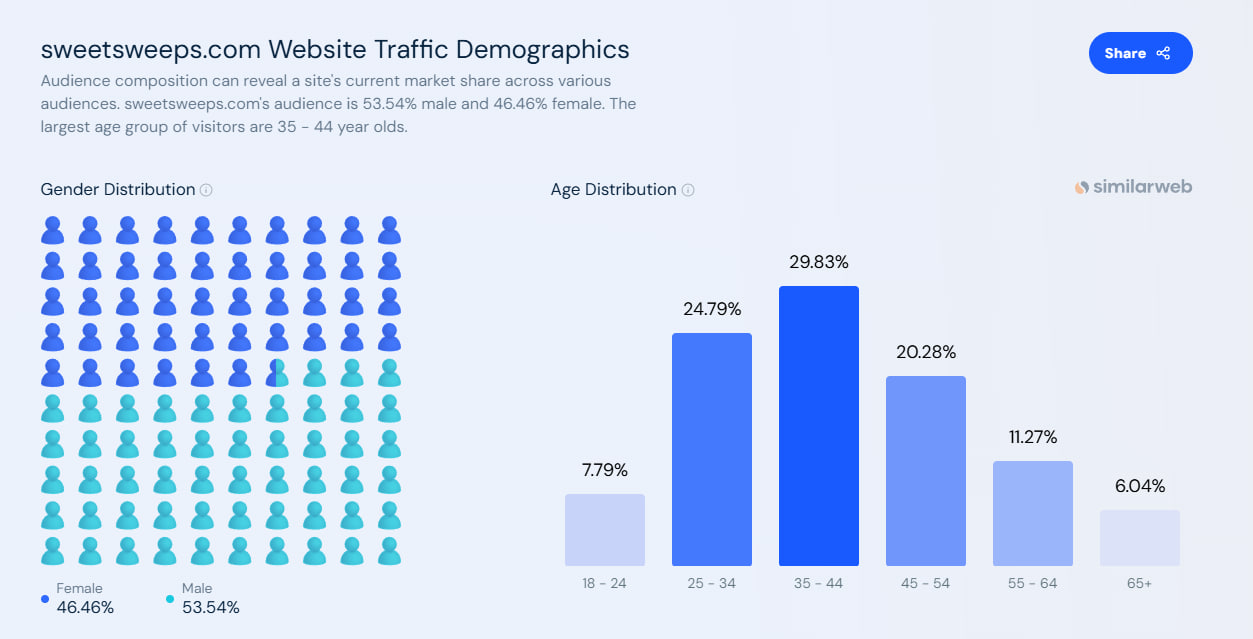
This is one of the most misunderstood parts of the industry. The audience often looks very different from traditional gambling audiences. When I pulled the Similarweb traffic demographics for sweetsweeps.com, the visitor base came back at 53.54% male and 46.46% female, almost an even split, which already breaks the assumption that sweepstakes casinos are a male-dominated gambling product. The age distribution surprised me even more. The largest single bucket is 35 to 44 year olds at 29.83% of traffic, followed by 25 to 34 at 24.79% and 45 to 54 at 20.28%. Combined, those three middle-age groups account for roughly three quarters of the audience. Only about 7.79% of visitors fall into the 18 to 24 bracket, and 6.04% are 65 and over.
1.7.2Where Those Players Actually Live
Demographics tell you who is playing. Geography tells you where the demand is concentrated and, more importantly right now, where it is being squeezed out by state law. The map below is the cleanest way I can show what happened in the U.S. sweepstakes casino market between late 2024 and early 2026.
Until 2025, the segment was a roughly $10 billion-a-year business in the United States, with California alone responsible for almost a fifth of that revenue and New York worth another $762 million in 2024 sales. Then the bans started landing. Montana went first in October 2025, California followed in January 2026 with AB 831, New York signed SB 5935A in December 2025, and Connecticut, New Jersey and Montana all locked the door behind them in the same window. On top of that, Washington, Idaho, Michigan and Nevada have effectively been off the table for years thanks to either felony anti-online-gambling statutes or hostile regulators who treat sweeps as illegal gambling.
Once you remove California and New York from the board, the center of gravity shifts hard. Texas and Florida are now the two undisputed hubs, and it is not close. Texas alone is estimated at around 10% of total U.S. sweepstakes revenue, roughly $1.4 billion in 2025, driven by 30 million people, no state-regulated online casino product to compete with, and a culture that already tolerates fantasy sports and skill-based real-money games. Florida is the same story with a different accent: 22 million people, no iGaming, a heavy concentration of casual gamers and snowbird retirees who skew exactly into the 35 to 64 sweepstakes core, and a regulator that has not (yet) moved against the segment the way New York or California did.
U.S. Player Distribution, Sweepstakes Casinos (2025-2026)
After the 2025-2026 ban wave, Texas and Florida are now the two undisputed hubs.
The next ring out, the medium-green tiles, is where most of the remaining U.S. revenue actually lives: Georgia, Pennsylvania, North Carolina, Ohio, Illinois, Tennessee and Virginia. Big populations, no friendly state iGaming option in most cases, and so far no enacted ban. If you are an operator, this is the map you have to wake up looking at every morning, because half of it is still moving.
1.7.3Why the Product Looks Cute by Design
That demographic context helps explain something that immediately stood out to me when I entered Sweet Sweeps itself. The platform feels cute. Bright colors. Friendly artwork. Soft design language. Playful mobile-game aesthetics. It does not resemble the dark, aggressive environment commonly associated with crypto casinos or high-risk gambling platforms.
And I do not think that is accidental. The visual language feels intentionally designed to create:
- familiarity
- comfort
- accessibility
- low psychological friction
1.7.4What That Audience Carries In With Them
That matters because many sweepstakes casino users are not necessarily traditional gamblers. Many come from:
- casual gaming
- mobile gaming
- Facebook-style game ecosystems
- entertainment-first platforms
And once you understand the audience, the product design of Sweet Sweeps starts making much more sense.
1.8 But for How Long Can Sweepstakes Casinos Keep Growing?
1.8.2The Regulatory Gap That Kept the Sector Underground
That is now one of the biggest questions surrounding the entire industry. Because despite the explosive growth of sweepstakes casinos, the regulatory environment is becoming significantly more complex. According to multiple legal and gaming industry reports published throughout 2025 and 2026, several U.S. states have begun reevaluating sweepstakes casino legality, while advertising restrictions and compliance expectations also increased.
1.8.3What Has Changed in the Last Few Years
A few years ago, the sector still felt relatively underground. Today:
- regulators know about it
- lawmakers know about it
- payment processors know about it
- advertising platforms know about it
- billions of dollars are now involved
1.8.4What This Means for New Operators
That does not necessarily mean the industry disappears. But it does mean operators entering the market today face a much more uncertain environment than they did a few years ago. The sweepstakes casino industry increasingly feels like a sector transitioning from:
- rapid experimental growth
- toward long-term regulatory maturation
And understanding where a platform sits within that transition is essential when evaluating operators like Sweet Sweeps.
Chapter 2: The Sweet Sweeps Field Test, What Happened When I Actually Played
That is the macro picture on US sweepstakes casinos. Now I want to zoom all the way in on a single operator and show what one of these platforms actually feels like when real money is on the line. I picked Sweet Sweeps for the deep field test because I had skin in the game on this one. I funded the account myself, played through the welcome bonus, hit the first KYC wall, ran the SC redemption flow end to end, and pulled a real USDT cash-out at the close.
Before I get into gameplay, I am going to do something most reviews skip. I am going to read the official rules and the Terms of Service first, because that is where the actual product lives. The marketing site sells you the vibe, the rules document sells you the deal.
From there I will walk you through the 200% welcome bonus math, the Gold Coin and Sweepstakes Coin economy, the quest system, the bonus area, the buying flow, the rollover requirement, the 30-day redemption window, the $5,000 cash-out cap, the VIP ladder, and the parts of the legal terms that quietly decide what happens if anything ever goes wrong. By the end of this chapter you will know whether Sweet Sweeps is a platform you want to play on, and just as importantly, you will have a checklist to run on every other sweepstakes site we ever touch.
2.1 Reading the Official Rules of Sweet Sweeps, and Where the Platform Starts Feeling Much More Serious
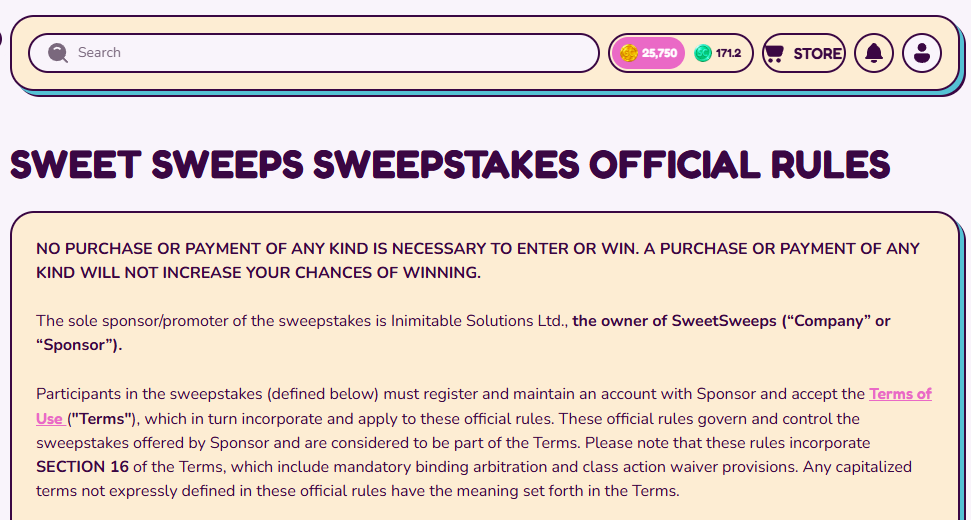
Sweet Sweeps sets the tone with candy-coded branding, but the official rules set the reality. From here on out, this is the platform we are actually testing.
2.1.1Why Most Reviews Stop at the Homepage
One of the biggest mistakes people make when reviewing sweepstakes casinos is stopping at the homepage. Cute graphics. Bonuses. Slots. Jackpots. Daily rewards. But the real product is hidden inside the rules. And when you actually begin reading the official sweepstakes terms of Sweet Sweeps, the platform immediately starts feeling less like a casual Facebook-style game and much more like a legally engineered American gaming product.
2.1.2Why the Rules Are Where the Real Story Lives
That distinction matters. Because sweepstakes casinos do not survive based only on marketing. They survive based on structure. And structure lives inside the terms.
2.2 The 200% Welcome Bonus, How the Numbers Work
2.2.1First Look at the Sweet Sweeps Store
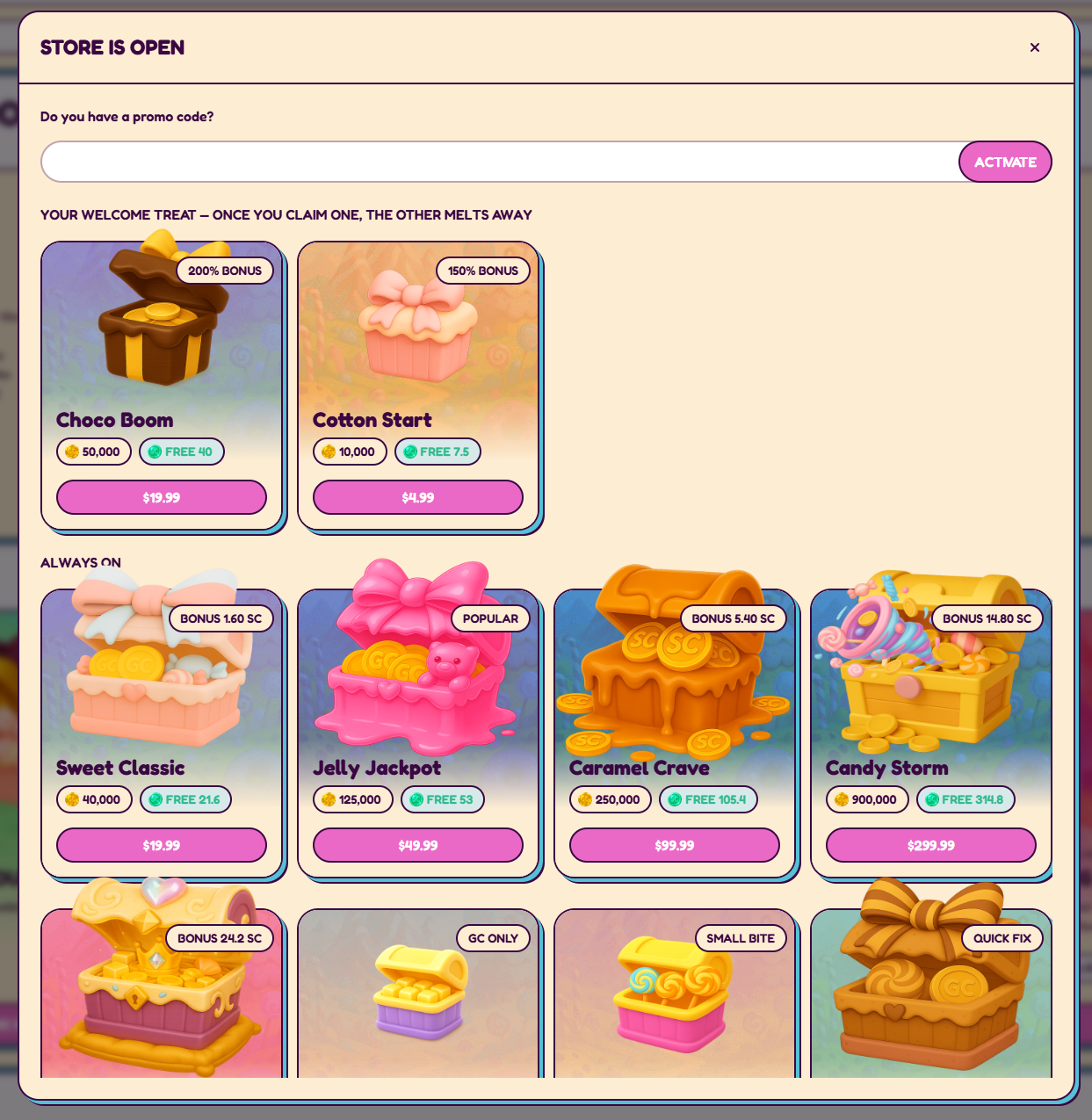
Now that we both understand the two-coin model, the welcome bonus is the easiest place to see it in action. The first time I opened the Sweet Sweeps store on a fresh account, this is the screen I landed on.
2.2.2Reading the Welcome Tile Itself
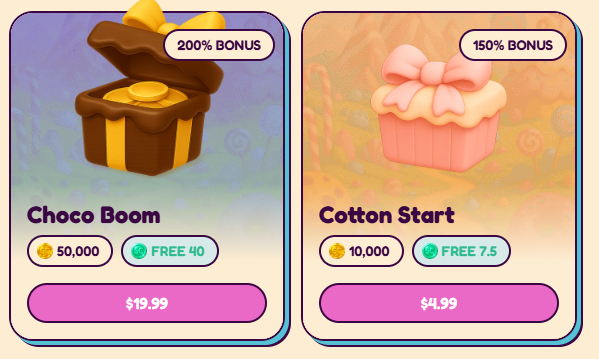
The top tile is the welcome treat. Choco Boom is $19.99 for 50,000 Gold Coins, with 40 free Sweepstakes Coins on top, tagged "200% BONUS." Beside it, Cotton Start is $4.99 for 10,000 GC and 7.5 free SC, tagged "150% BONUS." The line above both tiles reads, in caps, "ONCE YOU CLAIM ONE, THE OTHER MELTS AWAY," meaning a new account picks one of the two welcome packs and the other goes away.
2.2.3The Math Behind the 200% Tag
The math behind the "200% BONUS" tag is straightforward. SC carries roughly one dollar of face value per coin, so 40 free SC on top of a $19.99 Choco Boom purchase represents about $40 of sweepstakes face value, which is roughly twice the cash price of the pack. The "150% BONUS" tag on Cotton Start works the same way against its $4.99 price.
2.2.4What the Store Looks Like After the Welcome Closes
The welcome ratio applies to those two packs only. Once that window closes, the always-on store is what every new and returning player sees. Sweet Classic is $19.99 for 40,000 GC and 21.6 SC. Jelly Jackpot is $49.99 for 125,000 GC and 53 SC. Caramel Crave is $99.99 for 250,000 GC and 105.4 SC. Candy Storm is $299.99 for 900,000 GC and 314.8 SC. Running the same dollars-to-SC math on those, the SC face value works out to roughly 105% to 108% of the cash price across the always-on packs.
2.2.5What 40 SC Actually Means in the Rules
The other thing worth knowing is what the 40 SC actually represents inside the rules. Per Sweet Sweeps' Official Rules, SC has to be played through SC games before any of it qualifies for redemption, identity verification is required before any payout, it can take up to 30 days to process the payment of any redeemed prizes, and the maximum redemption per Sweepstakes Entry Period is capped (up to $5,000 in most states). Those rules apply to any SC inside the platform, welcome bonus or not.
Welcome ratio versus repeat ratio
The two pack types side by side, with the SC face value compared to the cash price.
$19.99 → 50,000 GC + 40 SC
- SC face value: ~$40 against $19.99 spent
- Tagged "200% BONUS" in the store
- Pick one of two welcome packs per account
- Available exactly once per account
$19.99 → 40,000 GC + 21.6 SC
- SC face value: ~$21.60 against $19.99 spent
- Roughly a 105% to 108% face-value ratio
- This is the everyday store after the welcome
- Repeats on every future purchase
2.3 The First Thing That Stands Out: This Is Clearly Built as a U.S. Product
2.3.1The American Legal Frame
The rules immediately frame Sweet Sweeps as a product designed specifically around the American legal environment. According to the platform's official sweepstakes rules:
The Sweepstakes is open only to legal residents of the United States (excluding California, Connecticut, Idaho, Louisiana, Michigan, Montana, Nevada, New Jersey, or the State of New York...)
2.3.2What the State Exclusion List Tells Us
That exclusion list is important. Because it immediately shows how fragmented and state-dependent the American gaming environment still is. Some states:
- heavily restrict sweepstakes models
- interpret promotional gaming differently
- have regulatory frameworks that operators may consider too risky
2.3.3The States Where Things Are Actively Tightening
And interestingly, some of the excluded states, like New York and Michigan, are among the states that increasingly scrutinized sweepstakes casino operations in recent years. This is one of the clearest signs that sweepstakes casinos are not simply "internet casinos." They are highly jurisdiction-sensitive businesses operating inside a constantly evolving legal environment.
2.4 Apparently I Am Also Not Supposed to Win Big Today
2.3.23The Affiliate-Eligibility Wrinkle
There was also a funny moment reading the rules. Because technically, I may already fall into a restricted category myself. The terms contain eligibility restrictions connected to affiliates, partners and associated persons. And since my agency is actively attempting to work with the brand, there is a reasonable chance I would not even qualify for major prize eligibility under the platform's own rules.
2.3.24Probably for the Best, Honestly
Which, honestly, is probably Sweet Sweeps' way of making sure I do not accidentally hit a max win while reviewing the platform. A tragic situation for journalism.
2.5 Sweepstakes Coins (SC), Where the Entire Model Changes
Two currencies, two completely different jobs
The dual-currency split is the legal and operational backbone of every sweepstakes casino.
The entertainment currency
- Purchased with real money, but has zero cash value
- Used to play games purely for fun
- No KYC, no redemption, no prizes attached
- Replenished as fast as you spend it
The promotional currency
- Always given as a free bonus, never sold directly
- Wins from SC play can be redeemed for cash
- Must be played through gameplay before redemption
- Triggers full KYC and the 30-day payout window
2.2.1What the Official Rules Actually Say About SC
The most important section in the rules is the explanation of Sweepstakes Coins, or SC. According to the official rules:
Sweepstakes Coins can only be used to play sweepstakes games for a chance to accumulate eligible Sweepstakes Coins that can be redeemed for cash and prizes.
2.2.2Why This Is the Legal Hinge of the Whole Category
This is the moment where the platform clearly separates itself from a traditional social casino. Because unlike old-school social casinos, the sweepstakes system introduces redeemability. That changes everything psychologically. The rules also explicitly state:
Sweepstakes Coins cannot be purchased under any circumstances.
2.2.3The Promotional-Sweepstakes Framing
And structurally, this is one of the most important legal pillars behind sweepstakes casinos. The platform positions SC as promotional sweepstakes entries rather than directly purchased gambling currency.
2.6 The "Free Entry" System Exists, but Let's Be Honest About How Practical It Is
2.6.1The No-Purchase Pathways That Exist
Like many sweepstakes casinos, Sweet Sweeps includes alternative methods for users to obtain Sweepstakes Coins without purchase. That includes:
- daily login bonuses
- social media giveaways
- referral systems
- promotional activities
- email or SMS bonuses
- a request-based sweepstakes entry system
According to the rules, users may obtain SC through:
- daily login rewards
- referral bonuses
- promotional quests
- social giveaways
- platform activities without purchase
2.6.2The Free SC Request, and What It Actually Looks Like
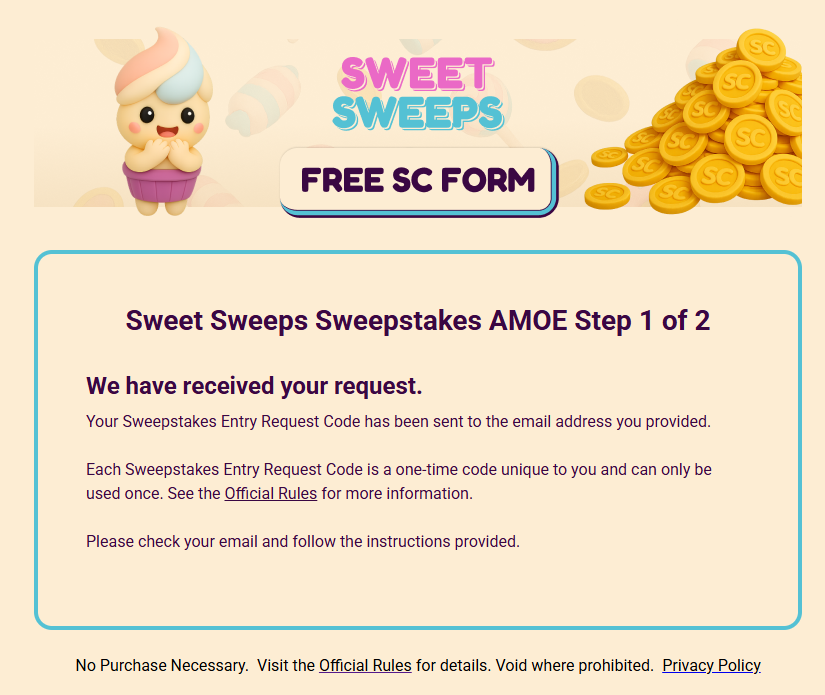
There is also a formal request mechanism allowing users to request Sweepstakes Coins, and I ran it myself to see what the experience actually feels like. I went through the official "Free SC Form", submitted the request, and within seconds got the on-screen confirmation that the entry was received and a one-time code was being emailed over. So the no-purchase pathway is not a paper concept on the rules page. The system is in place, the form is one click from the lobby, and the platform processes the request in real time.
The flow is throttled, though. Requests appear tied to narrow processing windows, often centered around Mondays, so a player who tries to live entirely on free SC will hit pacing limits fast. Reading that charitably, those limits are how the platform protects its own economy. The entire dual-currency model only works if most participants are also engaging with the broader ecosystem, the daily logins, the giveaways, the GC purchases that fund the operation. If the free pathway were uncapped and instant, a coordinated group with zero intent to participate could quietly drain the prize pool. The throttling is the business defending the model that lets the prizes exist in the first place, not a hidden gotcha.
2.6.3What AMOE Actually Is, and Who Powers It for Sweet Sweeps
I want to slow down for a second on those four letters, because AMOE is the entire reason this category exists legally in the United States. AMOE stands for Alternative Method of Entry. Under U.S. sweepstakes law, any promotion that hands out prizes of value cannot require a purchase to enter. If it does, it stops being a sweepstakes and starts looking like an illegal lottery. The fix is the no-purchase path, the AMOE, which has to be free, reasonably accessible, and offer the same chance to win as the paid path. Every sweepstakes promotion you have ever seen on a soda cup, a cereal box, or a casino website only stands legal because of an AMOE somewhere in its rules.
For Sweet Sweeps, the AMOE is not run in-house. The actual receipt and processing of free Sweepstakes Coin requests is handled by SCA Promotions through their EasyScan AMOE service. SCA Promotions is one of the long-standing third-party promotions and prize-fulfillment companies in the U.S. sweepstakes industry, and EasyScan AMOE is the specific product they sell to sweepstakes operators to handle the no-purchase entry pipeline end to end, the request capture, the entry codes, the unique identifiers, and the audit trail that regulators and lawyers expect to see if anyone ever asks how the free path actually works.
That detail matters more than it sounds. Because when an independent third party is wired into the no-purchase pathway, the operator cannot quietly turn it off, slow-walk it into uselessness, or pretend it works while it does not. Someone outside Sweet Sweeps is on the hook for delivering those entries. For us as players, that is a structural protection sitting underneath the entire SC economy, and it is one of the cleaner signals that the platform is taking the legal-foundation side of sweepstakes seriously instead of paying it lip service.
2.6.4The Practical Versus the Legal Pathway
So while the free participation pathway absolutely exists structurally, the practical user experience appears far more centered around the broader platform ecosystem:
- daily engagement
- retention systems
- coin package interactions
And this is where sweepstakes casinos become particularly interesting. Because legally, the no-purchase pathway matters enormously. Operationally, however, the mainstream user experience is clearly designed around continuous engagement with the platform itself.
2.7 The Most Important Rule in the Entire System
How Sweeps Coins actually become real money
The four-step path most players never read in the rules.
Buy Gold Coins
Receive free SC bonus
Play SC through games
Redeem for cash
2.7.1The Clause That Stopped Me Cold
This section immediately stood out to me:
Only games played with Sweepstakes Coins provide the opportunity to win additional Sweepstakes Coins that may be redeemed for cash and prizes.
And even more importantly:
Sweepstakes Coins that have been won through game play [...] may be redeemed for a prize.
2.7.2Why Free SC Alone Is Not Enough
This is a critical distinction. Because the rules are effectively saying: simply collecting free Sweepstakes Coins is not necessarily enough for redemption eligibility. The SC generally needs to pass through gameplay activity. And from a systems perspective, it is easy to understand why this exists. Without gameplay requirements, users could theoretically attempt to farm promotional distributions and immediately redeem them without meaningful platform engagement.
2.7.3The Psychological Lock the Rule Creates
So the platform creates a gameplay progression requirement before redemption becomes possible. But psychologically, this is also the exact point where the experience begins feeling much closer to gambling behavior than to a simple promotional giveaway. Because now gameplay, accumulation, risk, progression, and redemption potential become interconnected.
2.8 KYC Is Mandatory, and Anonymous-Casino Users May Hate That
2.8.1What the Rules Require
Another major operational difference between sweepstakes casinos and many crypto casinos is identity verification. According to the official rules, redemption requires identity verification and compliance procedures. That means KYC is effectively mandatory if users want to redeem prizes. For mainstream audiences, this may not feel unusual.
2.8.2Why That Feels Like a Wall to Some Players
But for users coming from crypto casino environments, where anonymity and instant withdrawals became culturally normalized, this can feel like a major friction point. And honestly, that tension says a lot about how differently sweepstakes casinos position themselves compared to offshore crypto gambling platforms. Sweepstakes casinos increasingly appear to operate closer to mainstream compliance-oriented consumer platforms than to anonymous gambling ecosystems.
2.9 The 30-Day Redemption Window, and Why It Exists
From "I won" to "money in the bank"
What the 30-day clause actually looks like in practice.
Hit a redeemable SC win
Submit KYC documents
Compliance and fraud review
Payout, up to 30 days
2.9.1What the Rules Actually Say About the Window
This was probably the section that concerned me the most operationally. According to the rules:
It may take up to 30 days to process the payment of any redeemed Prizes to you.
2.9.2What the Platform Itself Adds On Top
The platform also states that:
- identity verification may create delays
- prizes above $600 may require enhanced fraud reviews
- payments may be split into multiple sums
- processing times are not guaranteed
2.9.3Why Some of That Delay Makes Operational Sense
From a compliance perspective, some delay is understandable. Fraud prevention, identity verification, AML procedures, and payment reviews are all normal operational realities. But 30 days is still a very long time in modern online gaming expectations. Especially in a world where:
- crypto casinos normalize near-instant withdrawals
- regulated sportsbooks often process within days
- users increasingly expect immediate liquidity
2.9.4The Real Question for Big Wins
And this raises a much bigger question: If a player wins big, can they actually access the money smoothly? Because operational trust in gaming platforms is not built when users deposit. It is built when users withdraw.
2.9.5The Other Job the 30-Day Window Is Doing
To be fair to the operator side, that 30-day window is also doing a second job that benefits the model long-term. It gives the compliance team room to catch coordinated abuse, multi-accounting rings, and bonus-farming patterns that would otherwise quietly drain the prize pool that everyone else is playing for. Player frustration with the wait is real, and the operational reason it exists is just as real. Both can be true at the same time.
2.10 The $5,000 Redemption Cap, and the Business Logic Behind It
2.10.1What the Cap Clause Actually Says
Another clause that immediately stood out was this:
The maximum redemption of a prize won by a single Participant during any Sweepstakes Entry Period is limited to the value of US $5,000 in Florida...
2.10.2And the Companion Restriction
And importantly:
Any requested redemption in excess of the Maximum Redemption will not be paid during the period, but must be deferred until the next Sweepstakes Entry Period.
2.10.3What This Means If You Win Big
This creates a very important practical question: If a player wins significantly more than that amount, what actually happens operationally? Does the player still fully own the winnings? Can the money ultimately be redeemed over time? Does the cap only affect redemption timing? Or does it materially affect liquidity and user access to large prizes?
2.10.4The Wording Itself, Read Carefully
Because from the wording itself, the issue appears less about whether winnings exist and more about how and when they can actually be redeemed. And honestly, this is where sweepstakes casinos begin feeling very different from both:
- traditional social casinos
- fully regulated online gambling environments
2.10.5The Structural Logic Behind the Cap
The system starts revealing itself as something structurally unique:
- part promotional framework
- part gaming ecosystem
- part compliance-heavy redemption platform
- part casino-like engagement system
2.10.6Reading the Cap Charitably
Read charitably, the cap is the platform protecting the math that makes prizes possible at all. Without a per-period limit, a small group of players who only ever take free SC could in theory dominate redemptions while contributing nothing to the GC side that actually funds the operation. The cap, the gameplay-through requirement, and the slower payout window all push the system toward players who actually engage with the broader platform, which is the only way a dual-currency model can survive long-term. The friction has a job. It is keeping the prize pool real for the players who are actually playing.
To be specific, this clause does not really bite the regular paying customer. As I document in detail in section 2.21, the practical limits on a normal SC withdrawal are 999 SC per single redemption and 5,000 SC total per day. A player who is buying Gold Coin packages and redeeming SC at the natural pace would have to be on a serious heater to ever brush against the per-period $5,000 ceiling.
The clause is really aimed at the edge case where a user tries to live entirely on the free SC pathway, claiming daily logins and social giveaways, never participating on the GC purchase side that actually funds the operation, and then expecting to redeem like a paying customer. The dual-currency model can absorb a thin slice of that. It collapses if free-only redemptions grow large enough to dominate the prize pool. The cap is the lever that keeps the redemption economy tied to the player base that is actually buying in.
Key clauses worth knowing upfront
The operational realities every player should understand before depositing.
- Up to 30 days to process the payment of any redeemed prize.
- $5,000 cap per Sweepstakes Entry Period in Florida, with the rest deferred to the next period.
- Mandatory KYC before any redemption is processed.
- SC must pass through gameplay before it becomes redeemable, free coins alone do not qualify.
- "No purchase necessary" pathway does exist legally, daily logins, social giveaways, referral, and a request mechanism.
- Excluded states are listed openly in the rules, no pretending the product works everywhere.
2.11 Despite Being Based in Gibraltar, Sweet Sweeps Anchors Its Rules in American Law
2.11.1The Governing-Law Clause
One of the most interesting details buried inside the official rules is the governing law clause. Because despite the company operating from Gibraltar, a jurisdiction heavily associated with online gaming companies, the platform explicitly anchors the sweepstakes framework in American law. According to the official rules:
All issues and questions concerning the construction, validity, interpretation and enforceability of these Official Rules [...] shall be governed by, and construed in accordance with, the laws of the State of Delaware...
2.11.2Why That Choice Matters
That clause matters more than many users probably realize. Because it reinforces something we already started noticing throughout the rules: Sweet Sweeps is not positioning itself like a typical offshore gambling platform targeting Americans from outside the U.S. Instead, structurally, the platform appears heavily designed around the American sweepstakes framework itself.
2.11.3The Old Offshore Playbook
That distinction is important. Many offshore casinos targeting U.S. users historically relied on:
- weaker offshore jurisdictions
- minimal compliance structures
- anonymous, no-KYC offshore systems
- operational distance from American legal frameworks
2.11.4The Newer Sweepstakes Playbook
But sweepstakes casinos increasingly appear to be taking a very different approach. The model seems much closer to:
- consumer-promotion law
- compliance-oriented operational structures
- state-by-state legal positioning
And the Delaware governing-law clause reinforces that perception.
2.12 Time to Actually Test the Platform
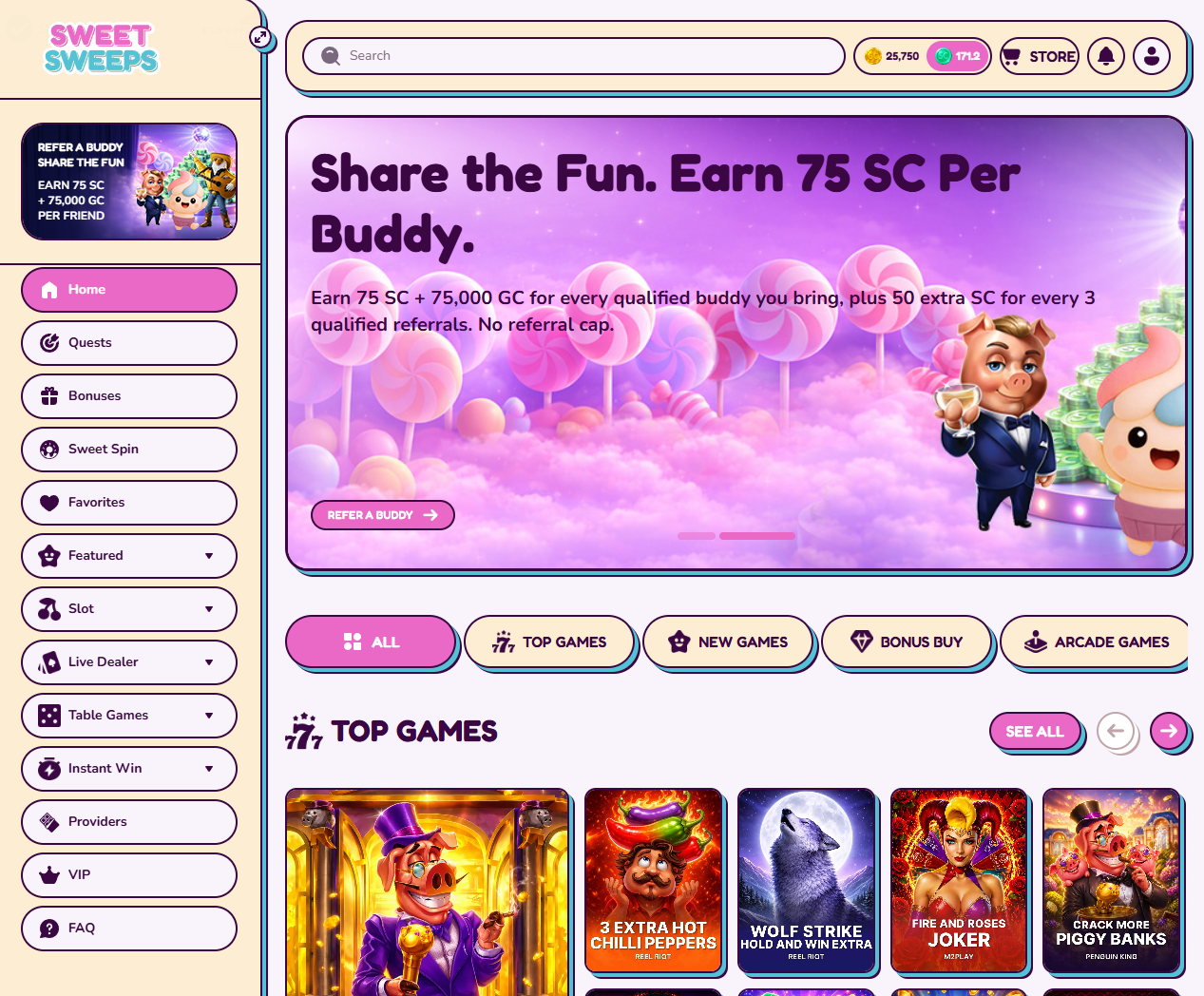
2.12.1Logging In With a Real Account
Theory is one thing. Actually using the product is another. And now it was finally time to interact with Sweet Sweeps directly. The team provided me with 250 Sweepstakes Coins so I could properly test the experience and evaluate how the platform behaves operationally. Naturally, my first instinct was simple: let's gamble.
2.12.2The KYC Wall Appears Immediately
But before I could even think about redemption or testing the full prize flow, another reality of the sweepstakes ecosystem immediately appeared: KYC. Unlike many crypto casinos that allow users to gamble anonymously with minimal verification, Sweet Sweeps appears heavily structured around identity verification and compliance procedures.
2.12.3What That Says About the Type of Product
And honestly, that alone says a lot about the type of product this is trying to become. Not a pure offshore gambling environment. Not a simple social casino either. Something much closer to a compliance-oriented American promotional gaming platform. So before the spins even begin, the first real operational test becomes very clear:
2.12.4The Question That Mattered Going In
How smooth, or painful, is the KYC process itself?
2.13 Hitting the First KYC Wall, Right Before I Could Spend a Cent
2.13.1The Modal That Blocks Everything Else
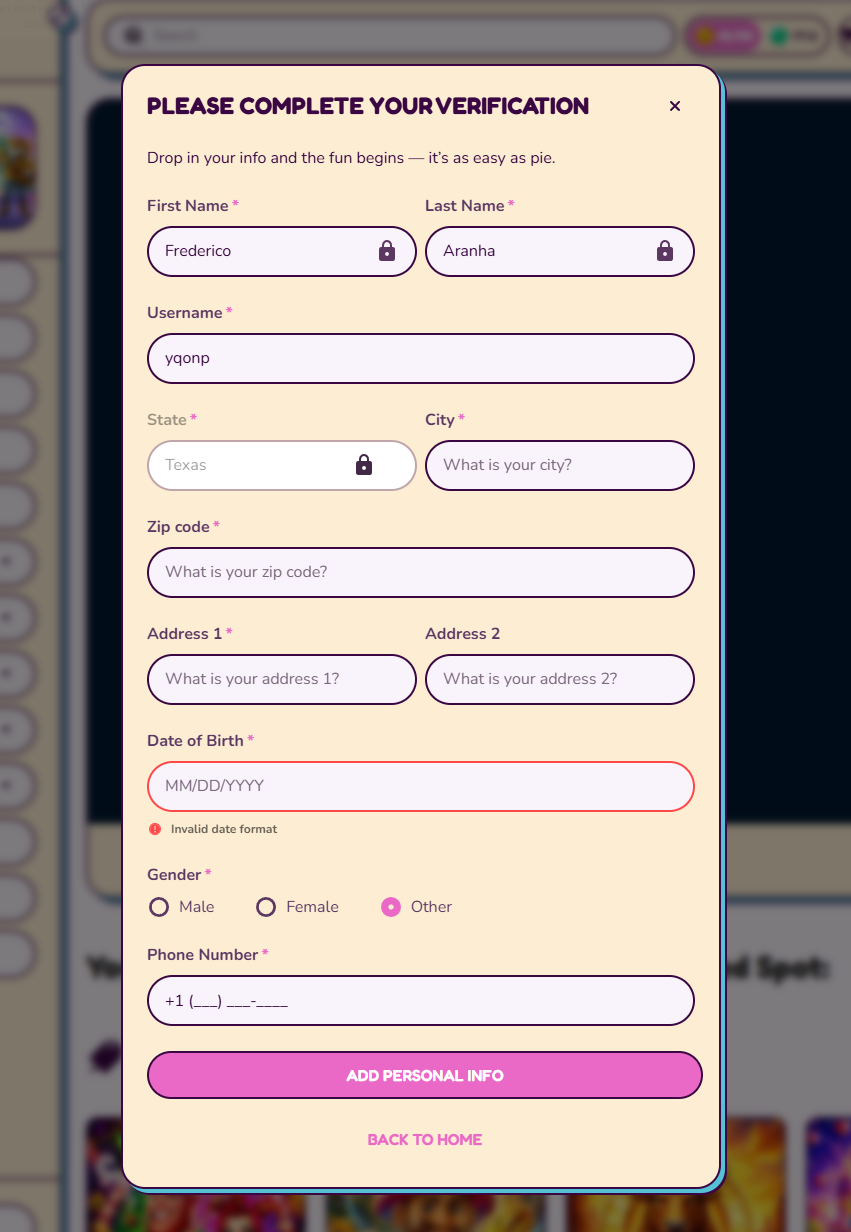
Before I could buy a single coin package, before I could deposit anything, before I could play anything beyond the free promotional games in the lobby, the platform stopped me at a verification modal. This is the first KYC barrier on Sweet Sweeps, and it shows up exactly where any compliance-serious U.S. operator would put it: at the gate between casual browsing and any kind of real-money interaction with the platform.
2.13.2Tier 1 Personal Information, Up Front
What is being asked here is essentially Tier 1 personal information, the kind of data any regulated U.S. financial-adjacent platform collects up front. A few things stood out to me as I worked through the form.
2.13.3What Was Locked, and What I Could Edit
First, several fields were already locked and pre-filled, marked with a small padlock icon. First Name, Last Name, and State in my case were all locked, which means the platform pulled them from earlier signup data and is treating them as identity attributes that cannot be casually edited later. That is the right behavior. If a player could change their legal name on the verification screen, the entire downstream KYC chain would be undermined, including the eventual prize redemption and the tax reporting that comes with wins above $600.
2.13.4The Identity Stack They're Asking For
Second, the still-open fields cover the standard mainstream-American identity stack:
- Username, the display handle, which is not part of identity
- City
- ZIP code
- Address line 1, with an optional Address line 2
- Date of birth in MM/DD/YYYY format
- Gender, with male, female, and other options
- U.S.-format phone number
2.13.5What This Modal Is Not (Yet)
Third, and this is important context, this modal is not the document-upload stage of KYC. There is no request for a passport, a driver's license, or a utility bill at this point. Sweet Sweeps appears to use a tiered approach, the kind that has become standard at compliance-oriented U.S. consumer platforms: collect the personal information first, then escalate to document verification later, typically when the player tries to redeem a Sweeps Coins prize. That sequencing is friendly to the casual browser who never tries to redeem, and serious for the player who actually does.
2.13.7What Unlocks Once You Submit
Once the personal information form is submitted, the platform unlocks the rest of the casino experience. From this point forward, I am no longer just a browser, I am a registered, identifiable U.S. participant with my personal information on file. The full document KYC, the Veriff biometric check, and the official verified status of my account do not happen yet, those land later at the redemption wall and I walk through that whole flow in section 2.19. Profile completion is the gate to play, not the gate to cash out. So with that profile wall behind me, the next thing I want to understand, before recommending anything to anyone, is how the coins actually behave once verification is done. How quickly does the GC balance drain in real play, how does the SC bonus arrive in practice, and what does the dual-currency loop feel like as an actual player rather than a rules reader.
2.14 The UI, And Why It Actually Took the Edge Off Real Stakes
2.14.1Opening My First Game and Realizing It Felt Different
The first thing that hit me when I opened a game on Sweet Sweeps was not the math, it was the feeling. I sat down with Sweet Rush Megaways by BGaming, set a 200 GC base bet, and pressed spin. The reels span. The candy machine wilds dropped. And nothing in my body went off.
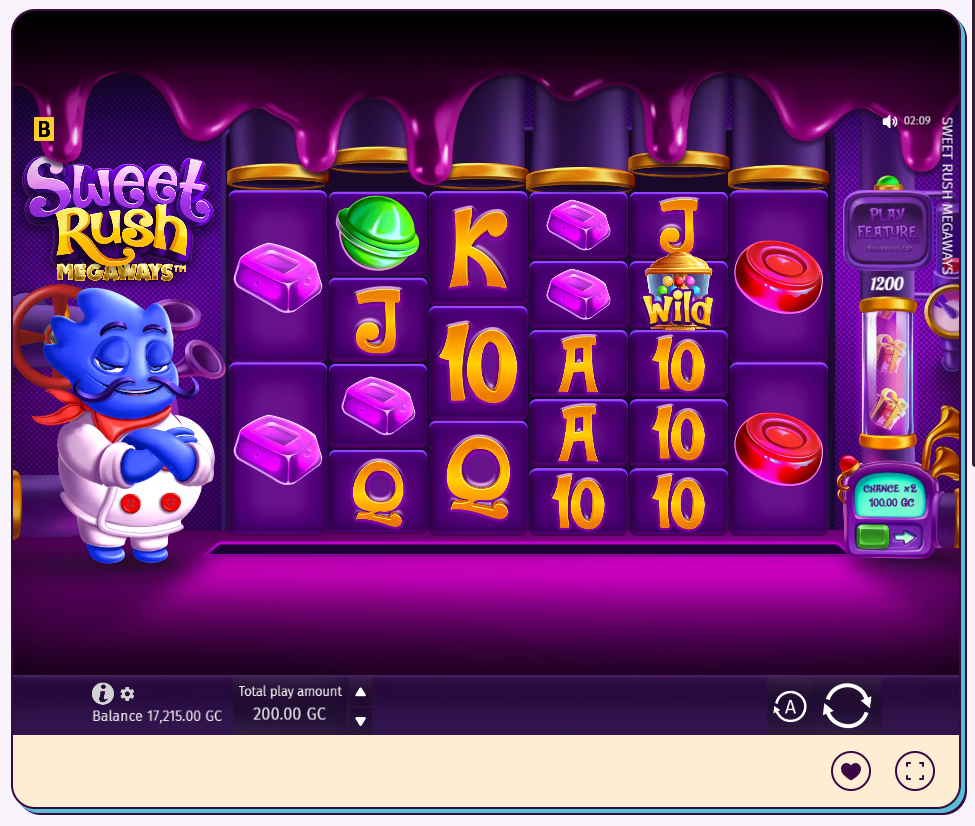
That sounds like a small thing. It is not. Anyone who has played real-money slots on a regulated FIAT casino, or on a crypto casino like Stake, knows that specific tension that lives in your stomach during the first few spins of a session. The "this is real money, this could go badly" hum. On Sweet Sweeps, playing in Gold Coin mode, it was just gone. I was looking at the reels, watching the math, enjoying the design, and not flinching.
That is the part that quietly matters about the dual-currency model. The UI is the same product the FIAT and crypto casinos sell us, the visual layer is just as polished, the games are real BGaming and Pragmatic and Hacksaw releases, but the emotional edge is dialed down by 90% the moment you are spinning Gold Coins. The pleasant surprise, for me, was how much that helped me actually pay attention to what the game was doing instead of how my pulse was reacting to it.
2.14.2Why Switching Currencies Might Actually Be a Discipline Tool
There is a real argument here for serious players, and it has nothing to do with the casino's marketing. Dopamine is the number one enemy of anyone who is gambling to actually win. Every consistent winner I know in any form of gambling, sports betting, poker, advantage play, has the same boring trait: they can stop. They can sit on their hands. They can fold or skip a bet without their nervous system melting down.
The dual-currency switch on Sweet Sweeps gives you a built-in cooldown lever you do not get on a normal casino. You can switch to Gold Coins, play the exact same game, on the exact same machine, with the exact same UI, and bleed the dopamine off without bleeding your bankroll. When the SC session is going badly and the chase reflex starts kicking in, flipping that toggle is a much smaller act of discipline than logging out of the site entirely. The product is quietly helping you do the hard thing.
I am not pretending the operator built this as a player-protection tool, they built it because the law required two currencies. But the side effect is real, and we should use it. Play with our heads so we don't pay with our pockets, that is the whole point.
I will circle back later in this article to the bigger picture, the marketing opportunities in this segment and the real challenges, including the trickiest one of all, how to bring players from established casinos like Stake into a sweepstakes product when the math on the slot side does not match. For now, let me keep walking through what the actual platform shows me.
2.15 The Game Info Card Tells You Everything Except the Most Important Number
2.15.1What the Public Game Card Shows You
When I clicked on a game tile on Sweet Sweeps, I got a properly built game info card. Provider, theme, volatility (high in this case), paylines (117,649), reel layout (6 by 7), max win multiplier (12,960x), plus a written description of how the bonus mechanic actually works. This is more game information than most regulated U.S. casinos surface on their main lobby page, and I want to give Sweet Sweeps credit for that.
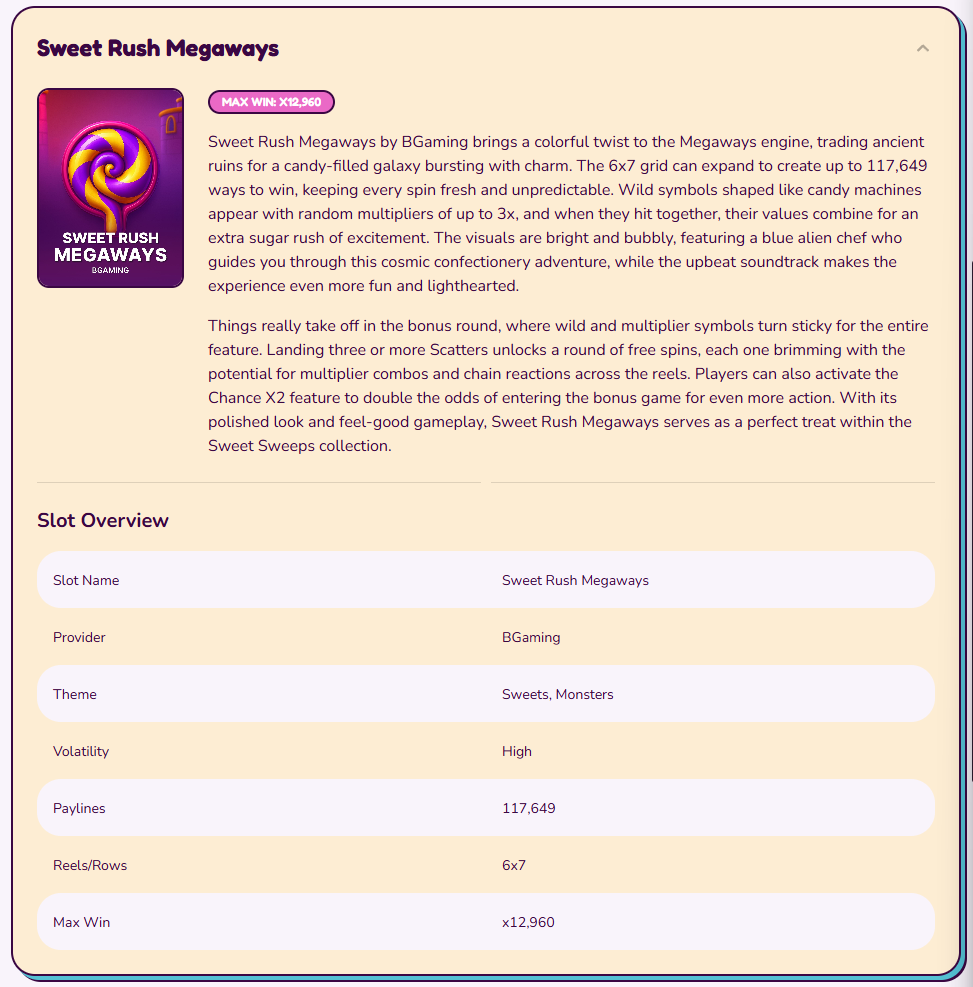
But there is one number missing from that overview table, and it is the number that actually matters more than every other field combined.
2.15.2The RTP You Have to Dig For
The RTP, return to player, the single most important math fact about any slot, is not on the lobby card and is not in the public game info modal. To find it, I had to launch the game, find the small (i) icon in the bottom corner of the in-game UI, open the Game Guide tab, and read it from the rules pane. That is two extra layers of friction between a player and the most important number in the entire product.
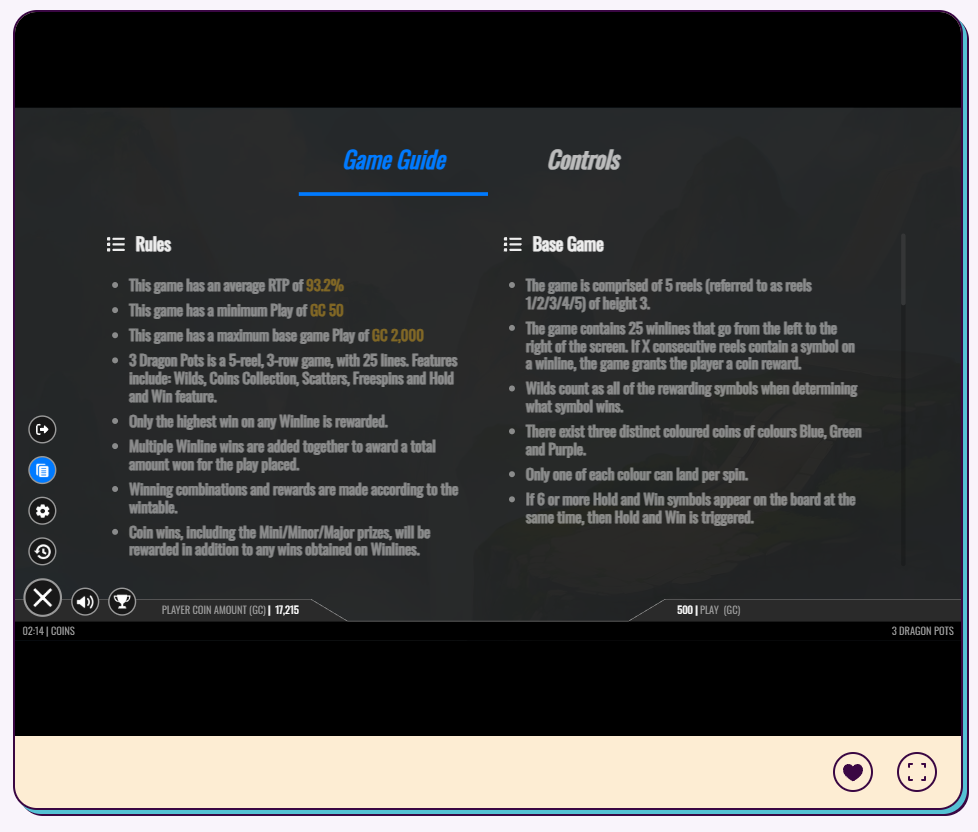
I do not think this is malicious. Most sweepstakes operators do this and most regulated U.S. casinos do it too. Provider terms, white-label aggregator design, and the simple fact that providers ship multiple RTP versions of the same game all push the RTP off the lobby. But once we know to look, we should look. And I did.
2.15.3Where Sweet Sweeps Sits Compared to Stake and Regulated Casinos
Once I started checking the in-game RTP across the Sweet Sweeps catalog, a pattern showed up that I had already started noticing in pieces all over the platform. The RTP versions running on Sweet Sweeps come in lower than what you would find at Stake, at any consolidated crypto casino, or at most regulated FIAT casinos in the U.S. and Europe.
A rough but honest range from what I checked across the lobby:
- Top end on Sweet Sweeps: roughly 96% to 98% RTP on a handful of premium titles, which lines up with the standard provider release.
- Middle band: a lot of titles sit in the 93% to 95% RTP range.
- Bottom end: I found games as low as around 91% RTP.
For comparison, on a casino like Stake or a serious regulated FIAT operator, you are usually looking at 96% to 97% as the floor on the same exact games from the same exact providers, with many slots sitting at 96.5% or higher and a small set above 97%. That means the same Sweet Rush Megaways or Sweet Bonanza you would play on a crypto casino can quietly cost you two to five extra percentage points of expected value when you spin it on a sweepstakes platform instead.
This is a serious problem when it comes to bridging traditional casino players to sweepstakes, and it is the math half of the challenge I mentioned earlier. The legal benefits are real, the player-protection benefits are real, the dopamine benefits are real, but if a player is comparing the exact same game side by side on Stake versus Sweet Sweeps, the math difference is loud and clear. That is a conversation we as a community have to have honestly, not paper over.
Are there upsides to a lower-RTP environment? Maybe. A higher house edge funds a real prize pool that the operator has to legally honor in cash. Lower RTP can correlate with higher hit frequency in some math models, which changes the play feel even if the long-run expected value is worse. And the entertainment-versus-investment framing is genuinely different when we are buying Gold Coins for fun and getting SC as the bonus, instead of depositing rent money. But honestly, we are not going to pretend a 91% slot is a good deal. Let's keep investigating.
2.15.4Live Dealer Games Are There, And They Pull the Average Back Up
The good news on the math side is that Sweet Sweeps has live dealer games in the lobby, and live games can meaningfully balance out the lower slot RTPs. Live blackjack played correctly sits at around 99.4% to 99.6% RTP. Live baccarat on the banker bet is around 98.94%. European-style single-zero live roulette is around 97.3%. Those numbers are basically baked into the rules of the game itself, and the operator cannot dial them down the way a provider can dial down a slot RTP.
That changes the picture for any player who is willing to bring some discipline to game selection. A bankroll spent mostly on live blackjack with a small allocation to slots looks completely different from a bankroll dumped entirely into 91% RTP candy slots. The same lobby that hides a few rough RTPs also gives us a path to play closer to the math we would get at a regulated table.
It does not solve the slot RTP problem. It does not erase the gap with Stake on the slot side. But it is a real, usable counter-balance, and it exists in the product today. If I am bringing a player over from a crypto casino, that's part of the pitch, and it is part of how we use this platform without bleeding edge to the house.
2.16 The Quests System, And What It Says About How Sweet Sweeps Keeps You Coming Back
2.16.1The Three Quests Sweet Sweeps Is Running Right Now
Once I had played a few games and stopped flinching at the reels, the next layer of the product I wanted to walk through was the Quests page. This is where Sweet Sweeps makes its retention play in the open, and it is worth reading carefully because the design choices here tell you exactly how the operator thinks about keeping a player engaged for thirty days at a time.
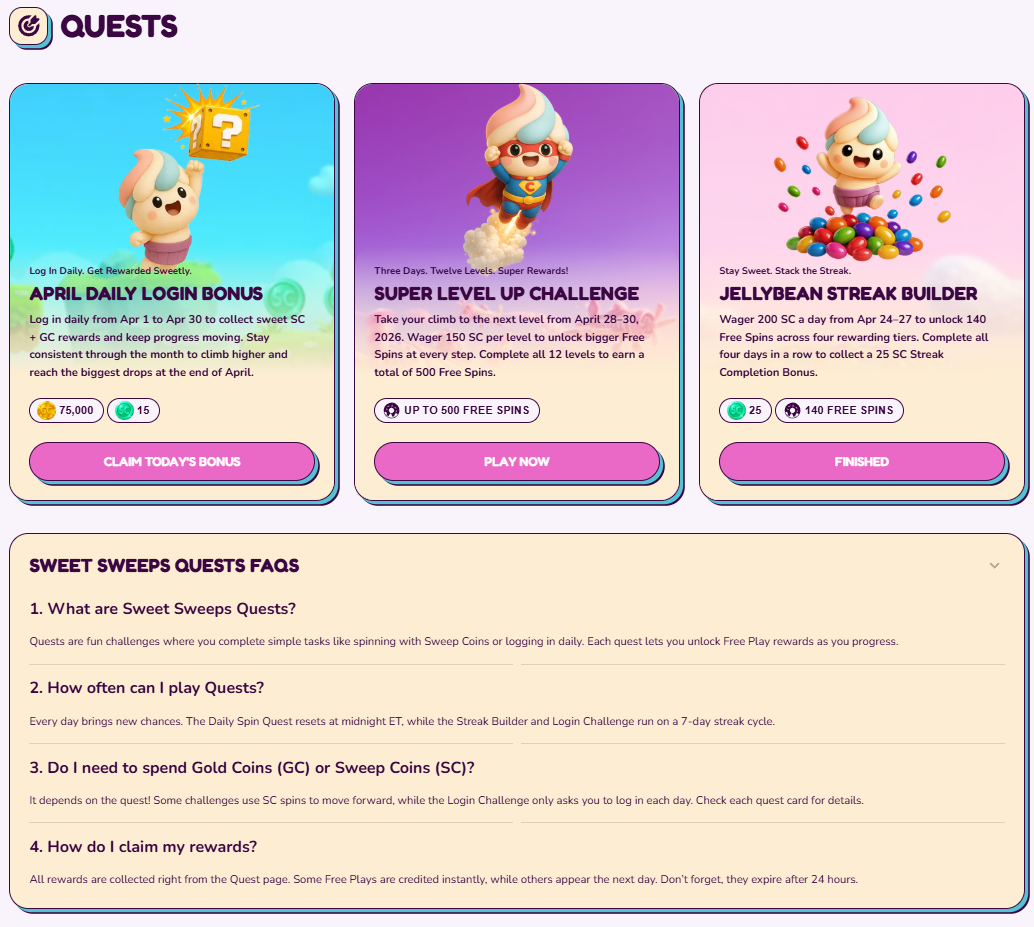
Three concurrent quests, all rewarding consistency, all pulling from the exact same playbook every modern free-to-play mobile game uses to drive daily active users. The Daily Login Bonus is the long burn (30 days). The Super Level Up Challenge is the short sprint (3 days). The Jellybean Streak Builder is the micro-streak (4 days). Different durations, same goal: get me opening the app every single day.
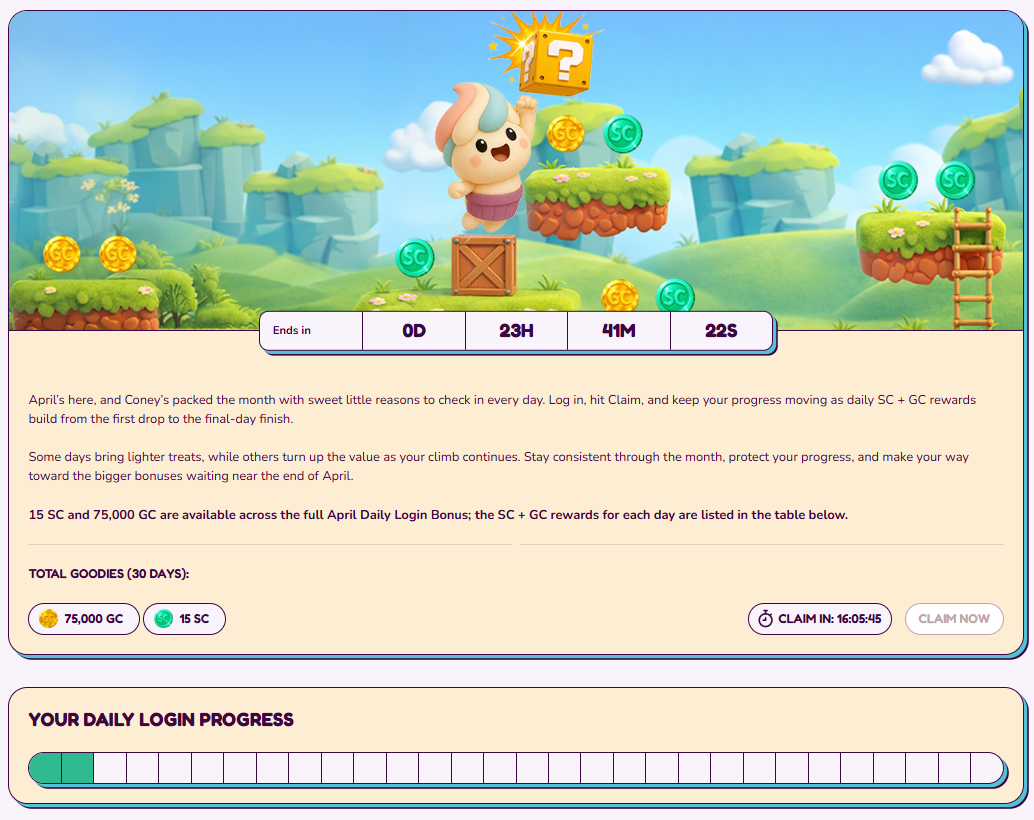
I claimed mine the moment I landed on the page, and the Gold Coin drop hit my balance on the spot. Honestly, the GC side of the daily login is a very good boost. A player who shows up every day across the full month pulls 75,000 Gold Coins out of just clicking Claim Today's Bonus, on top of 15 Sweepstakes Coins. For a player using Sweet Sweeps the way it is designed to be used, mostly on the entertainment side, that GC drip alone is more than enough to keep playing without ever buying a coin pack.
2.16.2The Daily Login Tier Table, And Why The SC Numbers Are So Small On Purpose
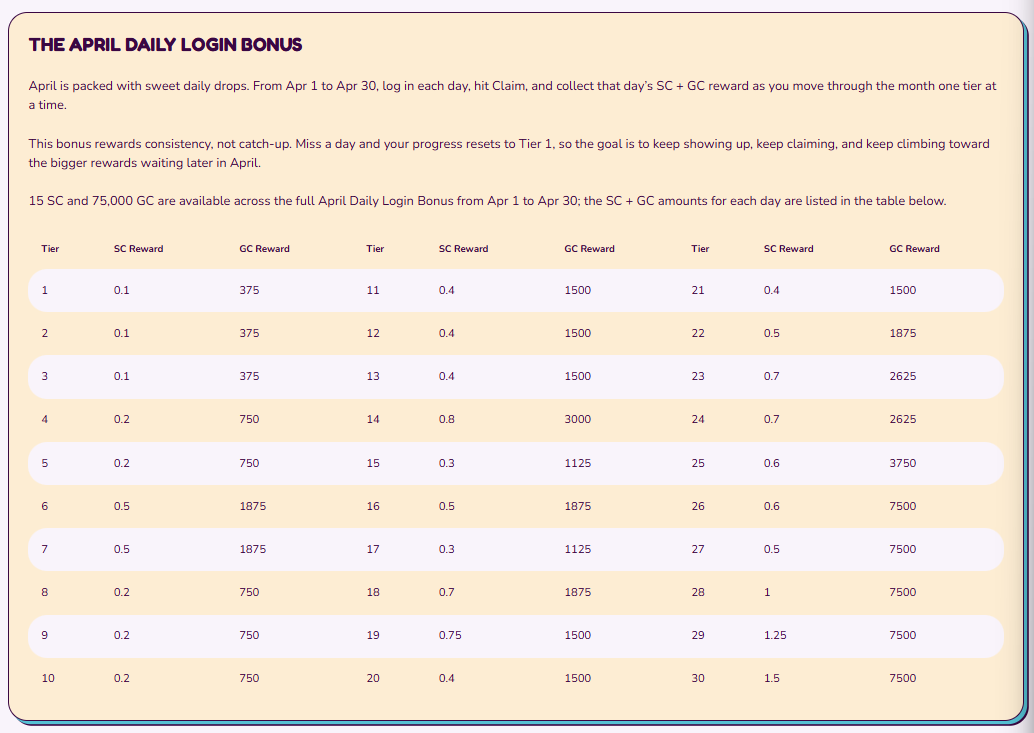
Now look at the actual numbers. Days 1 through 3 give you 0.1 SC and 375 GC. The middle of the month sits in the 0.3 to 0.8 SC range with 1,500 to 3,000 GC. Day 30 lands at 1.5 SC and 7,500 GC. Total over thirty days: 15 SC and 75,000 GC.
Fifteen Sweepstakes Coins for thirty days of consecutive logins. That sounds tiny, and it is, but it makes complete sense the moment you remember what SC actually is. SC is real money once it is redeemed. Every fraction of a Sweepstakes Coin the platform hands out is a real liability sitting on the operator's books, and every SC spin a player makes carries a real cost from the game provider, because providers take their cut on SC volume the same way they would on real-money volume in a regulated casino. GC, on the other hand, is the entertainment layer with effectively zero cash exposure. Pumping the GC numbers up while keeping the SC trickle small is just better business, and I would do the exact same thing if I were running this casino.
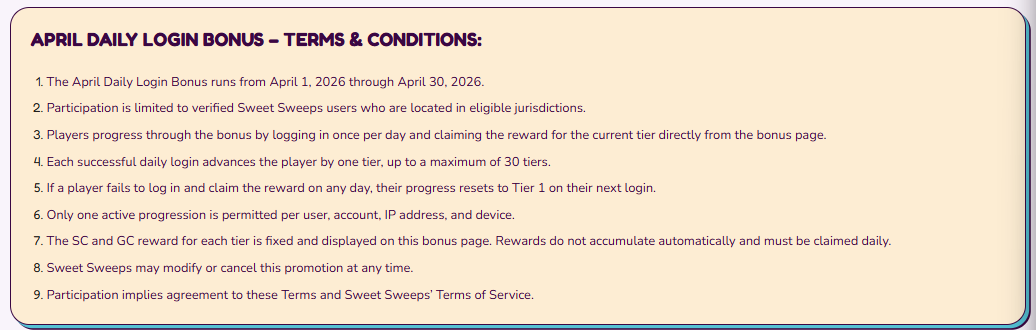
The terms make the retention loop explicit. Miss a single day and you are back to Tier 1. That is not a "miss a day, lose a day" rule, that is a "miss a day, lose the entire ladder you climbed". The structural payoff sits at the end of the month with the 7,500 GC days and the 1.5 SC finale, so the reset penalty is enormous relative to the daily ask. This is exactly the same psychology mobile games use with energy systems. The daily streak in Duolingo. The daily quest in any battle pass. The login bonus in every gacha game on the App Store. The friction of starting over is doing the heavy lifting, not the size of any single reward. We should know that walking in.
2.16.3The Coney Super Level Up Challenge, And The Math It Does Not Show You
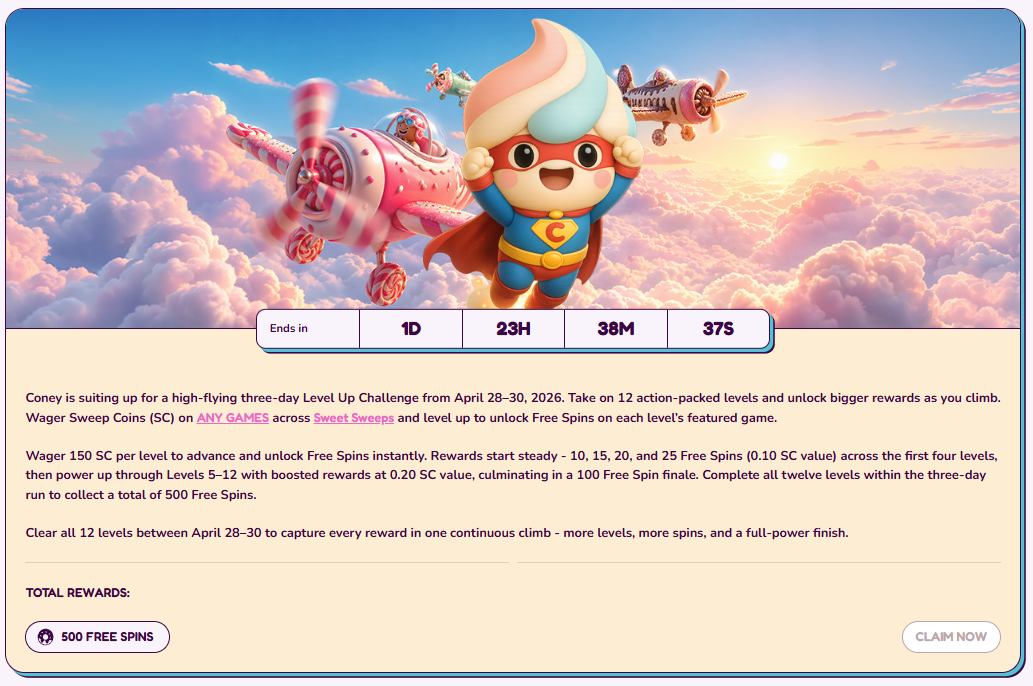
The Coney Super Level Up Challenge runs on the same retention logic as the daily login, just compressed into a brutal 3-day window with a much harder ask. Twelve levels in 72 hours, 150 SC of wagering per level on any game, climaxing in 500 Free Spins for clearing the full set. Same playbook, different time pressure.
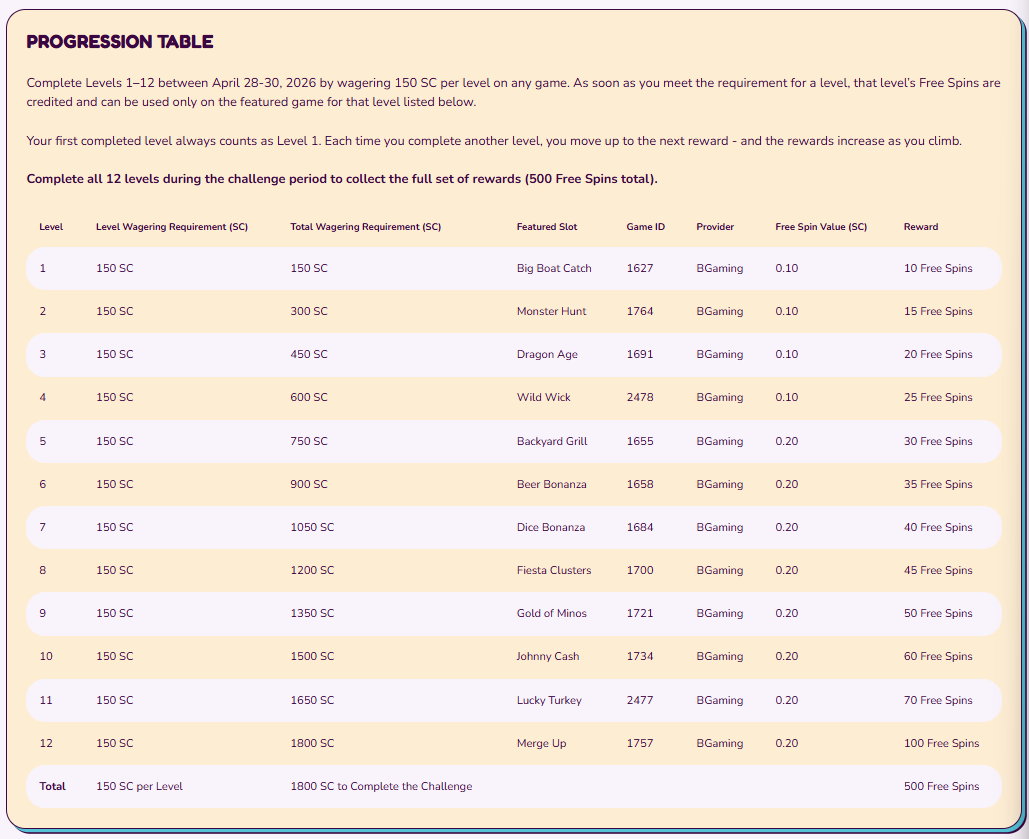
Now let's actually run the math, because this is where the RTP point from the previous section lands hard. To clear the full 12 levels, you have to wager 1,800 SC across the catalog. At the slot RTPs we just looked at, somewhere between 91% and 96% on most Sweet Sweeps titles, your expected loss on 1,800 SC of wagering sits anywhere from about 72 SC at the friendly end to 162 SC at the rough end, with most realistic catalogs landing in the 100 to 130 SC range.
What do you get back at the top? Five hundred Free Spins, with a face value of 0.10 SC on the first 70 spins and 0.20 SC on the final 430. Total face value: roughly 93 SC of free play. Then those 93 SC of free play are themselves subject to the same slot RTP, so the actual cash-equivalent return on the spins is closer to 85 to 90 SC.
Stack that up. The player wagers 1,800 SC, expects to lose somewhere around 100 to 130 SC of it during the climb, and earns back roughly 85 to 90 SC in free spin value at the end. In expectation, the challenge is a small negative-EV transaction sold as a positive-EV opportunity. The variance is huge, the entertainment is real, the dopamine of climbing a 12-level ladder is by design, but the long-run math is the math, and we have to know it walking in.
To be totally fair to Sweet Sweeps, this is structurally identical to almost every wagering challenge run by every regulated casino on Earth. It is not a Sweet Sweeps trick, it is the category. But because we are the math people on this site, we are going to flag it every time we see it. Play the challenge for the dopamine and the entertainment if you want, just do not play it because you think the spins at the end are paying for themselves.
2.16.4The One Number Missing From Every Quest Page, And Every Purchase Pack
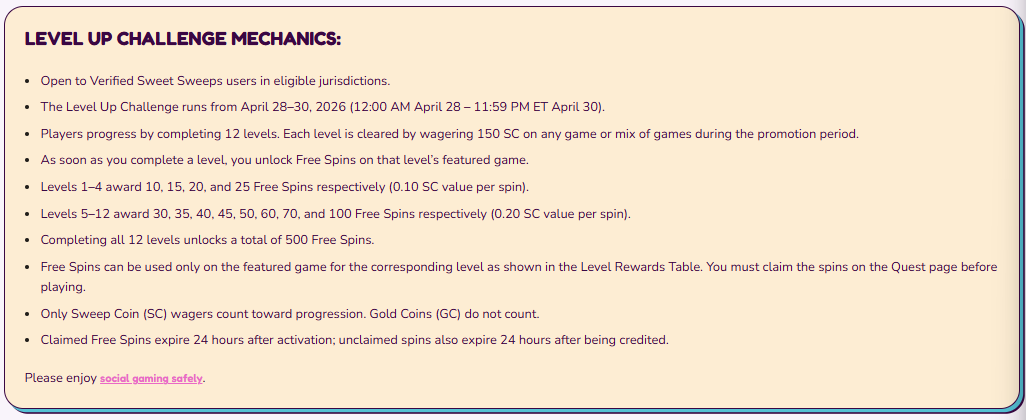
This is the part I want to single out across the entire Quests system, and across the store too. The rollover is missing. The mechanics block tells you exactly how to qualify for the Free Spins, exactly how much SC you have to wager to unlock each level, exactly what each spin is worth, and exactly when those spins expire. What it does not tell you, anywhere on the quest page, is the playthrough requirement on any SC you eventually win from those Free Spins before you can redeem it. I will come back to this in section 2.20, where the actual rollover number on bonus SC finally surfaces from a support chat, but on the quest page itself, in the moment a player is deciding whether to chase those Free Spins, the number that decides whether any SC ever becomes redeemable is simply absent.
I went back to the store's purchase pack pages to confirm this was not just a quest issue. Same gap. I can buy a Gold Coin pack and see exactly how much GC and how much bonus SC I will receive. What I cannot see, on the buy screen, is the playthrough or rollover the SC has to clear before any of it becomes redeemable.
For a category that is built entirely on the legal distinction between play money and redeemable prize currency, the playthrough rule is arguably the single most important number a player needs to see before they hand over a credit card or grind a quest for three straight days. It usually does live somewhere, in the official Sweepstakes Rules, in a buried FAQ, or in a support article. But it should be on the same screen as the offer, in the same font as the offer, every single time. And right now, on Sweet Sweeps, it is not.
I will come back to this in the verdict at the end of the review (2.2 What Gets Wrong). For now, it is the loudest disclosure flag I have hit in the product so far, and it is the kind of detail that separates a casino I can recommend with confidence from one I have to recommend with conditions.
2.17 The Bonus Area, and Why It Already Feels Different from a Traditional Casino
The bonus area is genuinely one of my favorite parts of Sweet Sweeps, and it took me a minute to figure out exactly why. At a traditional online casino the equivalent screen is filled with reload offers, deposit-match bonuses with brutal wagering, and demo modes where I am playing with fake money that means nothing. Here the math flips. I am not topping up a real-cash balance with strings attached, I am collecting Gold Coins to play with for fun, and I am collecting Sweep Coins as the actual upside. That feels meaningfully less risky, and at the same time more exciting than a demo, because the GC plays still trigger the same slot mechanics, the SC drops still carry real cash-out value, and the dopamine engine is running without me having to push real money through the door. From a player-protection seat, that is also genuinely a healthier loop to learn a slot or a table game on before we ever buy SC.
2.17.1The Generosity Side
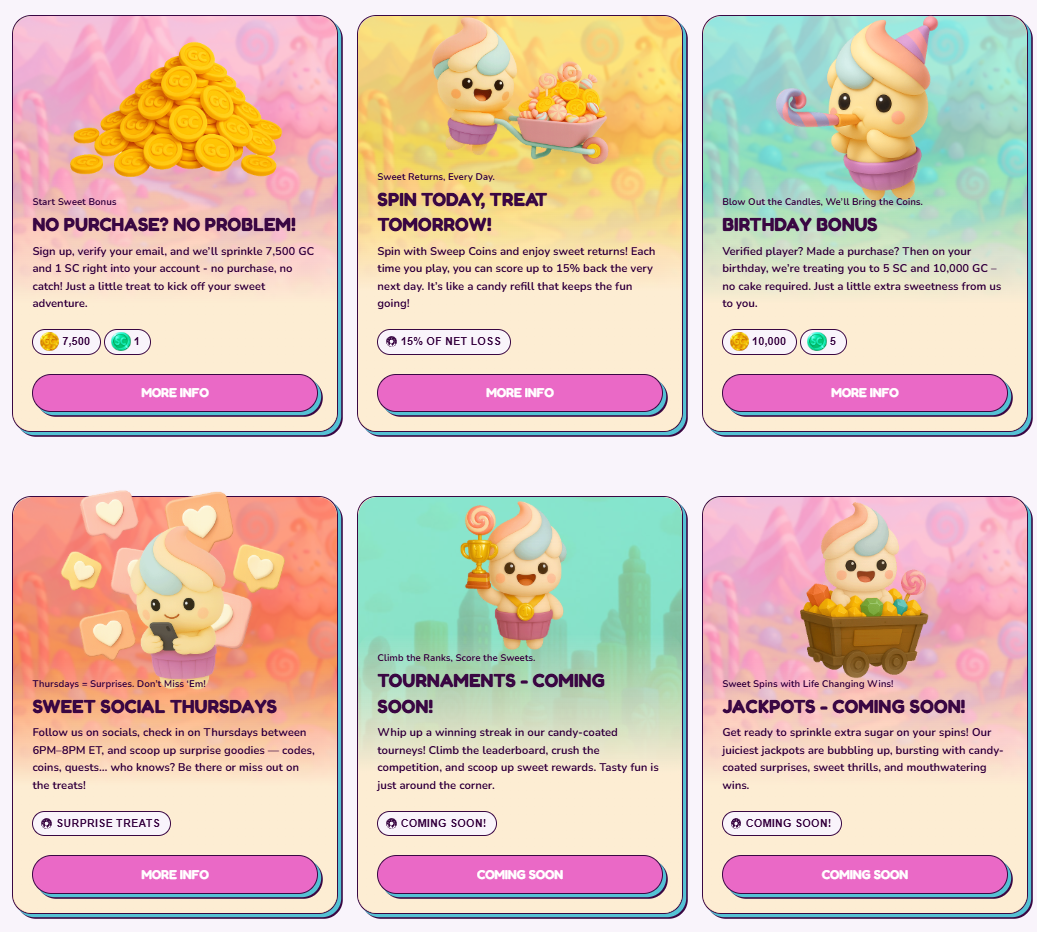
The first thing that hits me is how much they hand out for very little. Verifying your email at signup nets 7,500 GC + 1 SC, no purchase required. A verified birthday lands 10,000 GC + 5 SC on the day. And "Spin Today, Treat Tomorrow" returns up to 15% of your daily SC net loss the next day, which is essentially a built-in cashback that softens variance for free. None of these are huge in absolute SC terms, but together they are doing the heaviest selling job for me, because they show an operator that is comfortable putting coins in front of players before asking for anything in return. Generous operators in this category are not the norm.
2.17.2Social Engagement Gets Rewarded Too
Sweet Social Thursdays drops surprise codes, coins and quests on the social channels between 6PM and 8PM ET if you follow and check in. Anyone who has ever tried to grow an audience on Instagram or X knows how hard it is to make people care enough to show up at a specific window of time, and rewarding the players who do show up is good business and good community-building. I respect when an operator pays attention to that loop instead of just buying impressions.
2.17.3The Heavier Hitters: Sweet Start Packs and Bring a Buddy
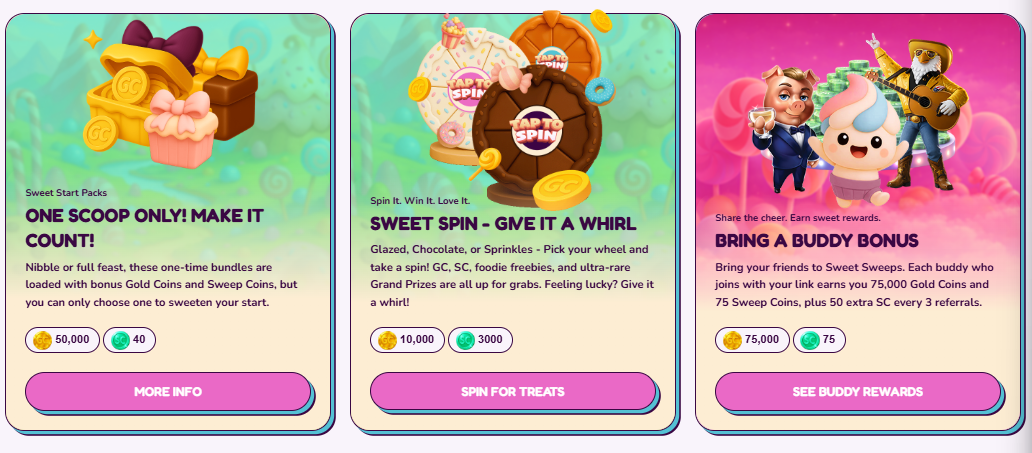
Two of the bigger offers sit one step above the freebies. One Scoop Only, the Sweet Start Pack, is a one-time bundle loaded with 50,000 GC + 40 SC, designed as the player's single chance to load up early. Bring a Buddy pays 75,000 GC + 75 SC per friend who signs up via your link, plus an extra 50 SC every 3 referrals on top. Bring a Buddy is the most rewarding promo on the page if you actually have an audience, and for somebody like me whose entire job is talking to players publicly, a referral structure that pays in real-cash-equivalent SC is significantly more interesting than a typical casino's affiliate page.
2.17.4Sweet Spins, the Sweet Sweeps "Original Game"
Sweet Spin sits in its own category, and the cleanest way to describe it is that it is the Sweet Sweeps equivalent of an "original" game. At a crypto-native casino like Duel, "originals" are platform-exclusive games such as Plinko, Keno, Crash and Mines that the operator builds in-house, runs on its own RTP and RNG, and uses as a brand-identity layer separate from third-party providers. At Sweet Sweeps, Sweet Spin plays exactly that role. It is a wheel you can spin in three flavors (Glazed, Chocolate, Sprinkles) for GC, SC, foodie freebies and ultra-rare Grand Prizes (the displayed top prize is up to 10,000 GC + 3,000 SC). It is not a slot from BGaming or Hacksaw, it is the operator's own promotional game, and that is genuinely a smart bit of product design because it gives the platform something nobody else in the catalog can offer.
2.17.5Coming Soon, Tournaments and Jackpots
Two more offers are already on the page in "Coming Soon" status. Tournaments will run leaderboards across the catalog with sweet rewards for the top finishers, and Jackpots will add network-wide progressive payouts to the slot lineup. I am holding judgment on both of these until they actually launch and I can run the math, but the fact that they are publicly on the roadmap, alongside the live offers above, signals an operator that wants to keep its promo deck deep enough to compete with the bigger names in the category.
2.18 Buying Sweet Spins, the UX Issue I Hit, and the Quiet Surprise About Gold Coins
After running through the slots and looking around the catalog, I went into the Sweet Spin area and bought my first spin. As I said in 2.17, Sweet Spin is the closest thing Sweet Sweeps has to an "original" game, the wheel is platform-exclusive, and that makes it the most interesting product surface to actually test under load. So I tested it, and what came back was a mix of one good UX flag, one strong piece of math transparency, and one quiet surprise about Gold Coins that I did not see coming.
2.18.1The Three Wheels and What They Cost
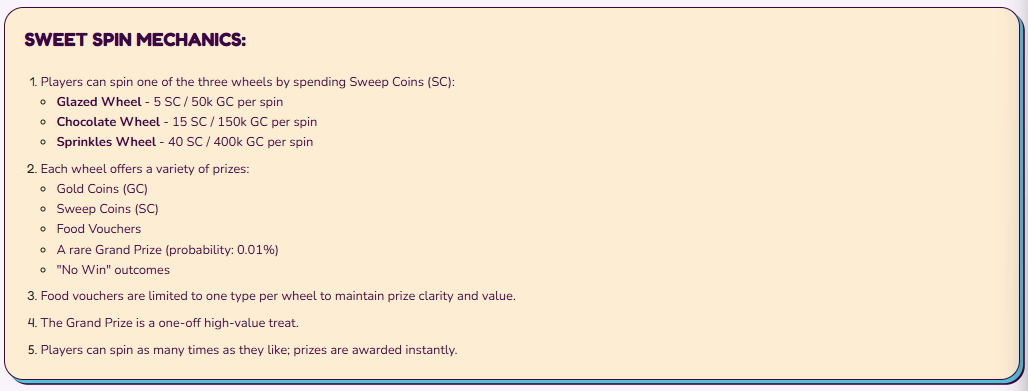
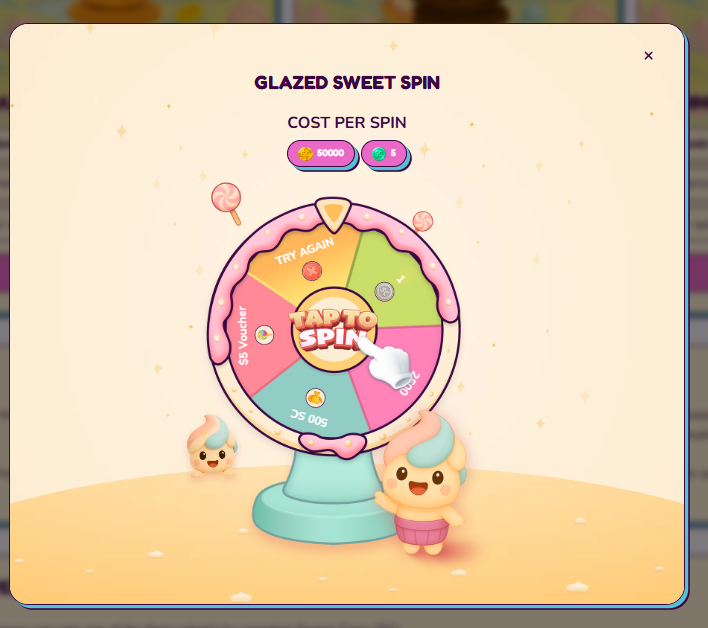
The Sweet Spin product is built around three wheels at three price tiers: Glazed at 5 SC or 50,000 GC per spin, Chocolate at 15 SC or 150,000 GC per spin, and Sprinkles at 40 SC or 400,000 GC per spin. Each wheel pays out Gold Coins, Sweep Coins, food vouchers, a rare Grand Prize at 0.01% probability, or a "No Win" outcome. Food vouchers are limited to one type per wheel to keep prize identity clear, and spins are awarded instantly. The price ladder mirrors the slot SC-bet ladder almost exactly: light recreational spinning at Glazed, mid-stakes at Chocolate, high-roller territory at Sprinkles.
2.18.2The Currency Substitution Issue, and the Balance Refresh Lag
Here is where I hit my first real UX flag on this product. The cost per spin is shown as "50,000 GC and 5 SC" in the same modal, which is technically accurate, the spin can be charged in either currency, but the wording does not make it obvious that it is one OR the other. I started spinning even though my GC balance was below 50,000. The system did not stop me. It silently switched and started charging my SC balance instead. That is fine in principle, charging the alternate currency when the primary one runs out is a reasonable fallback, but it is not explicit, and Sweep Coins have real cash-out value where Gold Coins do not, so silently substituting SC for GC is the wrong direction for player protection.
The second issue compounds it: the live balance does not update inside the spin modal. I had to close the game and reopen it to see the actual SC balance after spinning. So in the moments I was burning SC instead of GC, the modal was telling me nothing about it. This is fixable in one product cycle. A confirmation dialog of the form "You do not have enough GC, this spin will be charged in SC" plus a live balance ticker inside the modal would close both gaps. To Sweet Sweeps's credit, the substitution is not hidden in the Terms, but it should also be in the UI, in front of the player, every spin.
2.18.3The Glazed Wheel Math
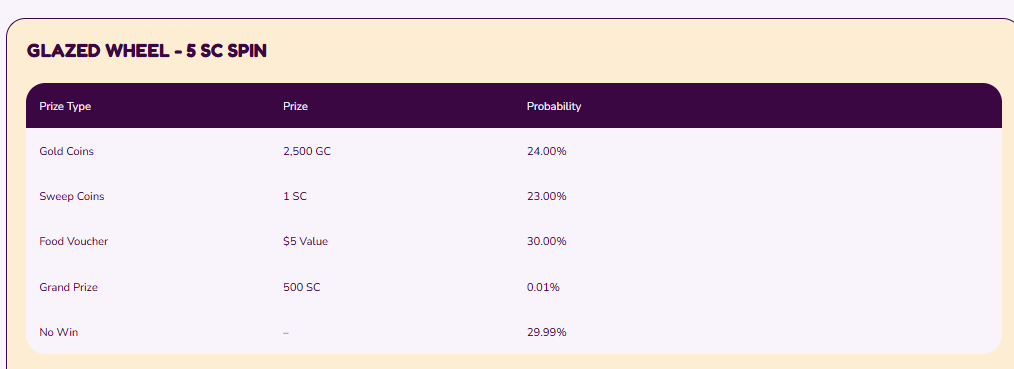
This is where Sweet Sweeps does something genuinely transparent that most casinos in this category do not: they publish the actual odds in the open. The Glazed Wheel, played at 5 SC per spin, has the following prize ladder: 24.00% chance of 2,500 GC, 23.00% chance of 1 SC, 30.00% chance of a $5 food voucher, 0.01% chance of the 500 SC grand prize, and 29.99% chance of "no win".
The straight SC math is brutal in isolation: 0.23 × 1 SC + 0.0001 × 500 SC = 0.28 SC of expected return on a 5 SC spin, about a 2.6% SC return rate. The Gold Coin math in isolation: 0.24 × 2,500 GC = 600 GC of expected return per spin, which against a 50,000 GC cost is about a 1.2% GC return. Both currencies are heavy losers if you only count the coin payouts. But there is a third asset on this wheel that changes the entire shape of the math.
2.18.4The Quiet Surprise, Gold Coins Have Real-World Value Through Food Vouchers
The food voucher is the part nobody talks about, and honestly it is the most interesting thing on this whole page. A 30% chance of a $5 voucher works out to $1.50 of real-world value per spin on average, regardless of which currency I paid with. In GC mode that means each 50,000 GC spin returns roughly $1.50 of food value as expected return, which is another way of saying that 1 million Gold Coins cash out to about $30 of real-world food. That is not a fortune, but it matters, because in most sweepstakes platforms Gold Coins are pure entertainment currency with literally zero cash-out path. Here they have a path, even if it is a small and food-shaped one.
That single design choice is why I respect this product more after running the math than before. Sweet Sweeps built an "originals" surface that pulls its own weight, gave Gold Coins a real-world utility they almost never have anywhere else, and published the odds so we can do this exact math ourselves before spinning. The UX issue I flagged in 2.18.2 still needs fixing, and I revisit it in 2.29.2 (What Sweet Sweeps Got Wrong) at the end of this chapter, but the underlying product design is more honest than it looks on first glance.
2.19 Saying Goodbye, KYC With Veriff, and a Quick Tour Through Sweet Sweeps Support
I went to log out, and before I left I decided I wanted to know exactly what happens when I try to take my money out. So I went looking for the rollover terms and started the redemption flow. The first thing the platform did was throw a KYC wall in front of me, and I have to be honest, KYC always makes me a little nervous. Not because I have anything to hide, but because every player in our community has a story about a casino that locked an account at withdrawal under "additional verification" and never let it out. So I went in slow, and I documented every screen.
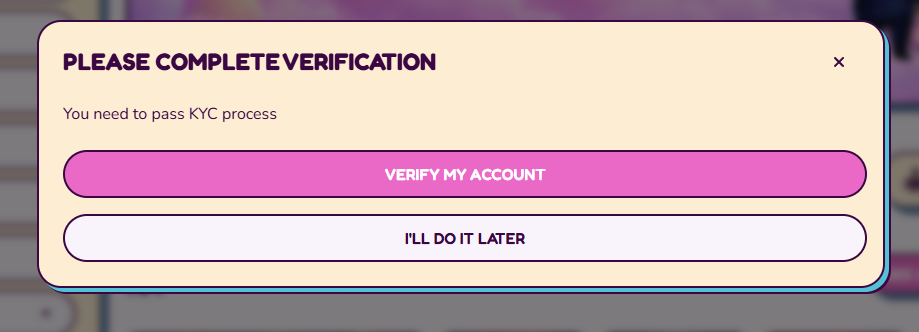
2.19.1The KYC Trigger, and the UNVERIFIED Flag
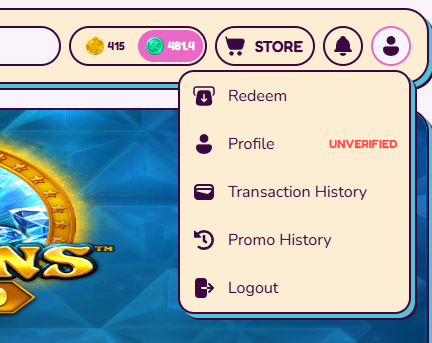
The profile dropdown has carried a red UNVERIFIED tag the whole time I have been on the platform. The site lets me play in GC mode without saying a word, but the second I walked toward redemption I hit the modal above with two CTAs (Verify My Account and I'll Do It Later). I respect the soft-launch, because forcing KYC on signup is a known conversion-killer that pushes players to less compliant operators, but the wall is there at the moment it actually has to be there. From a compliance and player-protection seat, that is the right design.
2.19.2The Veriff Mobile Flow: The Good, and the Two Soft Misses
Sweet Sweeps runs KYC through Veriff, which is one of the bigger regulated identity vendors in the space (Wise, Bolt, Deel and a long list of fintechs use them too). I started on desktop, the flow handed me a QR code with a clear "Use a smartphone" instruction, and I switched to my phone to finish.
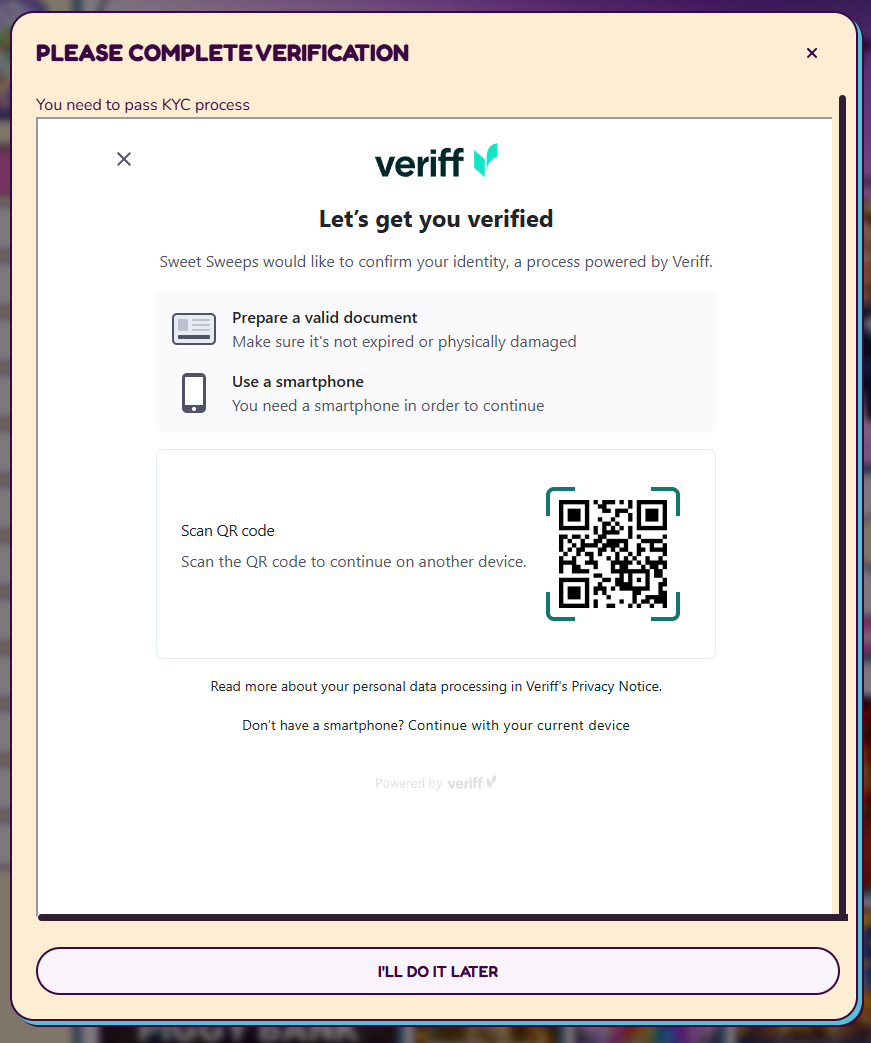
The mobile capture worked easily, my docs uploaded fast, and I got a clean confirmation modal: "WE HAVE SENT YOUR REQUEST. Please wait until the KYC result is received." So the submission UX is genuinely solid.
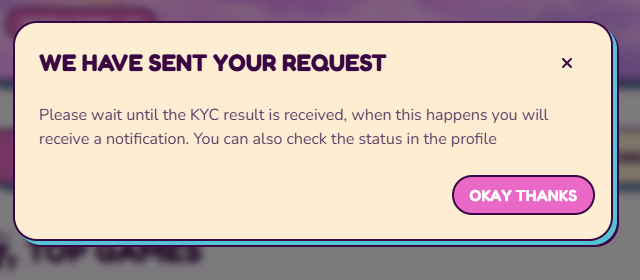
What was not solid: the result was not instant. On other platforms I have used recently, KYC comes back in literally one to two minutes, sometimes seconds, when the docs are clean. Here it sat in pending. And I never got an email confirming my docs were even submitted. That is two soft-misses in a row, because in 2026 the modern KYC flow either gives you a near-instant approval (which most KYC stacks do for clean submissions on first try) or it gives you an email receipt so you have an off-platform record that proves you uploaded. Sweet Sweeps did neither. Quick caveat: my account on this platform was set up specifically for the review, so it is possible some manual flag in the back office added review time on my case. I cannot confirm that, but I want to name it.
2.19.3Biometric Consent, What Sweet Sweeps Actually Asks For
While I waited, I went and read the Biometric Consent block in full. To Sweet Sweeps's credit, this is buried-but-readable, and it is honest about what is happening.
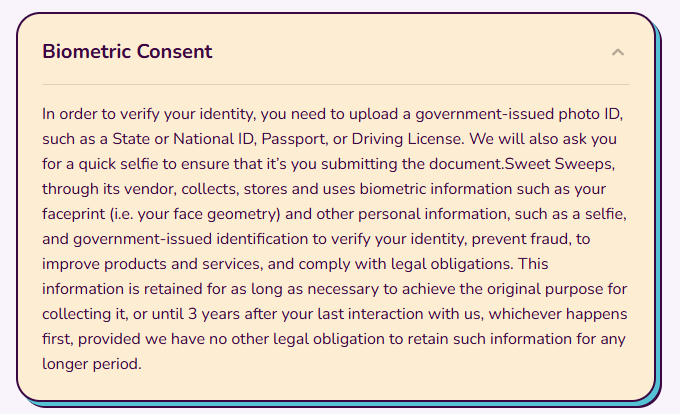
The retention rule is the line that matters. Your faceprint and ID copies are held for "as long as necessary for the original purpose," or "3 years after your last interaction with us," whichever is shorter, unless another legal obligation forces longer retention. That is not the most player-friendly retention window I have seen in this category (some operators clear biometric data within months of verification), and it is not the most aggressive (some hold for the regulatory maximum, which can stretch to 7+ years). It is in line with what regulated KYC vendors generally hold. The important part is they wrote it down where any player can read it before consenting.
2.19.4Talking to Support, Coney AI on Zendesk
With KYC still pending and no email arriving, I decided to test the support loop. The chat widget brings up Coney, the in-house AI bot, with a small intro that says the chat is recorded via cloud service. I asked the obvious question: "hi why my KYC isn't ready yet? what is the issue?"
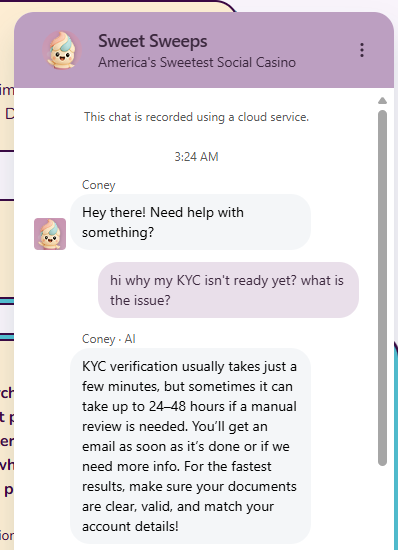
Coney's reply was actually well-trained: KYC takes minutes usually, can take 24 to 48 hours if a manual review is triggered, an email comes when it is done, fastest results need clean docs that match account details. That is the right answer, it tracks with what I have seen on other platforms, and honestly that one bot reply did about 80% of the support job for me on its own. The widget then offered the inline help article "Why Do I Need to Verify My Identity?" which laid out the four reasons in plain language: promotional play eligibility, one-account-per-player rule, account security, and redemption gating.
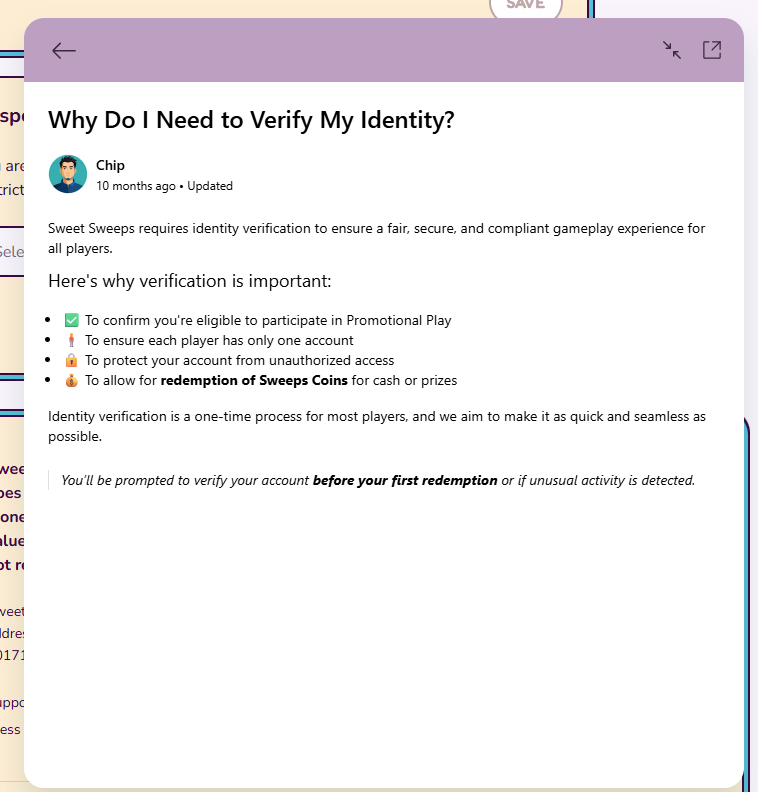
The Zendesk-powered help center is decent: articles are short, the tone is plain, and there is enough of a library that most players will resolve their question without needing a human at all.
2.19.5The Human Handoff, and What Sweet Sweeps Built On
I asked Coney for a real person anyway, because that is the test that matters. The bot handed me off to a Zendesk-built form (name first, then more fields), with an estimated wait time of 1 to 3 minutes.
1 minute is fine, 3 minutes is on the edge of "I am going to forget I asked," but for a sweepstakes platform of this size that is a reasonable SLA. I did not push the chat further because Coney's KYC reply already covered me. The deeper takeaway is the stack: Sweet Sweeps support runs on Zendesk for the help center and the human-handoff, with Coney as the AI front line. That is a well-known, regulated, audit-friendly support infrastructure, and it is what we want to see from any operator that is going to be holding our balance.
The honest summary of this whole experience: Sweet Sweeps's support stack is solid. The gap is back in the KYC flow itself, not in support, where a "we received your docs" email plus a faster result on simple cases would close the loop. This is the kind of fix that ships in one product cycle, and I revisit it in 2.29.2 (What Sweet Sweeps Got Wrong) at the end of this chapter.
2.20 The Rollover Surprise, and Why I Think Sweet Sweeps Should Be Marketing This Number on the Front Page
While I was still in the chat queue, the conversation got interesting in two ways at once. First, the KYC came through. Second, the rollover answer that came back is genuinely the most player-friendly wagering policy I have documented in this category, and Sweet Sweeps is not really shouting about it. They should be. This is the kind of structural advantage that should be on the homepage, not buried in a chat reply.
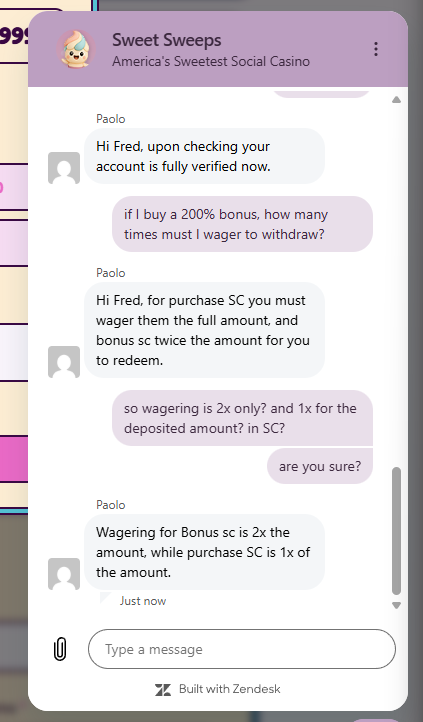
2.20.1First, the KYC Came Through
Paolo, a real human and not the Coney bot, opened the chat with: "Hi Fred, upon checking your account is fully verified now." That closes the open thread from 2.19. Total elapsed time from Veriff submission to verified was longer than the "few minutes" Coney had quoted as the typical case, but well inside the 24 to 48 hour worst-case the bot mentioned. Manual review path, most likely. The verification eventually completed without me having to chase it, which is what we want.
2.20.2The Rollover Rules, in Plain English
I asked Paolo the question that actually matters at withdrawal time: if I buy a 200% bonus, how many times do I have to wager before I can redeem? His reply was the cleanest answer I have gotten from any casino on this question:
- Purchase SC: 1x wagering. The promotional Sweep Coins that came bundled with my GC pack purchase (the ones the Official Rules describe as the free sweepstakes entry attached to a GC purchase, not directly purchased SC) have to be played through once, then they are freely redeemable.
- Bonus SC: 2x wagering. Bonus Sweep Coins have to be played through twice before they can be redeemed.
That is the entire rollover policy. No "30x of the bonus and the deposit combined." No "must be played on slots only and table games count for 10%." No "max bet $5 during wagering or your balance gets confiscated." No 30-day expiry on the bonus that I had to ask three follow-up questions to even find. Just 1x and 2x. I asked "are you sure?" twice because I genuinely did not believe what I was reading. Paolo was sure.
2.20.3The Math, 1.67x Effective Rollover vs Roughly 17.5x at a Traditional Fiat Casino
Let us put numbers on this for the 200% bonus case. Suppose I purchase $X of Sweep Coins under a 200% promo:
- I receive $X in purchase SC, plus $2X in bonus SC. Total balance: $3X.
- Wagering required: 1 × $X (purchase) + 2 × $2X (bonus) = $5X of total wagering.
- Effective rollover on the full balance: 5 ÷ 3 ≈ 1.67x.
Now compare that to a typical fiat online casino running a 100% match deposit bonus with a 35x wagering requirement (which is actually on the friendly end of the fiat industry, the harsher operators run 40x or 50x):
- I deposit $X and get a $X bonus. Total balance: $2X.
- Wagering required: 35 × $X = $35X of total wagering.
- Effective rollover on the full balance: 35 ÷ 2 = 17.5x.
Sweet Sweeps's structure is roughly 10x more player-friendly than the standard fiat casino bonus structure on this dimension. And it scales gently: even at an extreme 500% bonus the effective rollover is still under 2x. There is essentially no version of this offer where the wagering becomes punishing.
2.20.4The RTP Trade-off, and Why This Rollover Makes Sense in Context
I have to be honest about the other side of this trade. Sweet Sweeps's slot RTP runs lower than what we see at the major regulated online operators, and I covered that in detail earlier in the platform test. Lower RTP means the house edge per spin is bigger, which means the wagering you do burns through your balance faster than it would at a higher-RTP shop. So the 1x/2x rollover and the lower RTP are working as a paired math system: light rollover compensates for lower RTP, and lower RTP compensates for light rollover. The aggregate house edge across "buy SC, clear the wagering, redeem" is engineered to land in a similar zone to a traditional 35x-on-bonus, higher-RTP setup. Different shape, same destination.
The interesting part: the 1x/2x rollover is the friendlier half of that trade for the player who knows to check it. A 35x rollover at higher RTP can still be brutal in practice because variance has many more spins to wreck you across that much wagering, and the bonus rules at most fiat casinos are layered with restrictions (game weighting, max bet, expiry) that exist specifically to make the bonus harder to clear. A 1.67x effective rollover at lower RTP is a much shorter game with much smaller variance, and Sweet Sweeps does not stack restriction rules on top of the wagering. For most players in our community, the shorter and cleaner game is the safer one, even if the per-spin edge is slightly worse.
2.20.5Why Sweet Sweeps Should Be Shouting About This
This is the part that confuses me as a media operator. 1x purchase and 2x bonus is the kind of headline number that a competent marketing team puts on the homepage, on every promo banner, in the ad creative, and in the affiliate copy. Instead it is buried in the help center and you really only learn about it by asking support directly. There is a real marketing-honesty win sitting on the table here. The product is meaningfully more player-friendly on this dimension than the rest of the category, and the platform is letting that advantage hide. If I were running marketing at Sweet Sweeps, the next promo banner would read something like: "Bonus SC clears in just 2x. The rest of the industry charges you 35x. That is the difference."
One more honest note. This finding meaningfully changes the tone of my conclusion. The rollover policy is the kind of structural player-friendliness that weighs heavily against the disclosure gaps and UX issues I have flagged earlier in the review. I run that final balance in the field test bottom line at the end of this chapter (2.29).
2.21 The Redemption Flow, Limits, Crypto Cash-out, and Why I Withdrew the Minimum
With KYC cleared and the rollover policy on the record, I had everything I needed to actually run a redemption. Here is what happened next, and what every player on this platform should know before they ever click the Redeem button.
2.21.1Support Came Back in Under a Minute
Real measured wait time on the human handoff: under 1 minute, maybe less. That puts Sweet Sweeps at the fast end of the 1 to 3 minute SLA Coney had quoted, and in practical terms it puts the platform in the top tier for sweepstakes support response time. Most operators in this category sit in the 5 to 15 minute range. A player who can get a real human in under a minute is meaningfully less likely to close their account over a question, and that compounds across the whole retention curve. I have my own complaints about specific UX gaps on this platform, but on support response time Sweet Sweeps is genuinely good.
2.21.2The "$5,000" Question, and What It Actually Means
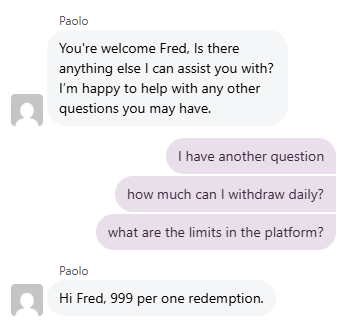
Before I actually ran the redemption, I asked Paolo about a number I had seen elsewhere: the $5,000 sweepstakes prize cap. That cap is real, but it is specifically the AMOE limit (the no-purchase mail-in sweepstakes entry path that every legal sweepstakes operator in the US has to offer to stay compliant). It is not a lifetime ceiling on what a paying player can win or withdraw across their account. Different number, different context. Worth knowing if you have ever read a sweepstakes terms page and gotten nervous about hitting a "lifetime cap" you do not actually have.
2.21.3The Real Withdrawal Limits, 60 Minimum, 999 Per Request, 5,000 Per Day
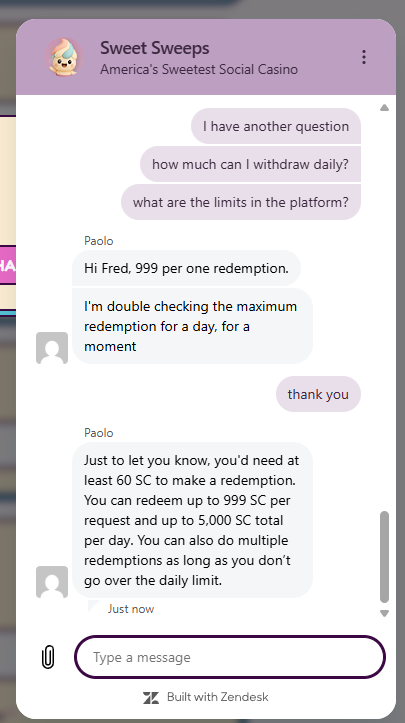
Paolo came back with the full numbers, and they belong on the record:
- Minimum redemption: 60 SC per request
- Maximum per single redemption: 999 SC per request
- Daily cap: 5,000 SC across the account, regardless of how many redemptions you split it into
At the standard sweepstakes redemption ratio of roughly 1 SC ≈ $1, that is about $5,000 of cash-out per day. For the recreational player this is more than enough, the vast majority of players in our community will never get within an order of magnitude of this number on a single day. For the hardcore high-roller who occasionally hits a five-figure score on a Sprinkles wheel grand prize or a hot slot run, the 5,000-per-day cap means a $25,000 win takes five days to cash out at full cadence. That is not a dealbreaker, and it is in line with what the larger sweepstakes operators run, but if you are playing at that volume you should know it before you sit down.
2.21.4The Redemption Flow Worked, and an Email Actually Showed Up This Time
I went ahead and redeemed 60 SC, the platform minimum, so I could document the flow without taking real value off the platform unnecessarily. The redemption modal triggered instantly:
And this time, unlike the KYC submission flow I documented in 2.19, an actual confirmation email did show up.
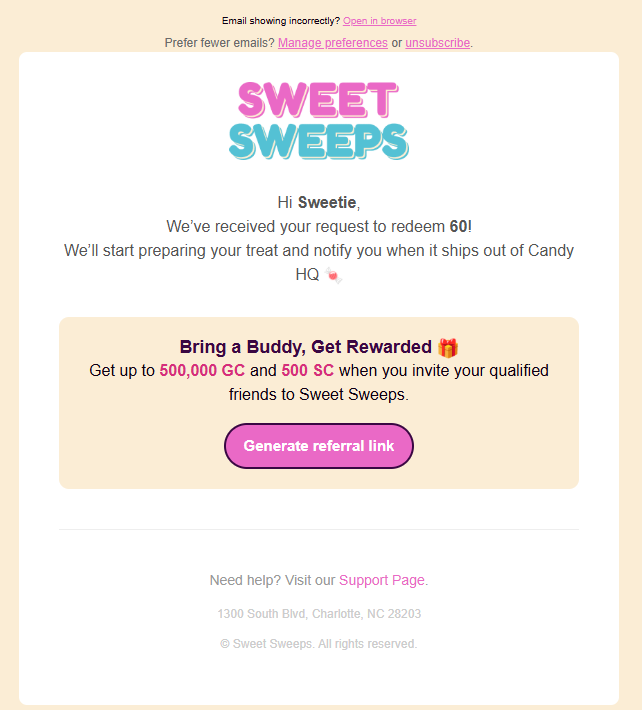
The email is genuinely light on detail (no transaction ID, no estimated settlement window, no destination wallet echo back), the salutation is the generic "Hi Sweetie" because the redemption email template uses a hard-coded brand greeting instead of pulling the first name the platform already has on the locked profile field (per 2.13.3), and there is a Bring a Buddy promo CTA stapled to the middle of it. But it exists, and the corporate address (1300 South Blvd, Charlotte NC 28203) is in the footer, which is the right transparency move for a regulated operator.
The bigger callback is this: Sweet Sweeps clearly has the email infrastructure in place, because it fired correctly for the redemption. The fact that no email goes out for the KYC submission is therefore a process gap, not a technology gap. They could ship that fix in one product cycle by reusing this exact template, swapping "redeem received" for "KYC docs received". This is one of the cheapest disclosure improvements in the entire backlog.
2.21.5Crypto Withdrawals, USDC on Solana, and Why That Matters
The actual headline finding of this entire section: Sweet Sweeps accepts crypto for purchases AND pays withdrawals back to crypto. I requested my redemption via USDC on the Solana network. For players who already hold crypto for other reasons (which is a meaningful chunk of the casino community we cover), this is the cleanest cash-out path possible.
The reasons this matters in 2026:
- Solana settlement is sub-second. No 3-5 business day ACH wait, no weekend settlement gap.
- Gas on Solana is effectively free. The 60 SC redemption is not getting eaten by a $5 to $25 network fee the way it would on Ethereum mainnet.
- USDC is a $1-pegged stablecoin. You receive what you redeem, no exchange-rate risk between submission and settlement.
- No card chargeback risk window. Some platforms hold withdrawals for 7 to 14 days after a card purchase to avoid chargeback exposure. Crypto-rail withdrawals do not have that hold.
Most sweepstakes platforms in 2026 either do not support crypto withdrawals at all or only support BTC and ETH with their high gas. Solana USDC is the fastest and cheapest legal cash-out rail in the category right now, and Sweet Sweeps is on it. Combined with the 1x/2x rollover from 2.20 and the $30-per-million-GC food voucher utility from 2.18, the cash-out economics on this platform are quietly among the strongest in the sweepstakes space. But there is a timing caveat we have to document before we close out this section, and it is the piece that will not land for every audience.
2.21.6The 6-to-12-Hour Processing Window, and the Audience That Will Not Love It
While I had Coney up, I asked the obvious follow-up: how long does the actual withdrawal take from request to wallet? The answer is the part of the cash-out story I need to put on the record honestly.
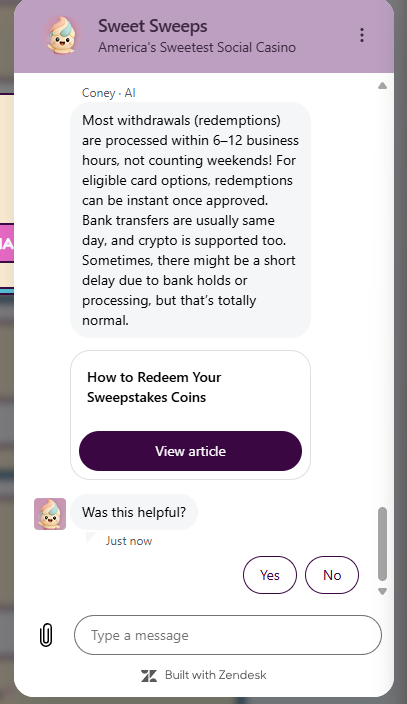
Two caveats matter here. First, the 6 to 12 business hour window is on top of the on-chain settlement time I mentioned in 2.21.5. The Solana leg itself is sub-second, but Sweet Sweeps's internal review and approval queue is the actual bottleneck. The fast crypto rail is downstream of a slower process. Second: this window does not count weekends, so a Friday-evening redemption can realistically land on Monday or Tuesday.
For the recreational player who is not refreshing the wallet every 30 seconds, 6 to 12 hours is fine. But for the player coming from a top-tier crypto-native casino with truly instant withdrawals (the better operators in that space settle in 30 seconds to 2 minutes from click to wallet), or even from a regulated fiat operator with same-day card settlement, this will feel slow. Honestly slow. This is the gap that will not land well in many geos and with the more experienced casino audience, and it is one of the bigger reasons a hardcore player from that side of the industry will not stay on Sweet Sweeps long term. The fix is the same shape as the missing KYC email from 2.19: a process gap, not a tech gap. More eyes on the approval queue, smarter automated approval rules for low-risk redemptions, or a posted SLA for crypto specifically would close this. Product-team work, not engineering.
2.22 The VIP Tier Ladder, What Swirl, Double Dip, and Trio Treat Actually Give You
Beyond the bonus area in 2.17, the daily quests in 2.16, and the Sweet Spin in 2.18, Sweet Sweeps runs a tiered VIP loyalty ladder. I am sitting at the bottom of it (Swirl) and the actual top of the ladder is not visible from where I am, but the first three tiers are documented openly in my account dashboard, and the structure itself tells a useful story about how this platform thinks about retention and high-value players. So let me walk through it honestly.
2.22.1The Three Visible Tiers and the Numbers
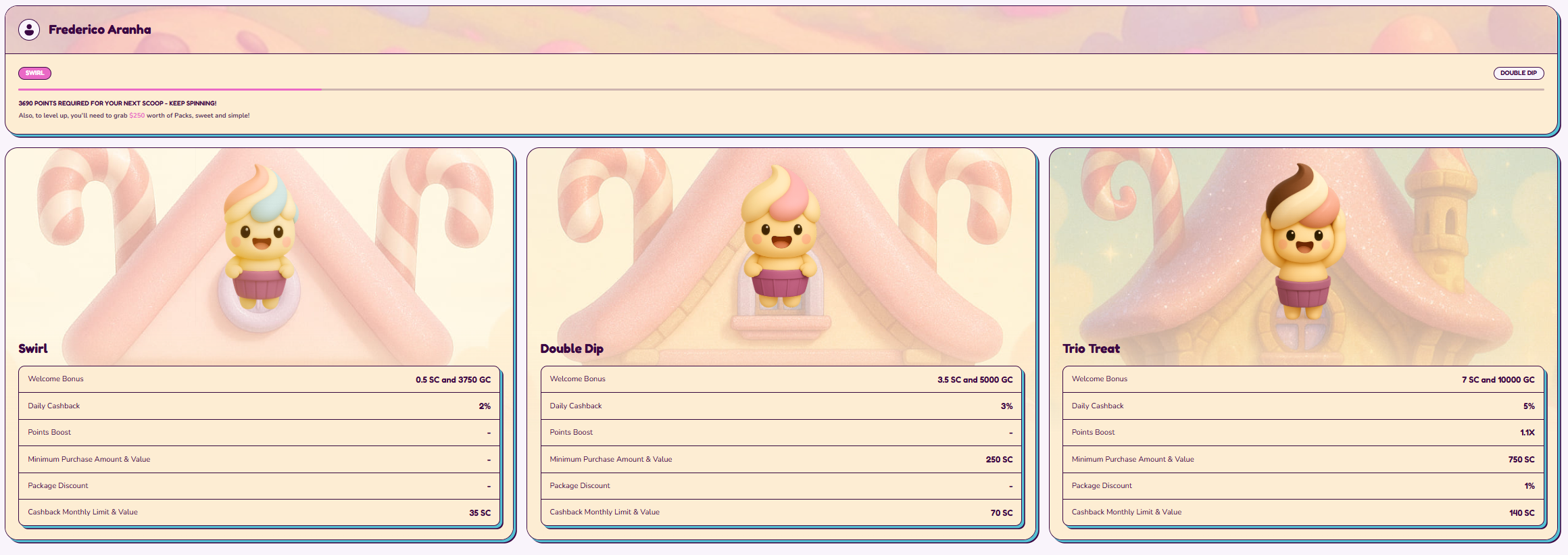
What the dashboard shows me right now: I am on Swirl (the entry tier), the next tier up is Double Dip, and the one above that is Trio Treat. Side-by-side, the published numbers look like this:
The progress bar at the top of my dashboard tells me I need 3,690 more points to reach the next scoop, and the small print under the bar tells me I would also need to push roughly $230 of Pack purchases through to make that level-up actually trigger. Two costs, not one. We will get back to that in a moment.
2.22.2The Real Cost to Climb, Points Plus Packs
The interesting part, and worth flagging honestly: the level-up gate is not just a play-volume number. The dashboard literally tells me I also need to "grab $230 worth of Packs, sweet and simple" to make this level-up happen. That means the VIP ladder is fundamentally a real-money commitment system, not a pure free-play loyalty system. A player who only ever plays free SC and never buys a Pack cannot meaningfully climb this ladder, no matter how many spins they grind through.
That is normal casino VIP design. Every operator on earth wires VIP progression to real spend, not to free-play volume, because the whole point of a VIP program is to retain and reward the players who are actually putting money through the platform. But it deserves to be on the record. The free-play side of Sweet Sweeps is genuinely generous (we covered that in 2.17 with the bonus area, in 2.20 with the 1x/2x rollover, and in 2.18.4 with the food voucher utility on GC). The VIP side of Sweet Sweeps is the part that wants real-money commitment. Both can be true, and players should know which side they are interacting with.
2.22.3What I Like and What I Do Not
What I like:
- The cashback percentage climbs at a sensible pace (2% to 3% to 5%) and sits in the same neighborhood as what mid-market online casinos publish for their loyalty cashback. Not aggressive, not insulting.
- The structure is open. I can see the next two tiers from the bottom without having reached them, with the actual perks broken out by line item. That is more transparency than most operators give us at the entry tier.
- The branding (Swirl, Double Dip, Trio Treat) stays on-theme with the candy-store identity I covered in 2.1. Internally consistent and on-brand, which is more thought than a lot of casinos put into their tier names.
- The Trio Treat monthly cashback cap of 910 SC is meaningfully bigger than the lower tiers (35 SC and 70 SC). That signals the platform actually wants to reward players who climb, instead of putting a velvet rope on the cashback right when it starts to matter.
What I do not like, or at least flag:
- The Points Boost only kicks in at Trio Treat. On Swirl and Double Dip the Points Boost line is dashed out. That means the loyalty multiplier (the thing that actually compounds and makes climbing feel like progress) is gated to the third tier. Players in the bottom two tiers do not get the compounding effect at all, which makes the climb feel slower than it should.
- We are looking at the bottom three tiers of the ladder. The actual top of the ladder is not visible from where I sit, so I cannot tell you whether the high-end Sweet Sweeps VIP perks are competitive with the high-end programs at the top crypto-native operators. That is a follow-up question I will park for a future article focused specifically on sweepstakes vs anonymous-casino VIP economics.
- The 1% Pack Discount at Trio Treat is small. It moves the math, but not by much. Higher tiers presumably stack more, but again, not visible from the bottom.
- The dual requirement (points plus dollar volume) means casual free-play players cannot meaningfully participate. That is not a flaw, that is a design choice, but it is worth saying out loud for the recreational audience: the VIP ladder is a real-money program. The free-play side of the platform is the bonus area, the quests, and the Sweet Spin, not this.
The closer is fairly simple. The VIP ladder is another retention mechanism on top of the quests, the Sweet Social Thursdays, and the Sweet Spin. It is not the part of the platform that converts a casual player. It is the part that converts an already-engaged player into a long-term repeat customer who is putting real money through. Standard casino design, honestly applied, with branding on-theme and the published numbers documented openly enough that we can do the math on our own. I do not love the dual gate, and I do not love that the Points Boost is gated this high, but neither of those is a player-protection issue. They are just product choices, and the player can read them and decide.
2.23 Now Let's Read the Terms of Service, Because This Is Where Real Player Protection Lives
2.23.1Where the Real Player Protection Lives
The official rules tell us how the sweepstakes itself works. The Terms of Service tell us what happens when something goes wrong, and that is where the real legal scaffolding sits. Most players never read this part, which is genuinely the most important section if you plan to deposit real money. So I want to walk through the dispute and arbitration framework specifically, because this is one of the strongest signals I have seen on a sweepstakes platform that the product is built for the long-term U.S. consumer market and not for the offshore "good luck collecting" model that a lot of players are unfortunately used to.
2.24 Step 1, the Notice of Dispute, the Part Most Players Will Skip
Before any arbitration can begin, Section 15 sets up a mandatory pre-arbitration step called the Notice of Dispute. The player has ten calendar days from the incident to send Sweet Sweeps a written Notice that includes:
- Username, email, legal name, residence address, and phone number on the account
- A detailed explanation of the complaint, with specific dates and times where they apply
- The exact remedy or amount being requested
Sweet Sweeps then has thirty calendar days to respond, and may request more info or a video resolution conference, in which the player must participate. After that closes without a fix, either side can move on to formal arbitration. The Terms call this Notice a "condition precedent", meaning skip it and the arbitrator can throw out your claim before it starts. An angry support email does not count.
2.25 Step 2, Binding Arbitration via JAMS, Translated for Humans
Sweet Sweeps does not run arbitration in-house. They use JAMS, one of the largest U.S. dispute-resolution providers and the same body that handles arbitration for major U.S. corporations. The arbitrator must be a practicing attorney or a retired federal judge with at least ten years in complex business disputes. Selection is mutual: JAMS sends both sides eight candidates, each side strikes three, both rank the rest, highest combined preference wins. Hearings are in New York or fully remote at either party's request, and the player only pays $250 in arbitration fees no matter how complex the case becomes; Sweet Sweeps absorbs the rest of the JAMS bill.
The numbers that make this a real player protection
2.26 What You Give Up, the Class Action Waiver
The trade is the class action waiver. Each player can only bring their own claim for their own losses, with no class actions, collective actions, private attorney general suits, or representative proceedings. That is squarely in the operator's interest, and it is the standard 2026 industry move for any U.S.-facing online platform, not a Sweet Sweeps invention. Two carve-outs matter: small claims court stays available for any dispute that fits, and intellectual property claims (copyrights, trademarks, trade secrets, patents) can still go to court. Inside arbitration, the arbitrator cannot award punitive, exemplary, or consequential damages including lost profits, so the upper bound on a player's recovery is their actual demonstrated loss.
2.27 Where the Whole Thing Lives Legally, Delaware and the Federal Arbitration Act
2.27.1Section 19, In One Read
Section 19 of the Terms anchors everything in U.S. law. The Terms themselves are governed by the laws of the State of Delaware. The arbitration agreement specifically is governed by the Federal Arbitration Act, which is the strongest legal framework in the United States for enforcing arbitration outcomes. Any actual lawsuit, in the small set of cases where lawsuits are still allowed, must be filed in the state or federal courts of Wilmington, Delaware, and both the player and the operator agree in advance to submit to that personal jurisdiction.
2.27.2Why Delaware
The reason this matters is that Delaware is the corporate-law capital of the United States. Most major U.S. companies are incorporated there because Delaware has the most developed body of business case law and the most predictable courts. By choosing Delaware as the governing law and Wilmington as the exclusive forum, Sweet Sweeps is signaling that they expect to be measured against the same legal standards as any other serious U.S. corporate operator. That is a much stronger commitment than picking a remote offshore jurisdiction where enforcement is essentially impossible for a U.S.-based player to pursue.
2.28 The Bottom Line on the Terms of Service
2.28.1What I Want You to Walk Away With
The Terms are not perfect. The class action waiver is real, the ten-day Notice of Dispute window is short, and the cap on damages limits the upside of any successful claim. But the structural commitment to JAMS arbitration with a federal-grade arbitrator, a $250 fee cap on the player side, a fair candidate-selection process, optional remote hearings, Delaware governing law, and the Federal Arbitration Act as the enforcement backbone is genuinely strong by sweepstakes-industry standards. Most platforms in this space either do not have a clear arbitration framework at all, or they bury the player in a process that requires international travel and tens of thousands of dollars to even initiate. Sweet Sweeps does not. That is worth giving them credit for, even when the rest of this review is asking hard questions about other parts of the operation. If you are going to play here, screenshot Section 15 and Section 16 of the Terms, save them somewhere you can find again, and remember the ten-day Notice window. That single piece of homework is worth more than any bonus the platform will ever offer.
2.29 The Field Test Bottom Line, Before I Zoom Out to the Research Question
Before I zoom out in Chapter 3 to the broader research question this whole piece is really about, let me close the Sweet Sweeps field test honestly. Six months ago when I picked Sweet Sweeps as the test bench for this research, I did not have an opinion about whether it was a good or bad platform. The deep dive in this chapter is what produced the opinion. So here is the synthesis of what the field test surfaced, in a single tight read.
2.29.1What Sweet Sweeps Got Right
The 1x and 2x rollover (2.20) is the structural advantage of this platform. Roughly 10x more player-friendly than the standard fiat casino bonus cycle. The crypto cash-out via USDC on Solana (2.21.5) is the cleanest cash-out rail available in this category right now. Support response under a minute (2.21.1) on a Zendesk plus Coney AI stack that handles roughly 80% of the work before a human is needed (2.19.4). The bonus area (2.17) is genuinely fun and generous without being predatory. The Quests system (2.16, 2.17, 2.18, 2.22) builds in retention without crossing into the dark patterns that other platforms in this category lean on. Sweet Spins (2.18) is a real platform-exclusive game with publicly disclosed odds, which puts it ahead of most. And the food voucher cash-out path on Sweet Spins (2.18.4) is a real-world utility loop most sweepstakes platforms do not bother to build.
The Terms of Service read (2.23 through 2.28) confirmed real US legal footing, which matters in a category where some operators are openly running on shaky ground. Delaware jurisdiction. US Federal Arbitration Act coverage. Veriff KYC with documented biometric retention rules. A real corporate address. Class action waiver and JAMS arbitration are standard but at least clearly disclosed.
2.29.2What Sweet Sweeps Got Wrong
The currency-substitution issue and balance refresh lag in Sweet Spin (2.18.2). The modal silently charges SC when GC runs out, and the live balance lags. That is a real disclosure issue that should be fixed before a regulator finds it. The missing "cost to clear" number per Quest (2.16.4) is the loudest disclosure flag on the whole platform. Players need to be able to estimate what a quest costs in expectation before they start it. The lower-than-top-regulated RTP (2.15) is a real gap. The per-spin house edge here is bigger than at the major regulated US books on equivalent games. The 5,000 SC daily withdrawal cap (2.21.3) is going to box in serious players. The 6 to 12 business hour withdrawal processing window (2.21.6) on top of on-chain settlement is a self-inflicted slowdown. And the 1x/2x rollover advantage being buried in support chats (2.20.5) instead of marketed on the front page is a self-inflicted competitive disadvantage. The marketing department should fix that.
The KYC submission email (2.19.2 vs 2.21.4) is missing. The redemption flow proves the email infrastructure works, so the lack of a confirmation email at the KYC submission step is a small but real friction.
2.29.3Who I Would Point at This Platform
Players who want a US-based sweepstakes operator with real legal footing, who want a clean crypto cash-out rail, and who do not mind a 5,000 SC daily withdrawal cap. Recreational players who like generous bonus structure and do not need top-shelf RTP. Players who want to test the sweepstakes model without going to the more aggressive operators in the category. Anyone who specifically wants the responsible-gambling toolkit a US-anchored platform actually has to provide.
2.29.4Who I Would Steer Somewhere Else
Hardcore high-volume players who will hit the 5,000 SC daily cap and feel boxed in. Players coming from anonymous-casino backgrounds who do not want to do KYC at all. Players whose primary criterion is RTP and who can play on a regulated US sportsbook in their state. Anyone allergic to dual-currency mechanics on principle.
2.29.5The Honest Take Before the Bigger Question
Sweet Sweeps is one of the more honest products in this category, with real legal footing, real responsible-gambling infrastructure, and a structurally player-friendlier rollover than most of its peers. I came out of the field test more positive on the platform than I expected to. But this whole research effort was not really about Sweet Sweeps as a product. It was about the category. So in Chapter 3, I am going to zoom out to the actual question this whole piece was driving at: is the US sweepstakes casino market worth building an Instagram channel around? Sweet Sweeps gave us the field data. The next chapter gives us the strategic answer.
3.1 The Central Contradiction at the Heart of This Market
Chapter 3 zooms out from the platform-level deep dive in Chapter 2 to the strategic read on the whole US sweepstakes category. Before we run any theories, I want to put the central contradiction on the page, because it is the structural anomaly that the Sweet Sweeps field test in Chapter 2 kept pointing back to, and it is the single most important thing to understand about this market in 2026. The platform-level mechanics in Chapter 2 are how the category works at the user level. This contradiction is what tells you where the category is actually going.
Here is the contradiction. The US sweepstakes casino market is, by any reasonable estimate, generating billions of dollars in annual revenue. Operators like VGW, Yellow Social Interactive, McLuck, High 5, Stake.us, Wow Vegas, and the rest are sitting on user bases that run into the millions. Mobile adoption is massive. Acquisition spending across Facebook, Google, and affiliate channels is aggressive enough that you cannot open a US-based gambling search query without tripping over a sweepstakes review page.
And yet, when you look at the media side of this category, almost nothing is there.
The shape of the contradiction
A category big enough to dominate paid media, with almost no organic creator footprint.
There is no dominant sweepstakes-native media ecosystem. There is no major sweepstakes-first influencer class the way poker had Daniel Negreanu and Phil Ivey, the way crypto-native casinos have Trainwreckstv and Roshtein, the way US sports betting has the Action Network and Barstool. There is barely a streamer culture for sweepstakes. There is no real community identity. There is no cult fanbase that wears a Pulsz hoodie or makes Chumba memes the way crypto-casino bettors make Stake memes.
This is highly unusual for an entertainment vertical of this scale. Almost every other gambling-adjacent ecosystem produces creators, communities, personalities, and a media culture as a near-automatic byproduct of growth. Sweepstakes did not.
The objective of this final chapter is to investigate why. Not assume. Investigate.
3.1.1Why This Matters For Anyone Deciding Where to Point a Channel
For a content operator like me, the question matters because attention has to point somewhere. If sweepstakes is genuinely a market with billions of dollars and millions of users but no creator class, that is either an enormous opportunity sitting unclaimed, or it is a structural warning that the market simply does not reward content investment. Both possibilities exist. We cannot tell which is true without doing the work.
So in the rest of this chapter I am going to walk through three competing theories that try to explain this contradiction, test each one against the evidence we actually have, and come out the other side with a strategic answer for where the play really is.
3.2 The Two Questions This Market Forces You to Ask
Before we test theories against the contradiction, let us be clean about the questions. There are actually two stacked on top of each other, and they sound like the same question but they have different answers and different stakes.
3.2.1The Analytical Question, Why No Creator Class
The first is the analytical question: why has a multi-billion-dollar gambling-adjacent ecosystem failed to produce a strong creator and media culture? That is a market-structure question, and it has an answer rooted in audience behavior, distribution mechanics, and regulatory environment. We can test theories against actual evidence here.
3.2.2The Strategic Question, Is This Worth an Instagram Channel
The second is the strategic question, the one anyone trying to build a content channel in or around this category eventually has to face: is it worth building an Instagram channel around sweepstakes content? That is a business decision, and it depends entirely on the answer to question one. I will share my own answer at the end of the chapter as one worked example, because I am someone who actually had to make this call for RAW CREW, but the framework is the part that matters more than my personal verdict.
If the audience is structurally not content-native, then a sweepstakes-first IG channel is going to fight gravity. If the market scaled on performance marketing because creators do not move the needle in this category, then the economics of trying to build creator-driven attention here are bad. If legal instability is the real reason no one has invested in long-term media here, then a serious channel investment becomes a regulatory bet, not a content bet.
I will work through all three theories now, and at the end I will give the strategic answer plainly. We may not love the answer. But it is what the evidence is pointing at.
3.3 Theory 1, the Sweepstakes Audience Is Not Content-Native
This is the most uncomfortable theory because it is the one with the most direct evidence. Let me set it up before I argue both sides.
3.3.1The Hypothesis
The hypothesis is that sweepstakes users behave more like casual mobile gaming consumers than like gambling enthusiasts. They play habitually. They consume passively. They do not deeply research games. They do not build identity around their gambling. They do not actively seek out communities or streamers or strategy content. If that is true, it would naturally suppress streamers, gambling influencers, review ecosystems, and discussion communities, and the absence we are seeing in the market is exactly what this theory predicts.
Theory 1, the quick read
Sweepstakes users behave like casual mobile gamers, not like a content-native gambling tribe.
The behavioral fingerprint matches casual mobile, not gambling
- Demographics skew female 35 to 54, not the typical iGaming male 21 to 34
- Mobile-first usage suppresses the long-form video consumption that creator culture lives on
- Search ecosystem is affiliate review pages, not personality-driven content
- Social engagement around brands looks more like casual game communities than sportsbook or poker tribes
Some sweepstakes streamers do exist
- SweepsKings tracks a small set of active sweepstakes streamers
- Pulsz, Stake.us, and a handful of others have low-volume creator programs running
- The audience is not zero, it is just nowhere near scale
- It is possible the creator class is suppressed, not absent
3.3.2Evidence For, the Demographics Do Not Look Like a Gambling Audience
The clearest data point is who is actually on these platforms. Per Similarweb, Chumba Casino's audience skews 56.29% female, with the largest age bracket being 35 to 44, and traffic overwhelmingly US-based. Pulsz looks nearly identical: 52.32% female, same dominant age bracket. Compare that to Gambling.com, AskGamblers, or PartyCasino, all of which skew significantly more male, younger, and gambling-native.
This is a real difference. The traditional gambling-native audience, the audience that produces and consumes streamer content, that watches slot reviews on YouTube, that joins Discord servers around specific casinos, is mostly young men. The sweepstakes audience is mostly mid-life women. That is not a value judgment, that is a market fact, and it has direct implications for what kind of content the audience does and does not consume.
3.3.3Evidence For, Mobile-First Behavior Suppresses Media Consumption
SweepsPulse estimates that more than 65% of sweepstakes users primarily access platforms through mobile devices. That matters because mobile-first gaming audiences historically spend heavily on the games but consume far less ecosystem media around them. FarmVille, Candy Crush, and Coin Master all generated massive revenue without producing a deep media culture comparable to esports, crypto, or even poker. The behavior pattern is play, spend, close the app, move on. There is no second screen. There is no community tab. There is no creator they follow specifically to learn the meta.
3.3.4Evidence For, the Search Ecosystem Is Affiliate, Not Personality
If you Google "best sweepstakes casino" or "Pulsz review" or "Chumba casino" right now, what comes back is dominated by affiliate pages, bonus comparison guides, SEO portals, and legal explainers. What does not come back is personalities. There is no equivalent of a creator who is THE place to go for sweepstakes content the way certain channels own the slot streamer space or the crypto-casino space. The search results themselves are telling us that creators do not own the topic. Affiliates do. That is a strong signal about how the audience actually finds and trusts platforms in this category.
3.3.5Evidence Against, Some Sweepstakes Streamers Do Exist
I cannot pretend the creator class is zero. SweepsKings maintains a streamer directory listing names like Brian Christopher, Lady Luck HQ, ClassyBeef, and Xposed who do produce sweepstakes content. So the population is not empty.
But when I look at who those creators actually are, almost all of them are traditional slot or casino streamers who have branched into sweepstakes coverage as part of a wider portfolio. They are not sweepstakes-native personalities. They are not built on sweepstakes the way certain creators are built on Stake or built on poker. The category supports adjacent coverage but has not produced its own marquee names. That weakens the theory but does not kill it.
3.3.6My Read on Theory 1
The evidence is leaning hard toward this theory being correct. Sweepstakes users may be generating spending without generating gambling identity. They are transacting with these platforms the way mobile gamers transact with free-to-play games, not the way gambling enthusiasts engage with their casinos. If that is the underlying behavior, weak community formation and weak creator ecosystems are not a bug. They are the natural output of the audience structure.
This was, frankly, the finding I least wanted to land on, because it is the one that most directly weakens the case for an Instagram channel built specifically around this category. Hold that thought, I will come back to it in 3.7.
3.4 Theory 2, This Market Scaled on Performance Marketing, Not Culture
The second theory is structural rather than behavioral. It says the absence of a creator class is not really about the audience, it is about how the operators chose to grow.
3.4.1The Hypothesis
Sweepstakes casinos scaled through Facebook ads, app store distribution, affiliate funnels, SEO, and paid acquisition. Not through creators. Not through Twitch culture. Not through influencer ecosystems. If operators built billion-dollar businesses without ever needing media personalities, then there was no pressure for a creator class to form, and the absence we observe is just a downstream effect of that distribution choice.
Theory 2, the quick read
The category scaled on Facebook ads, app stores, and affiliate funnels, so a creator class never had to form.
The distribution stack made creators optional
- Massive affiliate infrastructure already pumps traffic to operators
- App store distribution replaces the discovery layer creators usually own
- CPA economics on paid social outperform any reasonable creator deal
- Operators built billion-dollar books without a single influencer at scale
Other gambling verticals scaled the same way and still grew creators
- Crypto casinos also scaled on affiliates, and still produced Trainwreck and Roshtein
- US sports betting scaled on TV ads and partnerships, but still has the Acti class
- Performance marketing and creator culture are not actually mutually exclusive
- The absence may be a category-specific block, not a distribution mechanic
3.4.2Evidence For, a Massive Affiliate Infrastructure Already Exists
The acquisition pipeline for this category is saturated with affiliate and review infrastructure. SweepsKings, Sweepsy, SweepsPulse, dozens of bonus and ranking SEO sites. These exist. They function. They drive real volume. But they function as acquisition infrastructure, not as cultural ecosystems. They are pure utility content, ranked-list pages that send a click into a sign-up form. There is no creator in the loop. There is no personality the user is loyal to. There is just a comparison table with affiliate links.
3.4.3Evidence For, App Store Distribution Replaced the Creator Discovery Layer
Many sweepstakes casinos operate through Apple App Store and Google Play, often framed as social casino apps. App store distribution lowers trust friction, lowers onboarding friction, and lowers discovery friction. Users find these platforms through app rankings, paid install ads, or friend referrals. Not through creators. When the discovery layer is the app store, you do not need a streamer ecosystem to acquire users. The platform owns the platform.
3.4.4Evidence For, CPA Economics Favor Performance Marketing
Operators in this category reportedly pay aggressive affiliate commissions, CPA structures, and rev-share deals. Those economics incentivize performance marketing dominance, not creator culture development. If you can buy a verified user for X dollars through an affiliate funnel, you are not going to spend Y dollars cultivating a creator who might bring you 20 users a year. The unit economics push the spend toward CPA channels and starve the creator side.
3.4.5Evidence Against, Other Verticals Scaled the Same Way and Still Built Creator Culture
The problem with this theory is that lots of gambling-adjacent ecosystems scaled through paid acquisition early and STILL produced strong creator cultures eventually. Crypto-native casinos did. US sports betting did. Online poker did. Daily fantasy did. Performance marketing was the seed in all of them, but creators followed once the audience was big enough to support them. Sweepstakes has not gotten there even after years of scale, which suggests something more than distribution choice is suppressing creator formation. Performance marketing explains how the market scaled, but it does not fully explain why the cultural layer never showed up afterward.
3.4.6My Read on Theory 2
This theory is partially true and partially incomplete. Performance marketing absolutely explains the operational shape of how these platforms grew. But it does not explain the persistence of the cultural void. Other verticals built creator culture on top of performance marketing once they reached scale. Sweepstakes has not, and we have to ask why.
I think Theory 2 lives downstream of Theory 1 and Theory 3, not as an independent cause. The operators chose performance marketing because the audience did not reward creators (Theory 1), and creators did not show up to fill the gap because the legal environment made it too risky (Theory 3, coming up next).
3.5 Theory 3, Legal Instability Has Been Suppressing Long-Term Media Investment
The third theory is the one I think might be the most underrated, because it is not about audience or distribution, it is about risk-adjusted return on attention.
3.5.1The Hypothesis
The absence of major sweepstakes-native media may reflect structural legal fragility. Serious creators, investors, and media operators avoid overcommitting to an ecosystem that is facing escalating regulatory pressure. Why would anyone build a six-figure-follower IG channel around a vertical where half the operators might not exist in their current form 18 months from now? The legal uncertainty is the moat preventing media investment.
Theory 3, the quick read
The legal ground keeps shifting under the category, so nobody serious bets a media career on it.
2025 to 2026 has been a steady drumbeat of state pressure
- California AB 831 advanced as the most aggressive sweepstakes-targeting bill
- State attorneys general are using enforcement tools against operators directly
- The legal theory framing sweepstakes as unregistered gambling keeps strengthening
- Suppliers and platforms are quietly reducing exposure to the category
The market still operates and the lobbying side is fighting back
- Operators continue to acquire users at scale through 2026
- The Social and Promotional Games Association ramped up serious lobbying spend
- Several state-level pushes have stalled or been narrowed in scope
- Legal risk is real but not yet existential at the category level
3.5.2Evidence For, Multiple States Escalated Enforcement in 2025 and 2026
This is real and recent. California approved AB 831, which bans dual-currency sweepstakes casinos effective January 2026. That is not a warning shot, that is a complete category ban in the largest US state. And it is not isolated. Per CasinoBeats, Connecticut, New York, New Jersey, Montana, Nevada, Washington, and Michigan have all had sweepstakes-related enforcement activity, regulatory commentary, or legislation move in the same window. The pressure is multi-state, coordinated in tone if not in coordination, and accelerating.
3.5.3Evidence For, Attorneys General Are Actively Using Enforcement Tools
Multiple state AGs have used cease-and-desist letters, gambling statutes, consumer protection arguments, and payment processor pressure to push back against sweepstakes operators. This is the same playbook that was used against unregulated daily fantasy a decade ago and against unlicensed online poker before that. When AGs start coordinating around an enforcement theory, the trajectory historically points one direction.
3.5.4Evidence For, the Legal Theory Against the Sector Is Strengthening
The regulators are increasingly arguing a simple consumer-experience test. If you have casino-style games, plus a redeemable currency, plus economic value, plus wagering behavior, then the practical user experience resembles online gambling, and the legal carve-out the sweepstakes model rests on starts looking thin. That theory is getting refined and re-tested in state after state. Each successful enforcement action strengthens it as a precedent for the next one.
3.5.5Evidence For, Suppliers and Platforms Are Quietly Reducing Exposure
Industry reporting indicates that some game providers have started reducing exposure to sweepstakes operators, advertising platforms have tightened restrictions on sweepstakes promotion, and payment processors have reassessed risk on the category. When the supply side, the distribution side, AND the payments side all start nervously stepping back at the same time, that signals real ecosystem fragility, and it signals it to anyone smart enough to read the room before investing media energy in the space.
3.5.6Evidence Against, the Market Still Operates and Lobbying Has Intensified
Despite all the scrutiny, the market is still operating, user numbers are still large, new operators keep entering, and the industry's lobbying activity has intensified. The Social and Promotional Games Association has been actively pushing back, and operators are clearly willing to fight rather than fold. So the market still sees substantial economic opportunity, and investor confidence has not fully cracked.
3.5.7My Read on Theory 3
Of the three theories, this is the one I think most directly explains why no major media operator has planted a flag in this category yet. The unit economics of building a creator brand around an industry that might not legally exist in 18 months are terrible. You cannot justify a sustained content investment when the regulatory floor is moving. That is true even if the audience were content-native (it is not), and even if the distribution mechanics rewarded creators (they do not). The legal risk alone is enough to keep serious media builders on the sidelines, and that is a strong, structural explanation for the void.
3.6 The Synthesis, Massive Engagement Without Gambling Identity
Stacking the three theories together, here is the picture that comes out.
Sweepstakes casinos have achieved massive gambling-LIKE engagement. The transaction volumes are real, the time-on-site is real, the CPA economics are real. But they have not created strong gambling CULTURE. The audience spends like gamblers but behaves culturally like casual mobile consumers. The operators distribute through performance marketing because creators would not have moved the needle for this audience anyway. And the legal fragility of the whole category has scared off the kind of long-horizon media investment that, in other verticals, would have eventually built a cultural layer on top of the commercial one.
The category sits in an awkward intersection. It is between mobile gaming (where the user does not form gambling identity), casual entertainment (where the user does not seek out media around the activity), online gambling (where the legal risk is escalating), and promotional commerce (where the legal carve-out is increasingly under attack). It is not really fully any of those things, and that hybrid identity is exactly what suppresses cultural formation. There is no clear tribe to belong to, no clear creator to follow, no clear meta to learn. The category is a transactional surface, not a cultural one.
3.6.1What This Means for Anyone Trying to Build Content Here
If you are trying to build a sweepstakes-first content brand, you are simultaneously fighting an audience that does not reward depth, a distribution system that does not need creators, and a regulatory environment that punishes long-horizon investment. That is three structural headwinds at once. That is not a market gap waiting to be filled, that is a market gap that exists for real underlying reasons. The cultural void is a feature, not a bug, of how this category actually works.
3.7 The Strategic Read, What This Market Structure Means for Anyone Building Content Here
Time to read the strategic implication of everything above, and to answer the question 3.2.2 set up: what does this market structure mean for anyone trying to build a content channel in or around this category?
The honest read of the data, after the field test on Sweet Sweeps in Chapter 2 and after working through the three theories above, is that the strongest opportunity is NOT building a sweepstakes-first Instagram channel. The structural headwinds are too aligned against that play. The audience does not behave like a content-native gambling audience, the distribution mechanics do not reward creators, and the legal environment makes a sustained category-specific investment a bad risk-adjusted bet. That is the read for anyone considering this play, and for transparency, that is also the answer I gave myself when I asked the question for RAW CREW.
But that does not mean a sweepstakes deep-dive is wasted research. The opposite. Understanding why the channel does not work as a standalone bet is what tells you where the actual content opportunity sits, and the rest of this chapter is the answer to that question.
The decision filter I ran
A sweepstakes-first IG channel has to clear all of these to be worth building. It does not.
- Audience is content-native. Sweepstakes users behave like casual mobile, not like a tribe that follows creators.
- Distribution rewards creators. Operators built scale on paid acquisition and affiliates, not on personalities.
- Legal horizon supports a multi-year channel investment. 2025 to 2026 was nothing but state pressure escalating.
- Sweepstakes belongs in a broader gambling-media play as one major case study. That is the bet RAW CREW is already making.
- Responsible gambling framing fits cleanly across the whole category. Player protection is the second pillar, not a side note.
3.7.1The Stronger Play, Broader Online Gambling Media With Sweepstakes as a Case Study
The stronger opportunity is building trusted media around the broader US online gambling ecosystem, where sweepstakes shows up as one of the most important case studies, but is not the whole identity of the channel. That is the play I am going to make, and it is exactly what RAW CREW already is. The Sweet Sweeps deep dive in Chapter 2 of this piece is going to live as the proof-of-work on the sweepstakes question. It is a major case study. But the channel itself stays positioned around the bigger thing: real edge for players, math-driven analysis, honest reads on every category we touch (regulated, sweepstakes, provably fair, crypto-native, all of it), and the responsible-gambling pillar that we keep calling out as part of the edge.
3.7.2What This Means for Future Coverage on RAW CREW
Practically, here is what changes in the editorial direction going forward. Sweepstakes coverage absolutely stays in the rotation, because the category is huge and players need honest reads on it. But sweepstakes will never be the entire identity of what we do. The content stack will keep mixing sweepstakes case studies, regulated-market coverage, provably-fair analysis, and the responsible-gambling material that is already core to the brand. That is the honest answer to where the audience is, where the legal floor is not actively shifting, and where creator-driven content actually has structural pull.
3.7.3And the Reason This Even Matters, Player Protection
There is one more angle I want to close on, because it is not in the strategic spreadsheet but it is in the reason I do this work at all. Even if sweepstakes is structurally a poor category to build a channel ENTIRELY around, it is still a category where millions of US players are gambling under a legal frame that most of them do not fully understand. The dual-currency model, the AMOE path, the KYC walls, the rollover math, the redemption caps, the arbitration clauses we read together in 2.23 through 2.28 of Chapter 2, all of it is real, and players deserve someone explaining it honestly without trying to sell them a bonus code.
So the content on this category will keep happening, and the responsible-gambling framing will keep happening, because that is the reason we built any of this. Play with your head so we do not pay with our pocket. That is the line that runs through the whole RAW CREW project, and it is the line that runs through this research too.
3.8 The Operator Channel Audit, How Sweet Sweeps and SpinQuest Actually Use Instagram
Before we close the chapter, let us put two real Instagram accounts on the page, because how the operators themselves actually use this channel is one of the most useful signals in the whole category. Public follower counts, public post cadence, public content shape, all of it is right there for anyone to read.
I pulled the official Instagram of Sweet Sweeps, the platform that drove the field test in Chapter 2, and the official Instagram of SpinQuest, a close competitor in the same sweepstakes category. Same vertical, same legal framework, same dual-currency model. Two completely different channel strategies. The contrast is what teaches the lesson.
3.8.1Sweet Sweeps Own Instagram, On-Target Voice, Underbuilt Channel
Here is what Sweet Sweeps is shipping on its own brand IG, @sweetsweepsusa.
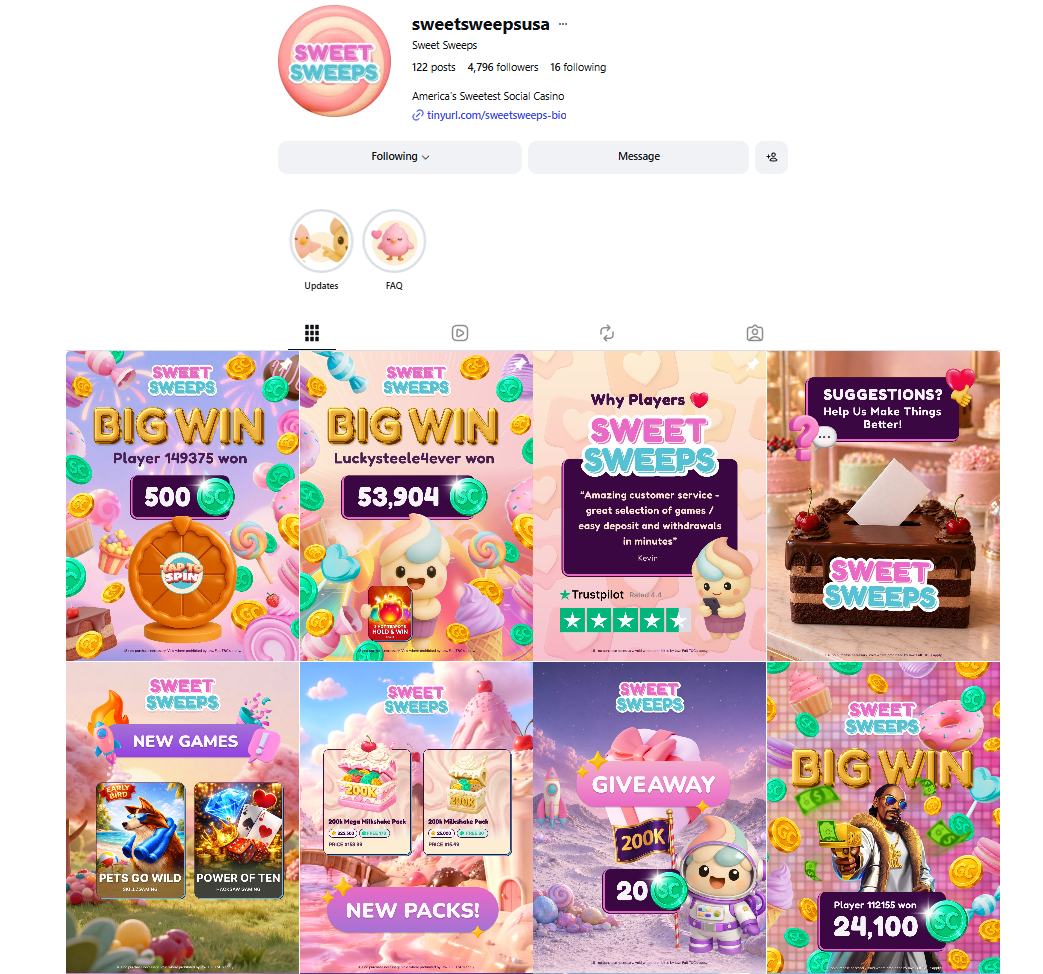
@sweetsweepsusa on Instagram, the official account of the platform that drove this research.
The numbers, 122 posts, 4,796 followers, bio reads "America's Sweetest Social Casino". The aesthetic is candy-pastel, with cute mascots, BIG WIN graphics with player handles and SC amounts, a Trustpilot testimonial card, a "NEW PACKS" promo, a giveaway tile. Nothing in there pretends to be hype-bro casino streaming. Nothing pretends to be young-male crypto culture. The voice is correct for the audience the demographics data describes, the casual mobile gamer who skews female 35 to 54.
The problem is not the voice. The problem is the volume and the reach. 122 posts and under 5,000 followers for a brand sitting inside a multi-billion-dollar category is, frankly, abandoned. The channel is on-strategy and under-invested. Whoever is running it understands who the buyer is, but the operator is not actually committing real budget or real cadence to the channel. This is consistent with Theory 2 from above, the operator built scale through paid acquisition and never needed organic IG to work, so it does not.
3.8.2SpinQuest, Wrong Demographic, Or the Only One That Actually Works on This Channel
Now look at @playspinquest, a direct sweepstakes competitor.
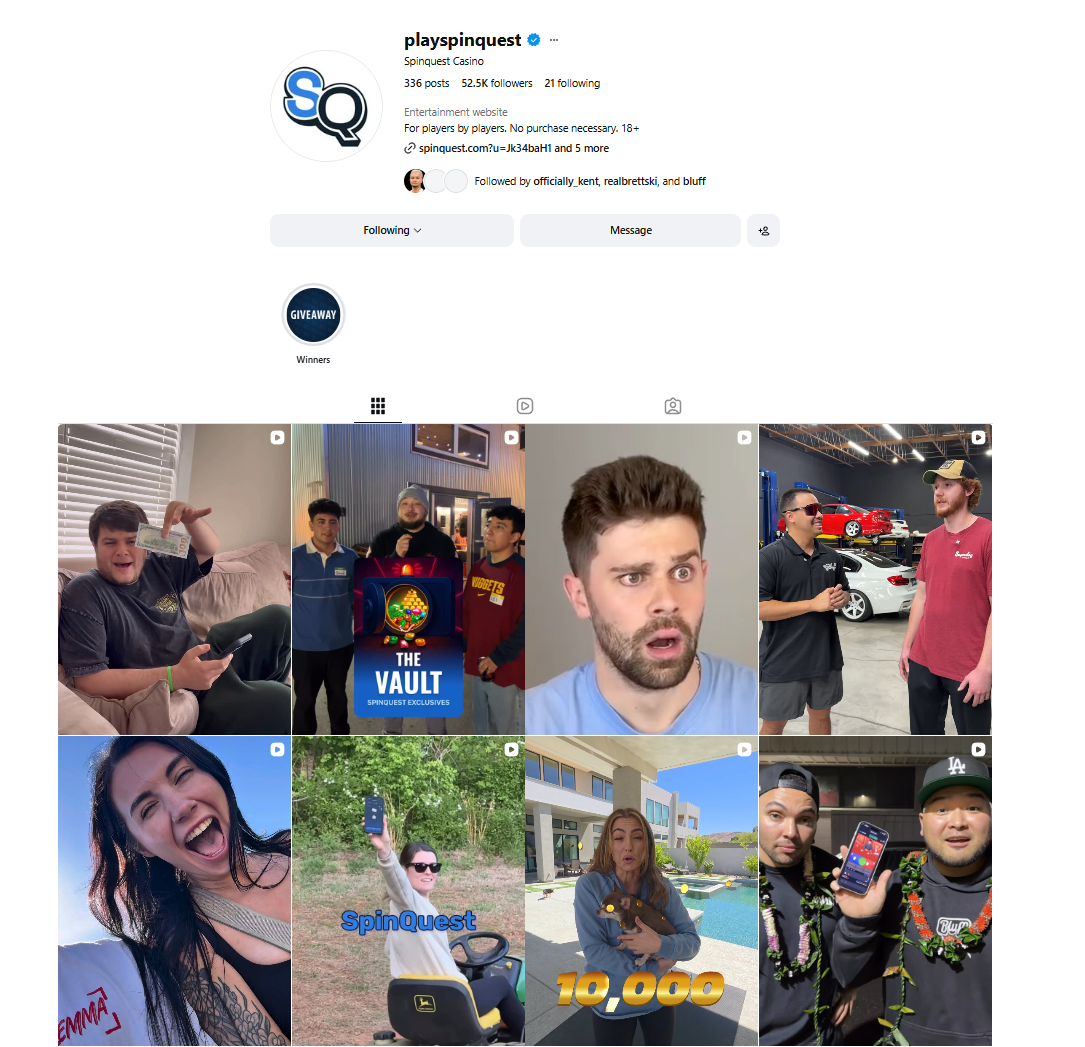
@playspinquest on Instagram, roughly ten times the follower count of Sweet Sweeps own IG.
The numbers, 336 posts, 52,500 followers, bio reads "For players by players. No purchase necessary. 18+". The aesthetic is the opposite of Sweet Sweeps. Streamers in living rooms holding stacks of cash, hype reaction thumbnails, guys-in-the-garage car content, "10,000" overlays, "THE VAULT" branded thumbnails with three guys posing. This is the casino streamer playbook, lifted wholesale onto a sweepstakes operator. Young men, hype, win clips, lifestyle bait.
This is the demographic the Similarweb data says is NOT the typical sweepstakes player. So at first glance SpinQuest looks like they are misreading their own audience. But they have ten times the follower count of Sweet Sweeps. So one of two things is happening, and figuring out which one is the next research question I want to chase.
3.8.3The Tension, Read A vs Read B
Two readings of the same data
SpinQuest is either misreading the audience, or they are the only operator who correctly diagnosed who the IG audience actually is.
SpinQuest is targeting the wrong demographic
- The actual sweepstakes purchase behavior is female 35 to 54, mobile, casual
- 52K followers of young-male streamer content do not convert into sweepstakes accounts
- The channel looks loud and works as vanity metric, but the funnel is broken
- Sweet Sweeps small but on-target IG might actually outperform per dollar spent
SpinQuest figured out who the IG audience actually is
- Players who BUY are one cohort, players who ENGAGE on social are a different cohort
- The IG-engaging cohort looks much more like the general crypto-casino streamer audience
- Targeting the actual content audience produced 10x the followers Sweet Sweeps got
- The other operators are leaving the channel on the table by trying to talk to the buyer instead of the viewer
If Read A is right, Sweet Sweeps is on the correct strategy and just needs to actually invest in the channel. If Read B is right, then SpinQuest is the only operator that has actually diagnosed the IG audience correctly, and the rest of the category is missing the channel entirely. The honest answer is, I do not know yet. The public follower count is a proxy, not a conversion number, and engagement rate, audience quality, and account-to-deposit ratios are what actually decide which read is right.
3.8.4Next Research, the Broader Operator Channel Audit
This first pass is two operators. To actually answer Read A vs Read B, I need a wider sweep. The follow-up article in this investigation will run the same audit across the rest of the category, with screenshots and engagement data, not just follower counts.
The next-research checklist
The audit method I am going to run for the follow-up piece, with the operators on the list.
- Audit 5 to 7 more operator IGs in the category. Pulsz, Stake.us, Wow Vegas, McLuck, High 5, Chumba, LuckyLand. Capture follower count, post count, content shape, demographic apparent target.
- Score engagement rate, not follower count. A 4K-follower channel with 800 likes per post beats a 52K dead-air channel. Likes per post divided by follower count is the real signal.
- Cross-reference with the SweepsKings creator scan. See which operators are actively running creator partnerships versus which are organic-only, and whether the partnered ones outperform.
- Look at regional concentration. SpinQuest may have effectively given up on the broad US demo and gone hard at one specific subculture. If so, that is another valid strategic answer to the same question.
- Pick a side on Read A vs Read B with evidence. The follow-up piece commits, the field-test data picks the winner, and the strategic implication for any future RAW CREW coverage gets sharper.
So that is where this lands for now. The strategic conclusion in 3.7 still holds, a sweepstakes-first IG channel is not the bet to build. But the operator channel audit is the next layer of the same research, and the two screenshots above are the seed observation. We are going to keep pulling at this thread, because the gap between what the audience data says and what the operators actually do on Instagram is the most interesting part of the whole sweepstakes story right now.